
Le blog Herba Barona › Sem categoria
Which Omega 3 to Choose: Fish, Krill or Algae
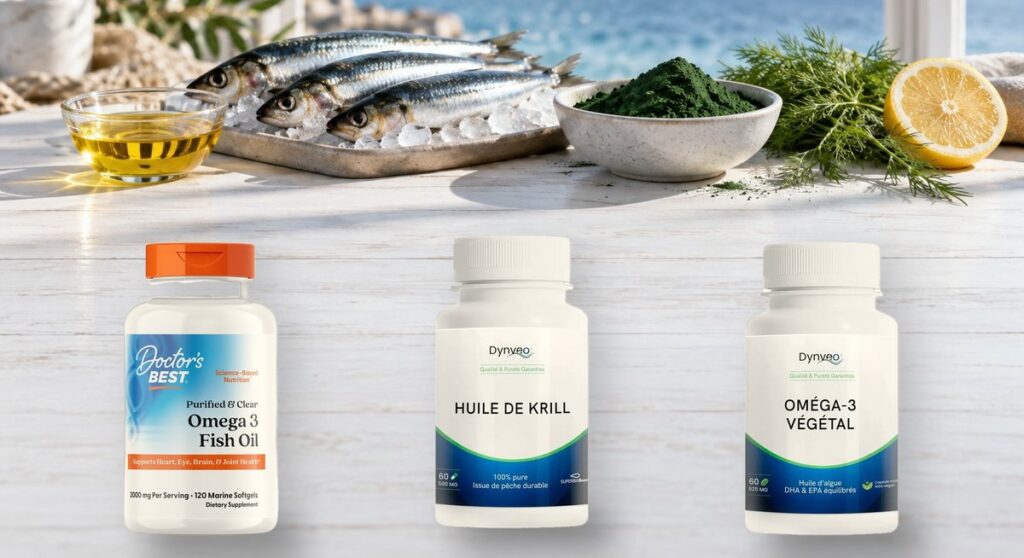
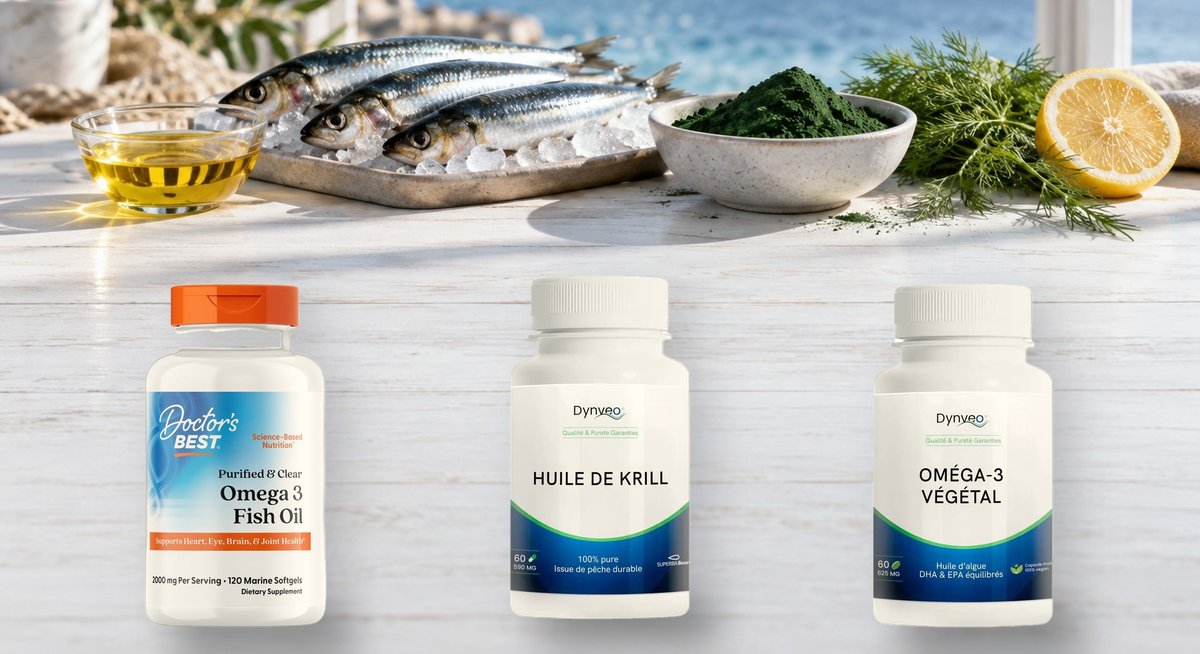
In front of the omega 3 shelf, many customers react the same way: there are a lot of them, and the labels all look alike. Fish oil, krill oil, microalgae oil, cod liver oil… and behind them, EPA and DHA figures that aren’t easy to compare. The good news is that three questions are enough to find your way: where does the oil come from, how much EPA and DHA does it provide per day, and in what form. All our products are on the omega 3 in Paris page.
EPA, DHA, ALA: what are we talking about?
“Omega 3” refers to a family of fatty acids. The two we look for in a marine supplement are EPA (eicosapentaenoic acid) and DHA (docosahexaenoic acid). A third, ALA (alpha-linolenic acid), is the plant-based one, found in flaxseed for example.
It’s EPA and DHA that carry the authorised claims. EPA and DHA contribute to normal heart function; the beneficial effect is obtained with a daily intake of 250 mg of EPA and DHA. DHA contributes to the maintenance of normal brain function; the beneficial effect is obtained with a daily intake of 250 mg of DHA. That’s why we first read these two figures on the label, not just the amount of oil.
Fish oil: the most common
This is the most classic form, and the one offering the highest doses of EPA and DHA. Doctor’s Best Golden Omega 3 provides 800 mg of EPA and 400 mg of DHA for 2 softgels, from anchovy oil purified by molecular distillation. Nutrimuscle Epax® omega 3 gives 1,520 mg of EPA and 760 mg of DHA for 4 capsules, from wild fish from cold seas.
One detail that matters: we keep the Nutrimuscle bottles refrigerated, from the moment they arrive until they’re sold. Omega 3 oil is sensitive to heat and oxidation. Nutrimuscle’s data sheet also states a TOTOX oxidation index below 3.
For those who prefer a spoon to a capsule, LYSI cod liver oil from Iceland is taken as one 5 ml teaspoon, which provides 540 mg of EPA and 610 mg of DHA, along with vitamin A and vitamin D. It should be kept in the fridge after opening.
Krill oil: small dose, different form
Krill is a small Antarctic crustacean. Its oil stands out for its form: a large part of its omega 3 is bound to phospholipids, and it naturally contains a red pigment, astaxanthin. Dynveo’s Superba Boost™ krill oil provides, for 2 capsules, 661 mg of phospholipids and 319 mg of total omega 3, including 177 mg of EPA and 83 mg of DHA, plus choline.
Its EPA and DHA doses are therefore much lower than those of a concentrated fish oil. It’s chosen for its particular form, not for the quantity. It remains a seafood product: avoid it if you’re allergic to crustaceans. If astaxanthin interests you on its own, it has its own astaxanthin shelf.
Algae oil: the plant-based version
Fish don’t make their own omega 3: they get it from the microalgae in their food chain. Some brands therefore go straight to the source. Dynveo’s plant-based Microalgae Omega 3 provides 500 mg of DHA and 250 mg of EPA for 2 vegetable capsules, from the Schizochytrium algae. No fish, no gelatine: it’s the solution for vegans and for those who dislike the marine aftertaste.
Flaxseed oil, meanwhile, provides ALA rather than EPA or DHA. It’s a different product, and doesn’t replace a fish oil if EPA and DHA are what you’re looking for.
Reading the form: triglycerides or ethyl esters
On the labels, one last mention comes up: the chemical form of the oil.
- Triglycerides: the natural form of fats, as in Novoma’s and Nutripure’s omega 3 (the latter only available in the shop).
- Re-esterified triglycerides (rTG): an oil concentrated and then converted back into triglycerides, like Dynveo’s microalgae omega 3.
- Ethyl esters: the form of many concentrated oils, such as Doctor’s Best Golden Omega.
- Phospholipids: the form specific to krill.
For a first purchase, focus mainly on the daily dose of EPA and DHA, and the freshness of the oil.
Frequently asked questions
When should omega 3 be taken?
With a meal. Doctor’s Best, for example, recommends its softgels with a meal containing fats, in one dose or split over two meals. Follow the dose on the label.
Why do some oils cause burping?
It’s often a matter of freshness. Keep your bottle cool, well closed, and take the capsules in the middle of a meal.
Is omega 3 suitable for everyone?
In case of pregnancy, breastfeeding or ongoing treatment, ask your doctor or pharmacist for advice first. Cod liver oil, being rich in vitamin A, is not suitable for pregnant women. Fish and krill oils contain seafood allergens.
Where can I find a more complete comparison?
Our guide omega 3: EPA, DHA, plant-based or marine details the differences between sources.
To feel the difference between a fish, krill and algae oil, nothing beats the counter: come and see us on rue Théophile Roussel, in the 12th arrondissement, and we’ll show you the labels side by side.