Creatine Creapure® Nutripure Capsules in Paris: 3 g of Creatine in 5 Capsules
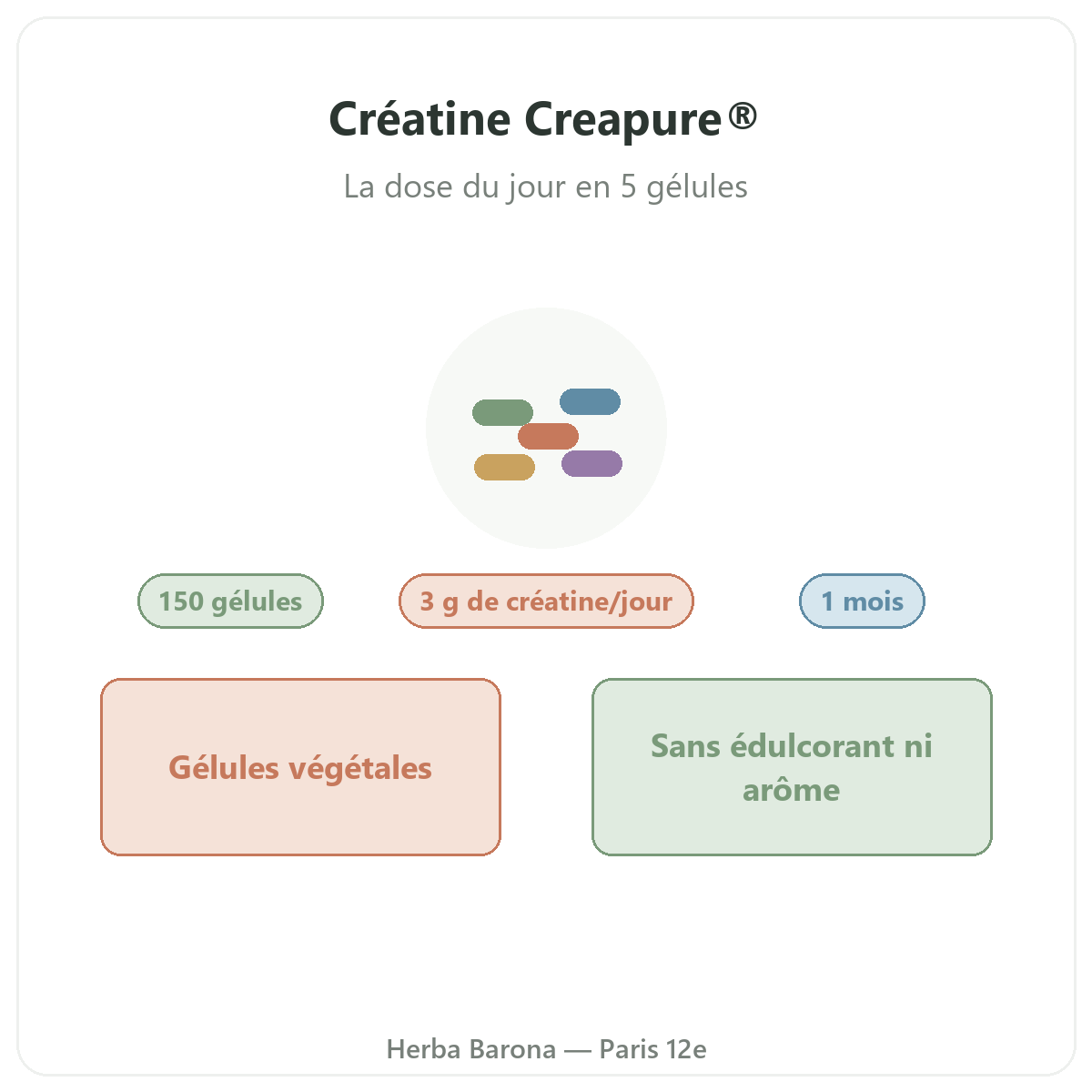
Creatine monohydrate Creapure® in vegetable capsules: 5 capsules provide the day’s 3 g of creatine, in a 150-capsule pot for a month. Available in Paris at Herba Barona.
▶ Creatine Creapure Nutripure capsules: the 3-minute video
Sold in store only. No shipping.
Creatine without a spoon or a shaker
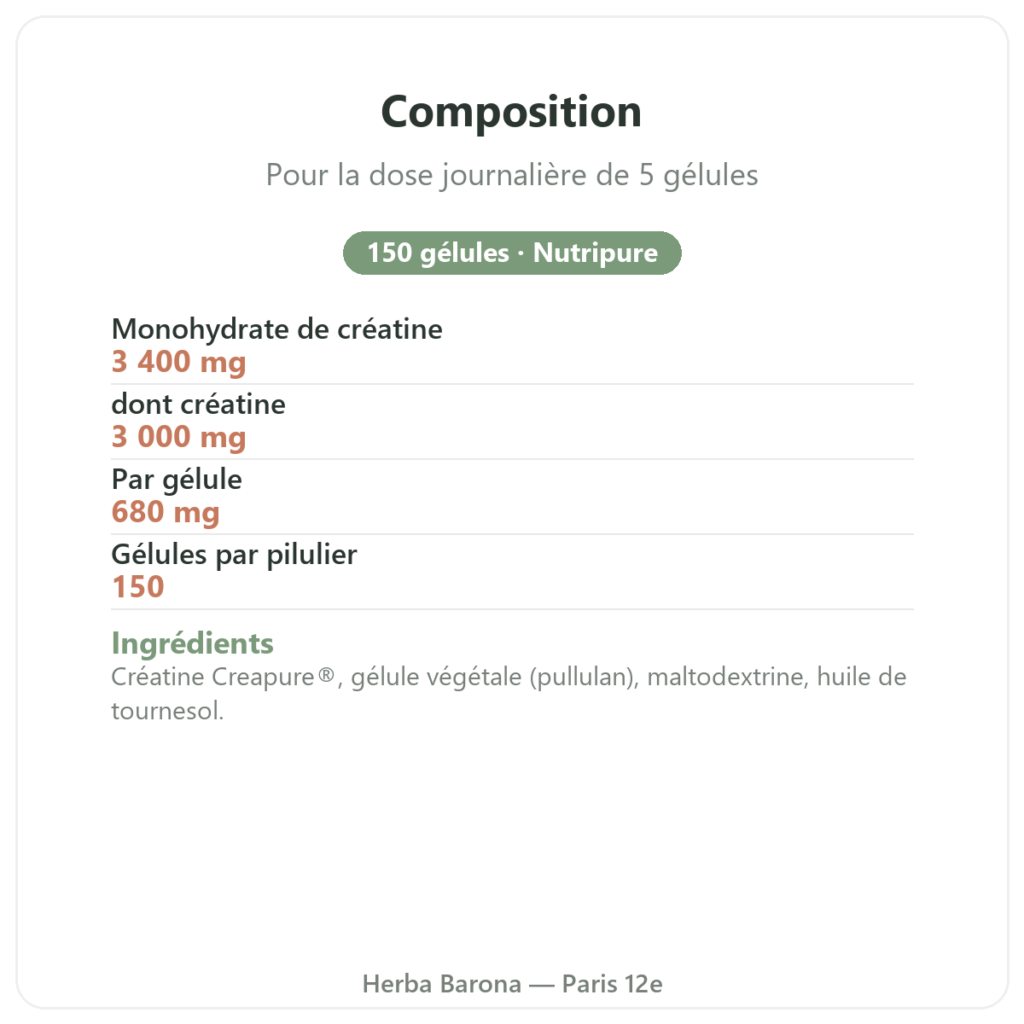
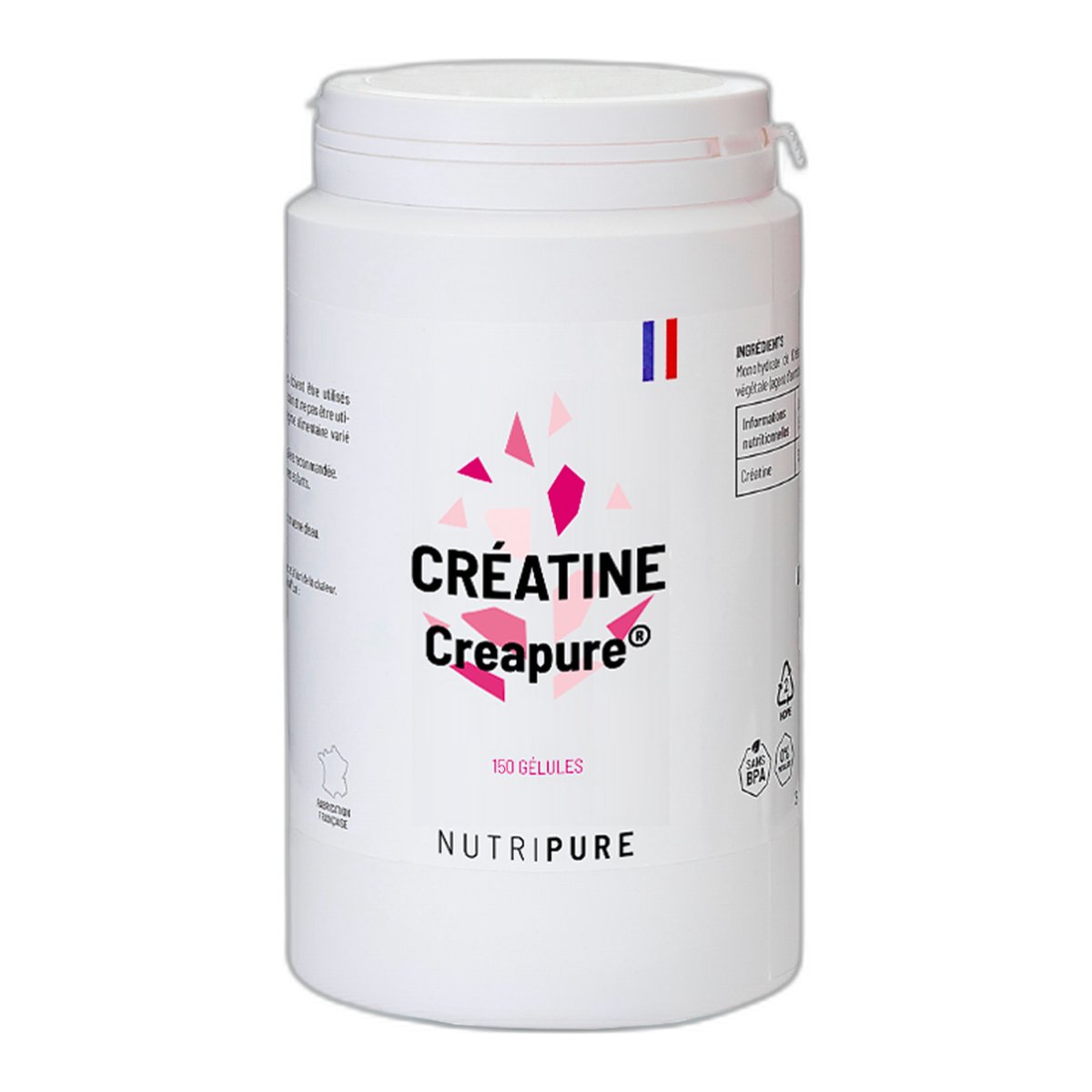
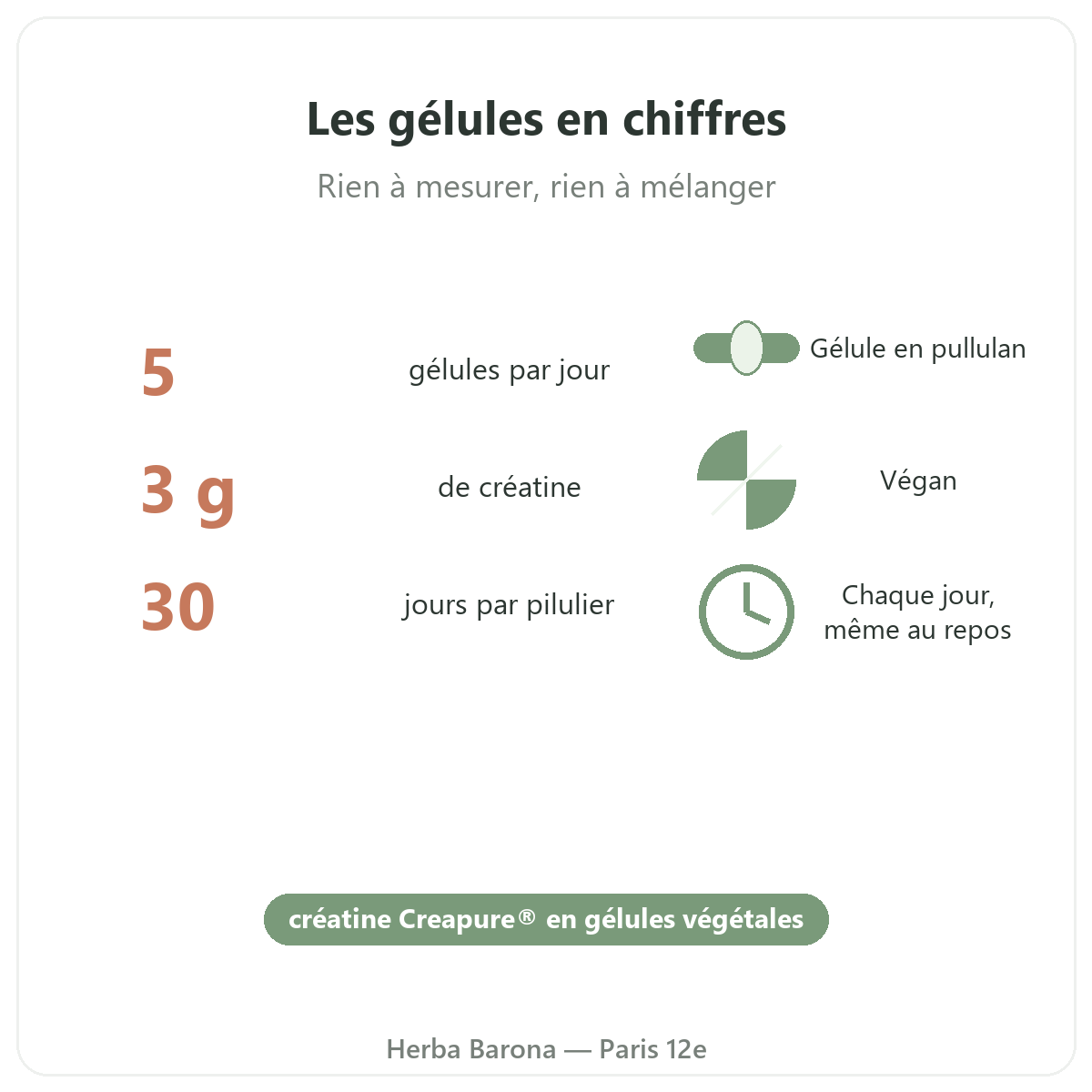
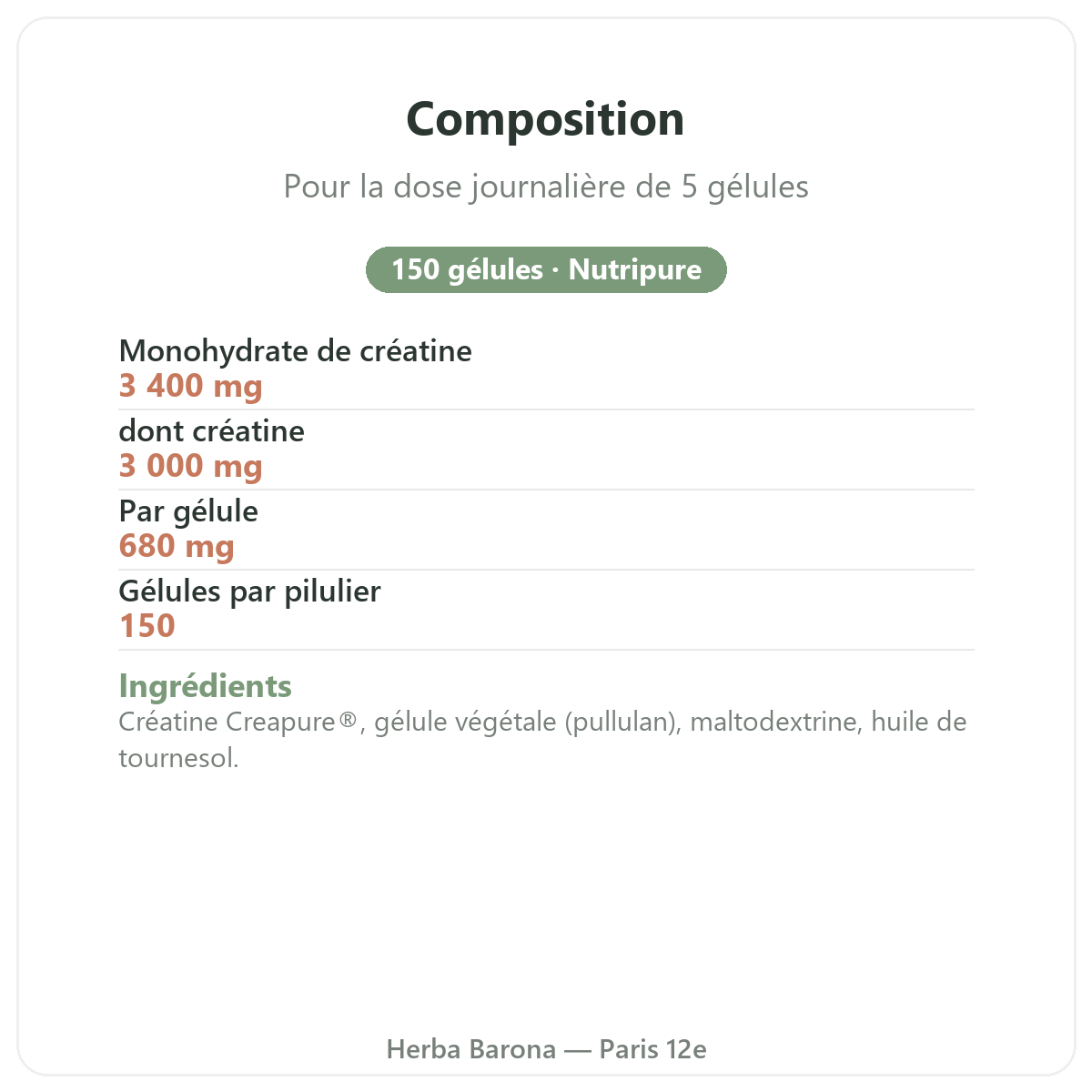
This version of Nutripure Creatine is aimed at those who want an exact dose without measuring anything. The white pot holds 150 vegetable capsules; five capsules make up the day’s dose, that is 3,400 mg of Creapure® creatine monohydrate, providing 3,000 mg of creatine.
The capsule has a rarely mentioned advantage. Nutripure reminds us that you should never prepare your shaker in advance: diluted in water and left standing, creatine gradually turns into creatinine, of no use to the muscle. The capsule, by contrast, stays dry: it is the only format you can prepare for the whole week in a pill organiser.
The creatine is identical to that in the 1 kg powder version of Nutripure Creatine: same raw material, same daily dose. The powder works out cheaper and mixes into any drink; the capsule gains in convenience. Other brands are on the shop’s creatine page.
What each capsule contains
The label is short. It lists Creapure® creatine monohydrate, of German origin, the capsule shell made from pullulan, and a little maltodextrin with a trace of sunflower oil (0.6%), used to fill the capsules evenly. There is no sweetener, flavouring or colouring.
Each capsule contains around 680 mg of creatine monohydrate. Pullulan is obtained by fermenting starch, with no animal gelatine at all; as for Creapure® creatine, it is produced by synthesis, with no material of animal origin. The product is therefore suitable for vegetarians and vegans.
Creapure®: what the testing looks for
A poorly run synthesis can leave by-products in a creatine. Creapure®’s testing tracks them in every batch: dicyandiamide, dihydrotriazine and creatinine.
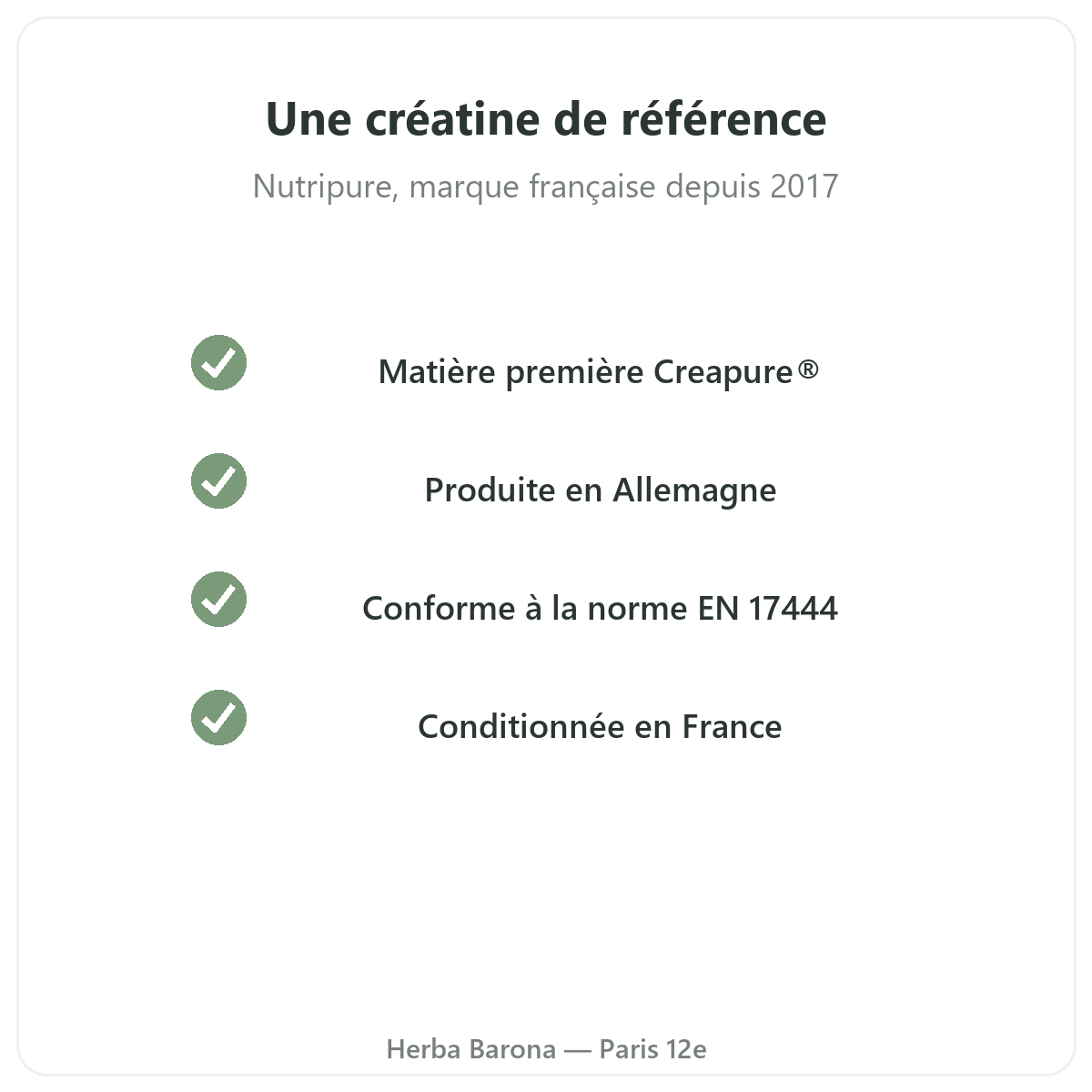
Creapure® is produced in Germany, in Trostberg, Bavaria, in a plant dedicated solely to this molecule. The site is certified to food and pharmaceutical industry standards (GMP, FSSC 22000, ISO standards), and the raw material is certified kosher and halal.
The finished product complies with the European standard EN 17444, designed to prevent banned substances in sports supplements. For a product containing only one active ingredient, the raw material is everything: that is what convinced us to offer it in our Paris shop.
A molecule discovered in meat broth
The story of creatine begins in Paris. In 1832, the chemist Michel-Eugène Chevreul isolated an unknown compound in a meat extract and named it after the Greek word kreas, meaning flesh.
Creatine is nothing exotic: the body makes it itself, in the liver and kidneys, from three amino acids, glycine, arginine and methionine. About 95% of our reserves are stored in skeletal muscle, the rest mainly in the heart and brain.
Food also provides some, but only via meat and fish. To find 3 g of creatine on a plate, you would need to eat several hundred grams of meat or fish every day, and cooking destroys part of it. For a vegetarian, the dietary intake is almost nil.
The muscle’s backup battery
For a brief, intense effort — a weight-training rep, a sprint, a jump — the muscle draws on ATP, its energy currency. In releasing this energy, ATP loses a phosphate group and becomes ADP, unusable as such. Creatine, stored in the muscle as phosphocreatine, then hands its phosphate to ADP, which turns back into ATP in a fraction of a second. Nutripure compares it to a backup battery.
Creatine is therefore not a stimulant: it contains no caffeine or excitants, gives no energy rush, and can be taken in the evening without a second thought. It maintains a system that already exists. The European Union authorises a health claim for it, whose official wording is: Creatine increases physical performance in successive bursts of short-term, high-intensity exercise. The beneficial effect is obtained with a daily intake of 3 g of creatine.
The five daily capsules provide exactly this 3 g. The claim targets intense, repeated efforts, such as weight-training sets, sprinting, crossfit or combat sports; we make no other claims.
How to take the capsules
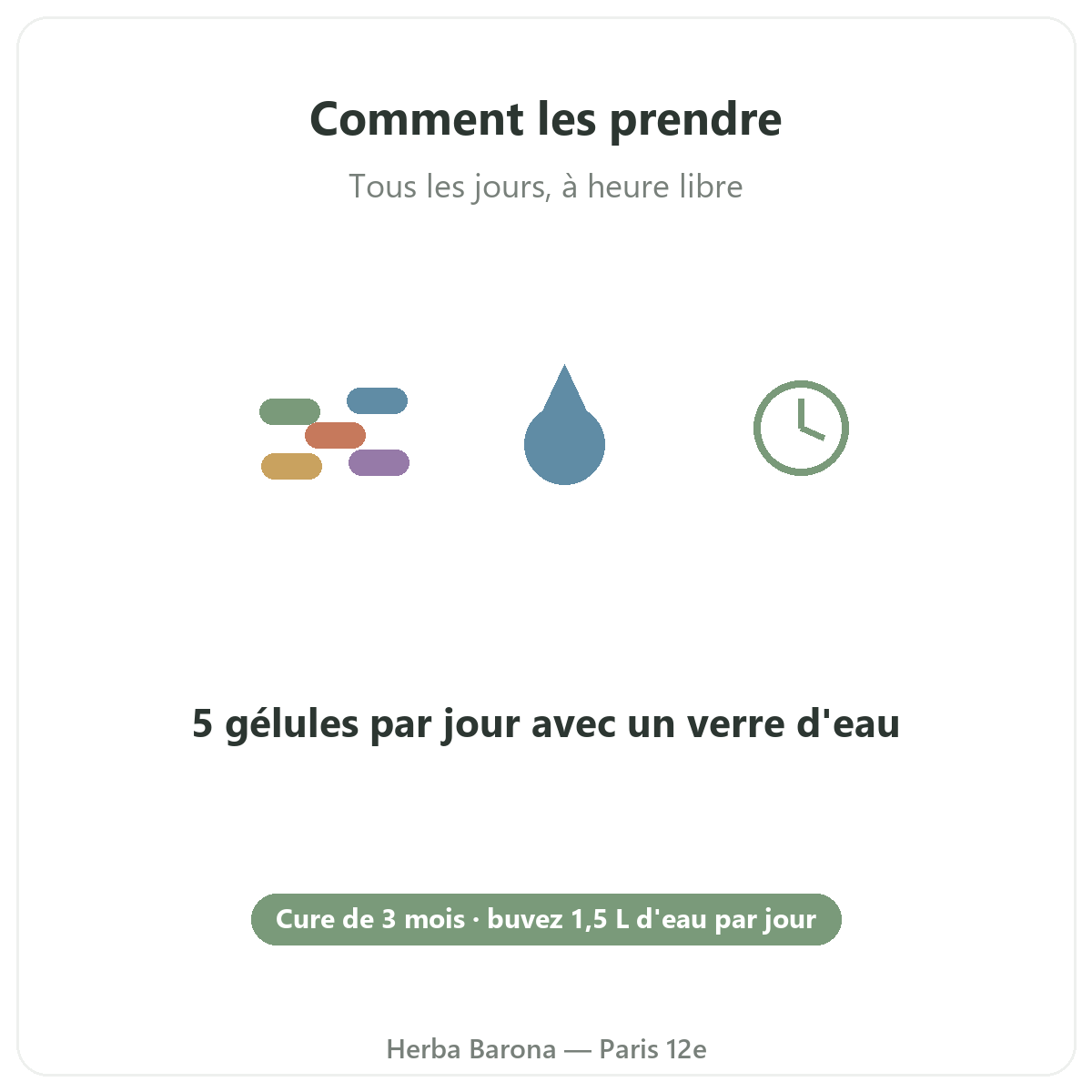
Nutripure recommends 5 capsules a day with a glass of water. You can take them all at once or split them, for example two in the morning and three after your session; the brand supports this split. On training days, taking them after exercise, with a snack containing carbohydrates and protein, is the most comfortable approach. On rest days, the dose can be taken with any meal you choose, no exceptions.
There is no need for a loading phase. The old method of 20 g a day for five days saturates muscles faster, but 3 g a day — the dose adopted in France for food supplements — reaches the same reserve level in three to four weeks. A commonly cited benchmark: 0.03 g per kilo, i.e. 2.4 g for 80 kg.
The recommended course lasts 3 months, i.e. three pots, possibly followed by a 1 to 2 month break; beyond four training sessions a week, it can be taken year-round. Drink at least 1.5 L of water a day. The capsules work just as well with Pure Recovery Nutripure as with a shaker of Muscle Protein Nutripure. For adults only; if pregnant, breastfeeding, undergoing treatment or in case of a health issue, seek advice from a healthcare professional.
Nutripure, a French brand at Herba Barona
Nutripure was founded in 2017 in Haute-Garonne, near Toulouse. Its founders are Christophe Carrio, five-time world champion in artistic karate and a qualified dietitian, and his brother Florent, an engineer. The brand favours short formulas and identified raw materials, with manufacturing in France. Nutripure L-Citrulline follows the same logic of a single ingredient per pot.
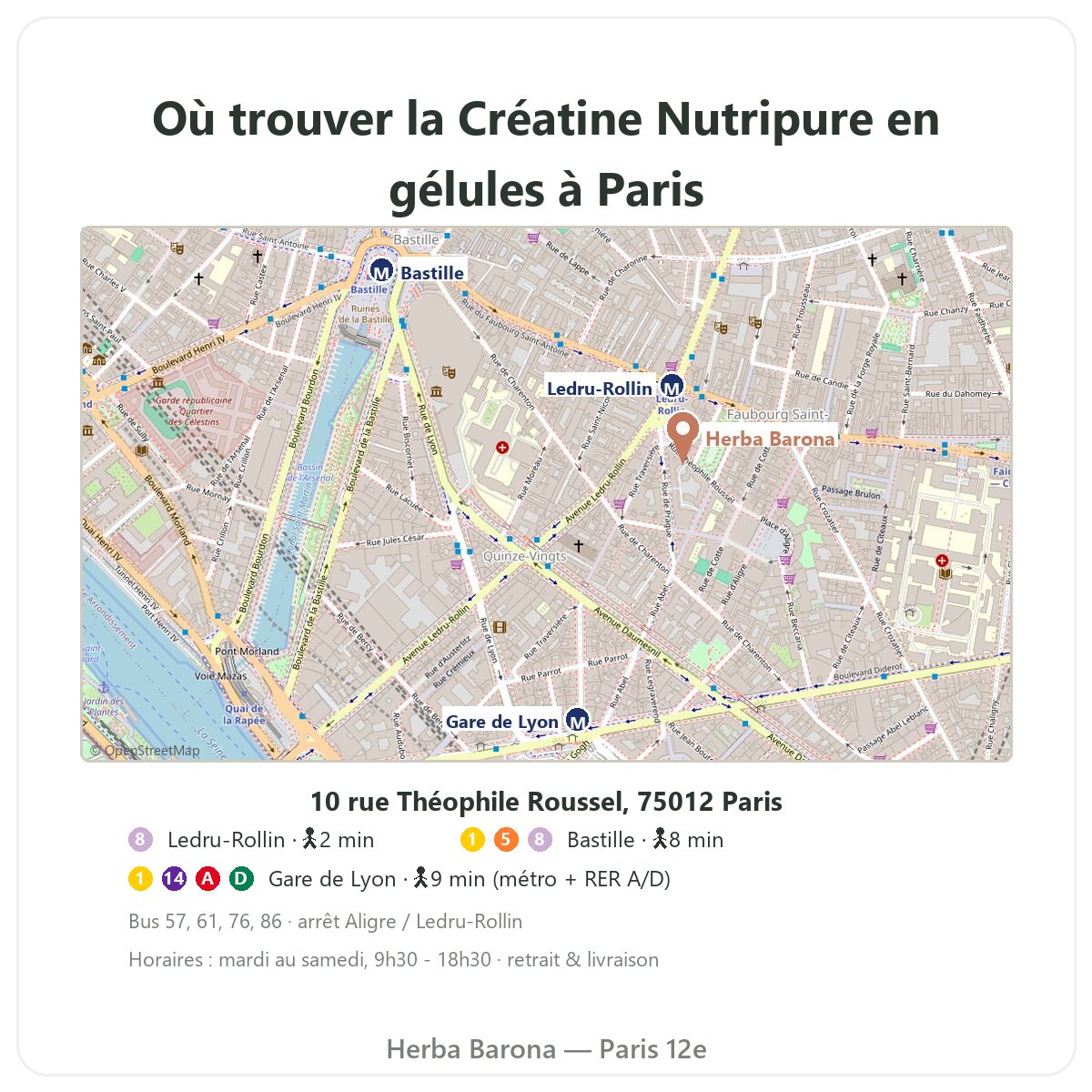
At Herba Barona, the Nutripure range has its place in our Paris shop, at 10 rue Théophile Roussel, open Tuesday to Saturday, near the Ledru-Rollin and Bastille metro stations. This product’s availability is shown on this page.
Frequently asked questions
Is creatine a doping substance?
No. Creatine does not appear on the World Anti-Doping Agency’s list of banned substances. This version also complies with the EN 17444 standard, designed for athletes subject to testing.
Does creatine cause bloating?
In the first few weeks, creatine draws a little water into the muscle, where it is stored, which can shift the scale by a few hundred grams. This effect stays limited to the start of use.
What happens when you stop?
Nothing drastic: reserves gradually return to their starting level within a few weeks, and the body carries on producing its own creatine as before.
Where to find Nutripure Creatine capsules in Paris?
At Herba Barona, 10 rue Théophile Roussel, Paris 12th, between Ledru-Rollin and Bastille. Its availability is shown on this page.
Herba Barona’s tip — with creatine, it is forgetting that breaks the habit, not the time of day you take it. Fill a weekly pill organiser on Sunday evening: 35 capsules, and the week is sorted, rest days included. Capsules don’t mind waiting, unlike a shaker prepared ahead of time.
Guide: Nutripure: our advice by goal
Guide: creatine explained simply