
Le blog Herba Barona › Actualités
How to Recognise Pure Shilajit: The Tests That Matter
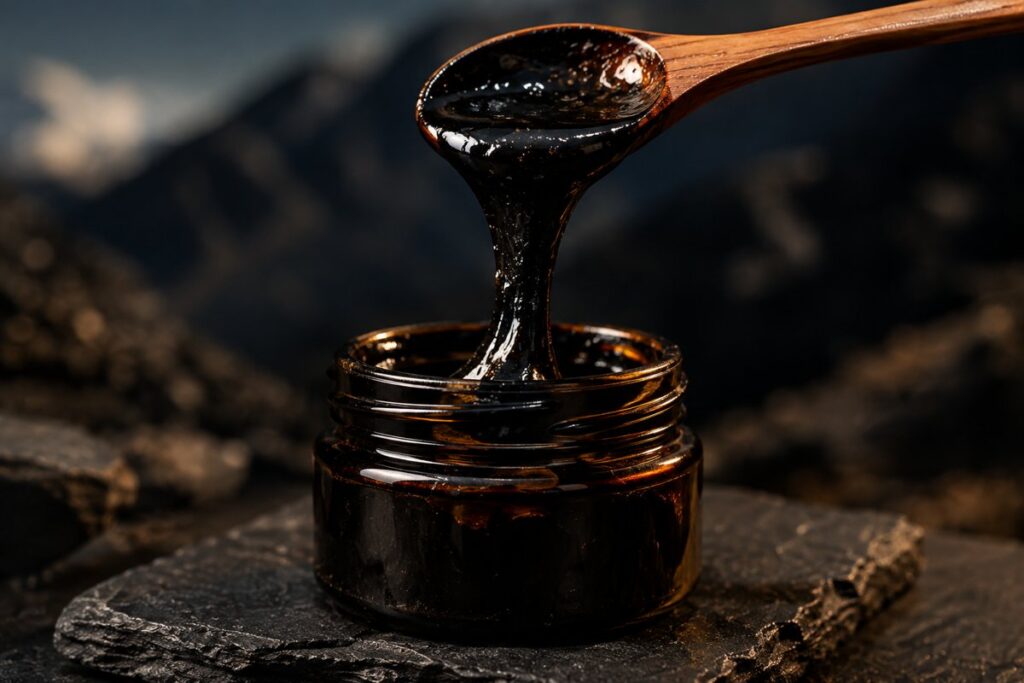
Have you ever compared two jars of shilajit online? Same colour, same promises, and sometimes a price that triples from one to the other. So which one is genuine? It’s a question we hear every week in store — and the good news is that there’s an answer. A few checks before buying, two or three gestures at home, and most dubious products fall apart on their own. Let us show you. 👇
What makes a “good” shilajit?
Let’s start with the number that matters: the fulvic acid level. It’s the reference marker for shilajit, measured in a laboratory. A serious product displays it proudly — the best resins range between 70 and 80%, and the ones we have chosen for the shop test at 75 to 79%. A jar that stays vague, something like “rich in minerals” with no percentage at all? Be wary. 🚩
Second habit: ask for lab analyses. Shilajit is harvested in the mountains, and everything comes down to purification. A serious supplier has every batch tested — heavy metals, contaminants — and can show the certificates. That’s actually our simple selection rule: no analysis, no shelf space.
And the origin? Himalaya, Altai, Kashmir… it should be stated somewhere, along with the purification method. “Premium quality” with no concrete information at all is just empty talk. The same goes for rock-bottom prices: genuine purified resin has an unavoidable cost. A jar that’s suspiciously cheap isn’t a bargain — it’s something other than shilajit.
And at home, what can you check?
With resin, yes, you can play detective. 🔍 Three simple, traditional tests:
The hand test. Genuine shilajit reacts to temperature: hard and brittle when cold, pliable in the palm. A paste that never changes is suspicious.
The glass-of-water test. The most revealing one. A small pinch of resin in warm water: it should dissolve slowly and completely, tinting the water a deep, rich brown. If grit remains at the bottom of the glass… you were sold filler, not shilajit.
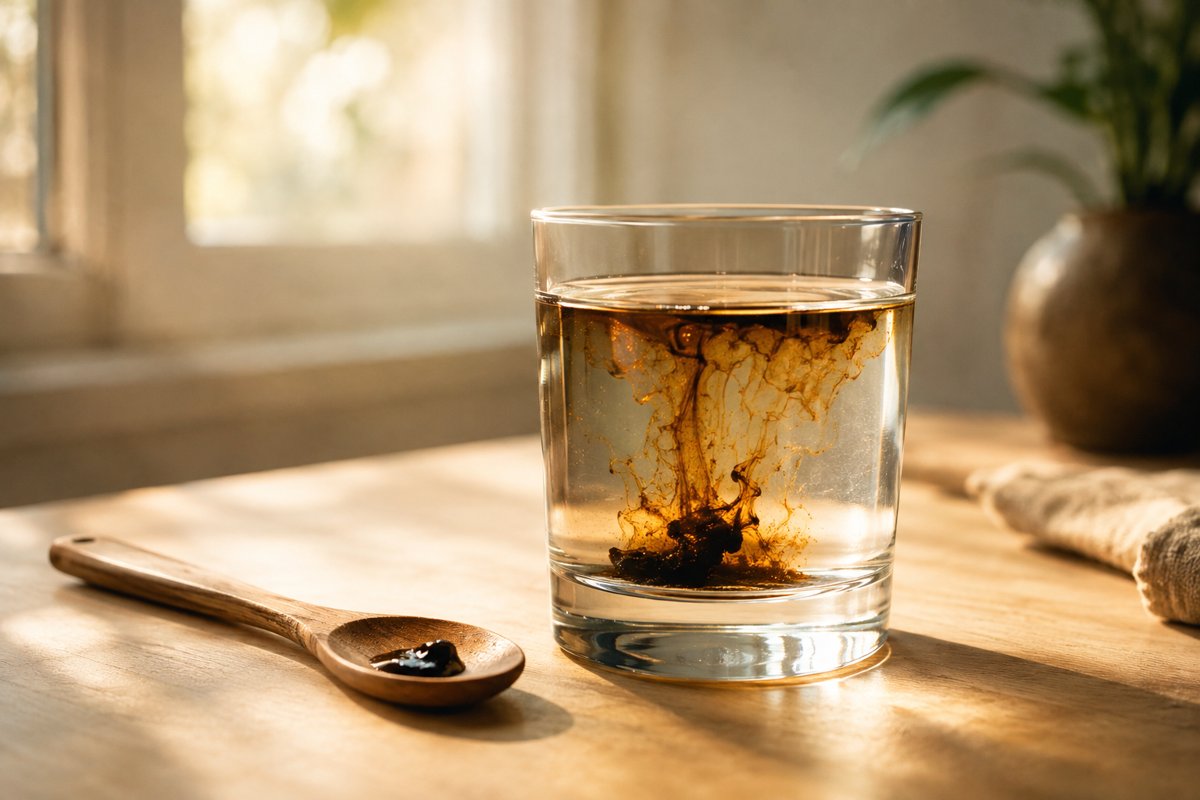
The glass-of-water test: golden-brown swirls, full dissolution, zero grainy residue.
Smell and taste. Genuine shilajit has a mineral, almost smoky smell, and a bitter, earthy taste that doesn’t fake it. A product that is nearly odourless and tasteless has most likely been cut.
Let’s be honest: none of these home checks replaces a lab analysis. But all three together already rule out most crude counterfeits.
And for capsules, how do you check? 🤔
Here, you can’t examine the raw material at all — everything rests on the paperwork, and that’s fine when it actually exists: a published fulvic acid level, batch analyses, an identifiable manufacturer. That’s exactly what we require before listing a capsule product: our pure Feel Pure shilajit capsules test at 70% fulvic acid, and the SIHO chilagite in 60 capsules documents its fulvic acid content batch by batch.
The traps we see out there
| The trap | The response |
|---|---|
| 🎭 Powder sold as resin | Powder itself isn’t a problem — but it must be sold as what it is, and tested |
| 💸 The rock-bottom price | 30 g of purified resin at next to nothing simply doesn’t exist |
| 📸 A beautiful photo… and something else in the parcel | Buy where you can see the real product before you pay |
| 👻 No traceability at all | No brand, no address, no analysis: walk away, whatever the price |
The simplest way? Come and see for yourself
You can read every guide in the world — nothing replaces an open jar in front of you. In store, we’re happy to show you the texture and smell of a pure resin on our demonstration jars: Feel Pure tests at 75% fulvic acid, SIHO reaches 79%. Touching, smelling, comparing — it’s still the best way to know exactly what you’re buying.
Questions we’re often asked
1Does “organic” shilajit exist?
No — and that makes sense: shilajit isn’t cultivated, it’s the result of a natural decomposition process that unfolds over many, many years in the mountains. You can’t certify such a process as “organic”: no organic certification exists for shilajit. A jar that proudly displays an organic label should actually raise suspicion. The real markers of quality are the fulvic acid level and the purity analyses.
2Does colour tell you anything?
Genuine resin is a very dark brown to black, and glossy. A pale or dull shade can suggest insufficient purification or a mixture — but only the analysis certificate is truly conclusive.
3Can you test the quality of capsules?
Not directly. For capsules, rely on the published fulvic acid level, batch analyses, and the manufacturer’s seriousness — or just ask us in store, we’ll show you the documents.
To go further: resin or capsules, which to choose?, our shilajit comparison guide and the shilajit category page. And if you visit us at Herba Barona, in Paris, bring your questions — it’s our favourite topic. 😊