
The Herba Barona blog › Sem categoria
Spirulina: powder, tablets or blue spirulina, which to choose
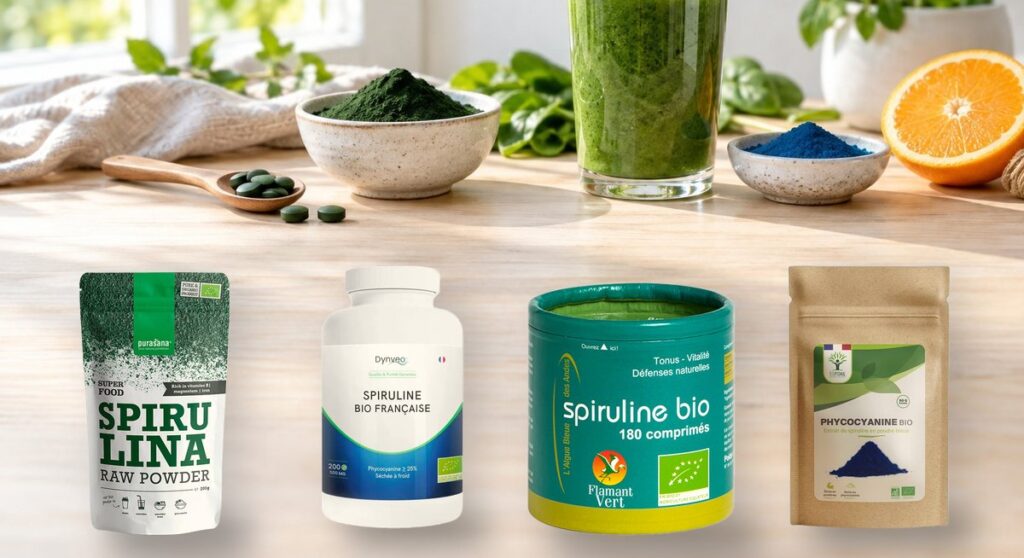
In front of the spirulina shelf, the question almost always comes up: “Powder or tablets?” And lately, a second one has joined it: “What’s this blue spirulina?” Both are good questions, because they’re not quite the same product. Let’s go through it here, form by form, with what we explain to our customers in the shop. All our products are on the spirulina in Paris page.
Spirulina, in a nutshell
Spirulina (Arthrospira platensis, often sold under the name Spirulina platensis) is a blue-green freshwater micro-algae. More precisely, it’s a cyanobacterium, one of the oldest living organisms on the planet. It is grown in ponds, harvested, drained, then dried. Everything that follows, powder, tablets or flakes, starts from this same dried algae.
Its colour comes from two pigments: chlorophyll, green, and phycocyanin, blue. It’s this second pigment that gives “blue” spirulina its name, which we’ll cover further down.
Powder: for drinks and recipes
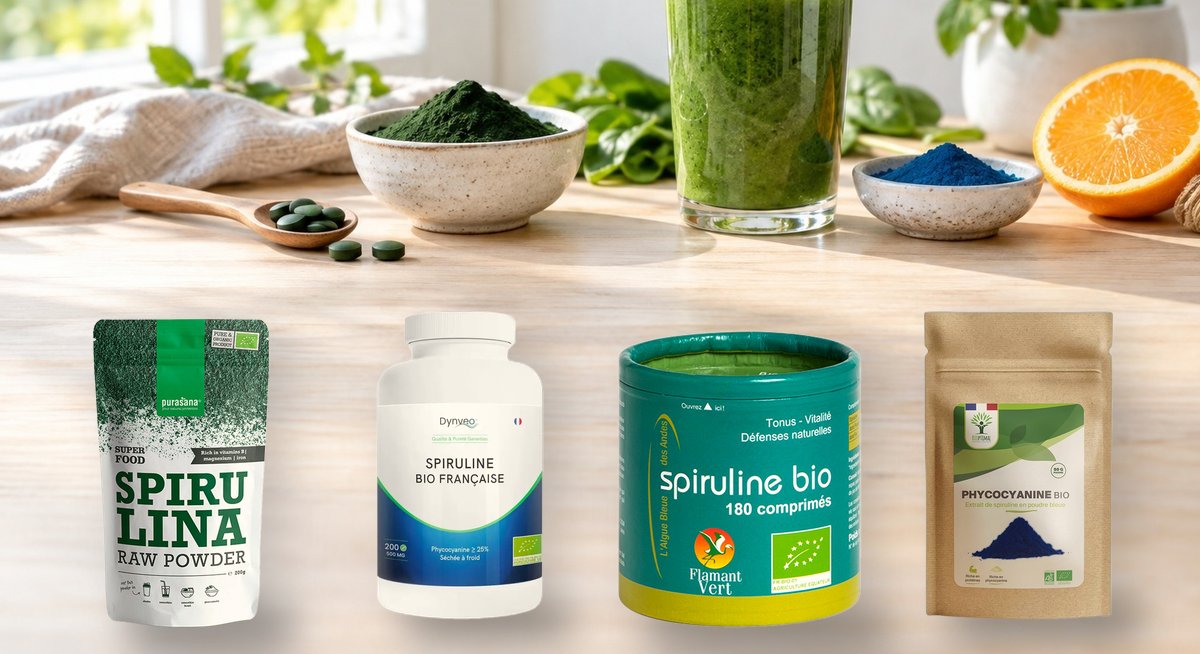
Powder is the simplest form: the dried algae, ground, with nothing else. Purasana’s organic spirulina powder is 100% organic spirulina, with no excipient, flavouring or additive, dried at low temperature. The stated dose is 5 g per day, around one teaspoon, in a juice, a smoothie, yoghurt or a glass of water.
Its strength is flexibility: you can dose it however you like. Its drawback is the taste, which is strong and not to everyone’s liking. An orange juice or a banana smoothie masks it far better than water on its own.
Between powder and tablets, there are also Dynveo’s spirulina flakes: thin strands, the least processed form after harvesting and drying, since there is no compression step. They can be sprinkled over a salad or a bowl, or mixed into a smoothie.
Tablets: so you don’t taste it
The tablet is the same powder, pressed. It’s swallowed with a glass of water, with no taste at all. It’s the form chosen by many people who take spirulina every day, at the office or while travelling.
Two examples from our range, of different origins:
- Dynveo’s organic French spirulina is grown in the south of France and dried at low temperature. The product page states up to 6 tablets a day, or 3 g, with phycocyanin standardised to at least 25%. The tablets are made of 100% spirulina.
- Flamant Vert spirulina is grown at 2,500 m altitude in Ecuador and Ecocert certified. The dose is also 6 tablets, or 3 g. The ingredient list mentions an anti-caking agent, talc, used in making the tablets.
A tip we repeat often, and that Dynveo’s product page also gives: start with two tablets a day in the first week, then gradually increase to the dose on the label. For powder, Purasana’s product page says the same: a reduced dose in the first week, before increasing.
Blue spirulina: an extract, not another algae
This is where confusion is common. Bioptimal’s organic blue spirulina powder is not a different variety of spirulina. It’s a water-based extract of organic spirulina that isolates phycocyanin, the blue pigment. The label states a standardisation of at least 55% phycocyanin, and a dose of half a teaspoon, or 1.5 g. The spirulina comes from Asia, and the powder is checked and packaged in a workshop in France.
In practice, blue spirulina has almost no taste or smell, and colours recipes a vivid blue: smoothie bowls, plant-based milks, baked goods. However, it is no longer the whole algae: it isn’t chosen to replace a green spirulina, but for the phycocyanin alone. Those interested in this pigment will find other forms, in capsules, in our phycocyanin range.
How to read a spirulina label
Whatever the form, four lines are enough to compare. Origin: the country and growing site are usually stated. Drying: a “low temperature” mention is a good sign, as spirulina dried too hot loses some of its colour. Phycocyanin, when given a figure, as a percentage or in milligrams per dose. And ingredients: 100% spirulina, or spirulina plus a processing aid. To go further on origin, our article on French spirulina details the growing operations.
Frequently asked questions
What time should spirulina be taken?
Dynveo’s product page recommends taking it with meals, with a large glass of water. There’s no fixed time: what matters is consistency, at the dose stated on the packaging.
Does blue spirulina replace green spirulina?
No. Green is the whole dried algae; blue is an extract that keeps only the phycocyanin. These are two different products, dosed differently.
Can spirulina be cooked?
It’s best added cold or at the end of preparation: heat dulls its colour. In a juice, a smoothie or on an already cooked dish, it keeps its deep green colour.
Are there any precautions?
Follow the stated dose. Purasana’s product page specifies that it is not suitable in cases of haemochromatosis or phenylketonuria. If pregnant, breastfeeding or undergoing treatment, ask your doctor or pharmacist for advice before taking it.
Powder, flakes, tablets or blue spirulina: we have them all at our Paris 12th shop, 10 rue Théophile Roussel, and we’re always happy to take the time to show you.