
The Herba Barona blog › Sem categoria
Digestive enzymes: how to choose and when to take them
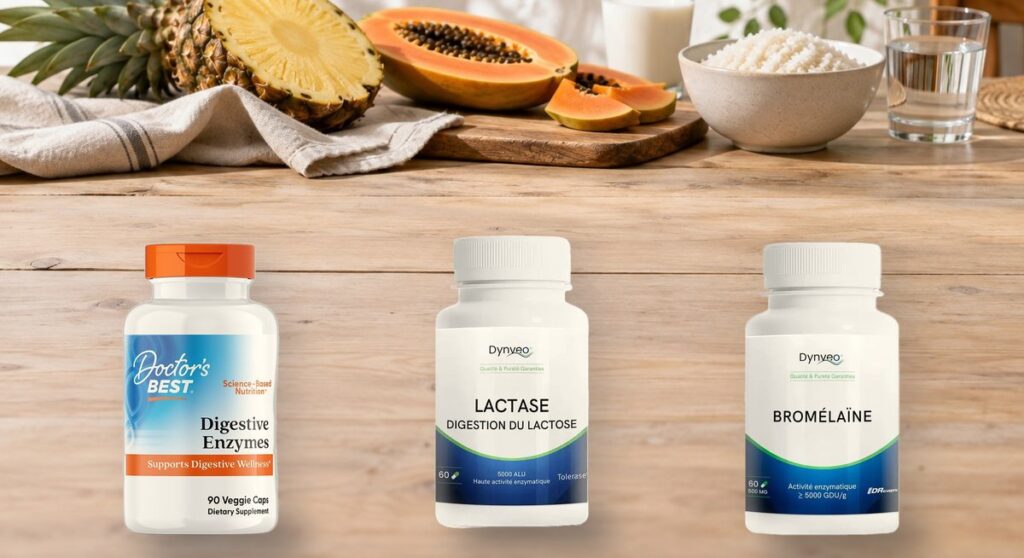
Digestive enzymes intrigue people. They’re talked about more and more, but on the shelf, the bottles carry abbreviations we’ve never seen before: HUT, DU, ALU, GDU. And when you turn the tub around, you discover that some formulas contain ox bile, others only plant-based enzymes, and others just a single enzyme. This guide covers what we explain at the counter so you can choose without mistakes, and above all take them at the right moment. Our full selection is on the digestive enzymes in Paris page.
What is an enzyme?
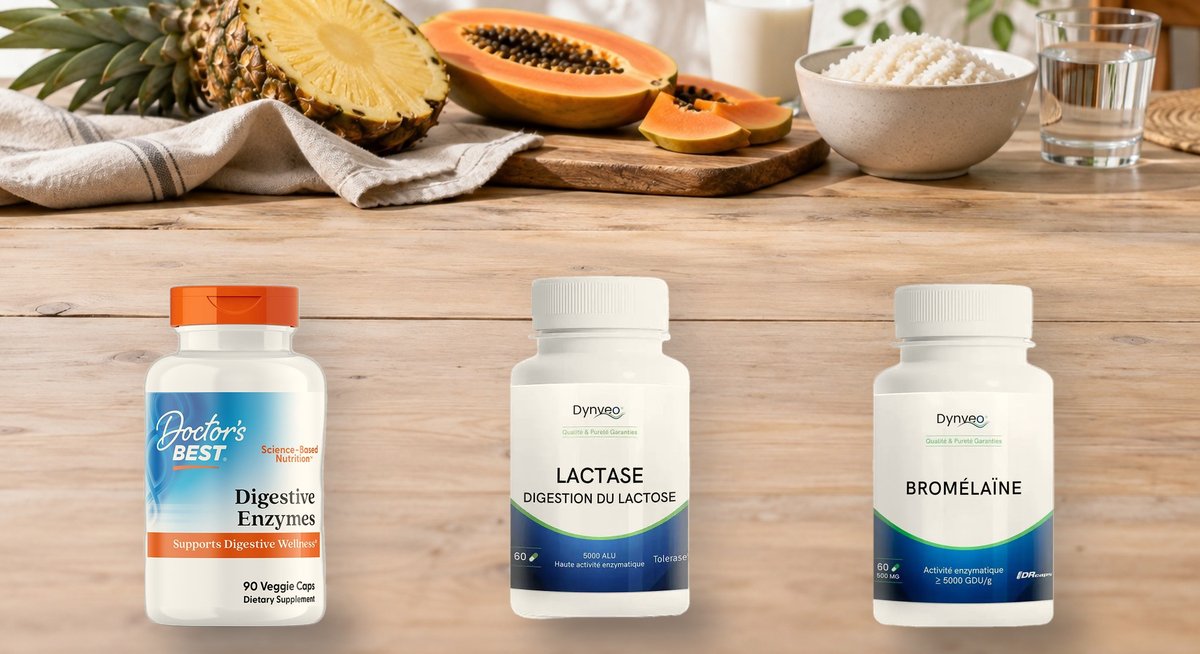
An enzyme is a protein that breaks down a specific molecule. Each family has its own target. Proteases act on proteins, amylases on starch, lipases on fats, cellulases on plant fibre, and lactase on lactose, the sugar found in milk. Our body makes its own digestive enzymes. A supplement provides additional ones, of plant, fungal or animal origin depending on the formula.
Before choosing, you need to know what you’re looking for: a broad complex covering several families, or a single enzyme targeted at one particular food.
Reading the units: why not milligrams?
This is the question we’re asked the most often. An enzyme is measured by its activity, meaning what it is able to break down, not by its weight. Two powders of the same weight can have very different activity levels. Hence these units:
- HUT for proteases,
- DU for amylases,
- ALU for lactase,
- GDU for bromelain, the enzyme from pineapple.
To compare two products, compare the same unit, for the same enzyme. A bottle that only lists milligrams of an “enzyme blend” doesn’t allow this comparison: ask us about it, we’ll look at the manufacturer’s data sheet with you.
Broad-spectrum complex: three profiles
Our three complexes are not alike, and the difference mainly comes down to the origin of the ingredients.
The complex with detailed units. Digestive Enzymes from Doctor’s Best list, per vegetable capsule, 95,000 HUT of proteases and 20,000 DU of amylases, along with glucoamylase, beta-glucanase and DPP-IV. It’s the most readable label in the range. The maker also presents this complex as covering proteins, carbohydrates, fats and fibre, hence the name “full spectrum”.
The 100% plant-based complex. Plant Enzymes from NOW Foods combine protease, amylase, lipase, cellulase, bromelain, papain and lactase, all of plant or fungal origin, in a cellulose capsule. The protease content is 12,500 HUT per capsule. It suits vegetarians and vegans; the label notes the presence of sulphites.
The complex with animal ingredients. Super Enzymes from NOW Foods combine betaine HCl, ox bile extract, pancreatin, papain and bromelain, in a bovine gelatine capsule. This is therefore not a product for vegetarians.
A single enzyme, for a specific purpose
Sometimes a complex isn’t necessary. Dynveo’s Lactase provides 5,000 ALU of Tolerase® L lactase per vegetable capsule. It is taken as needed, before a meal containing dairy products, rather than as a long-term course. Lactase splits lactose into two simple sugars, glucose and galactose.
Dynveo’s Bromelain 5000 GDU is extracted from pineapple stem: 500 mg per gastro-resistant DRcaps® capsule, with an activity of 5,000 GDU/g. Its instructions call for 1 to 3 capsules per day with a large glass of water, either at the start of meals or away from them, depending on the intended use.
When to take your digestive enzymes
The rule is simple: enzymes work on the meal, so they need to arrive at the same time as it does. Doctor’s Best recommends 1 capsule at the start of each main meal. NOW Foods states, for Super Enzymes, 1 capsule during each meal, preferably at the start, with a large glass of water. Taken away from a meal, a digestive enzyme has nothing to break down.
As for duration, a bottle of 90 capsules covers around one month at a rate of three meals a day, according to both Doctor’s Best and NOW Foods. For those taking just one a day, NOW Foods states that a bottle of Super Enzymes lasts around three months. In every case, do not exceed the dose stated on the label.
For bromelain, start with one capsule a day for two or three days, as recommended by Dynveo. It is not recommended for people allergic to pineapple, papaya or latex, and should be avoided during anticoagulant treatment.
Frequently asked questions
Can the capsules be opened?
Doctor’s Best states that its capsules can be opened and mixed with water or a lukewarm food. For the gastro-resistant bromelain capsule, swallow it whole: it’s the coating that protects it.
Enzymes or probiotics?
These are not the same thing: enzymes break down food, probiotics are live micro-organisms. Our guide on choosing your probiotics and our probiotics and prebiotics range cover the topic.
Should they be taken at every meal?
The complexes are intended for main meals, lactase only for meals containing dairy products. Follow the label on your product.
Are there any precautions?
Yes. If pregnant, if you have a digestive condition monitored by a doctor, or if undergoing treatment, ask your doctor or pharmacist for advice before starting.
To untangle HUT, DU and GDU in person, the easiest way is to come and see us at our shop in Paris 12th, rue Théophile Roussel: we’ll turn the bottles over together and help you find the right one.