
Le blog Herba Barona › Sem categoria
Astaxanthin: where it comes from and how to choose it
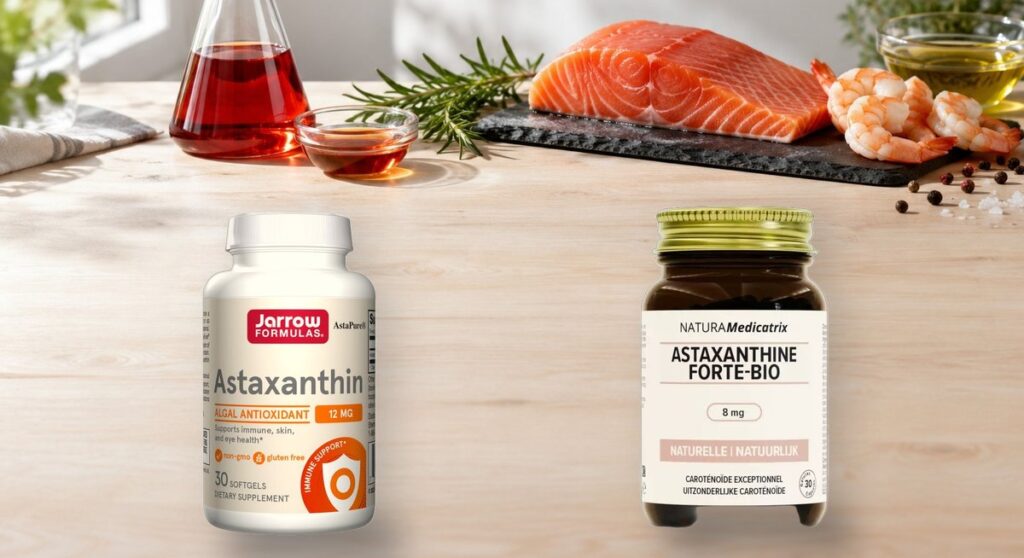
Wild salmon, shrimp, flamingos: they all owe their colour to the same molecule, astaxanthin. When customers ask us about it, they’ve usually read the word somewhere and have two questions: where exactly does it come from, and how do you choose between two boxes with different dosages? Let’s start from the beginning, with the products in our range. Our products are on the astaxanthin in Paris page.
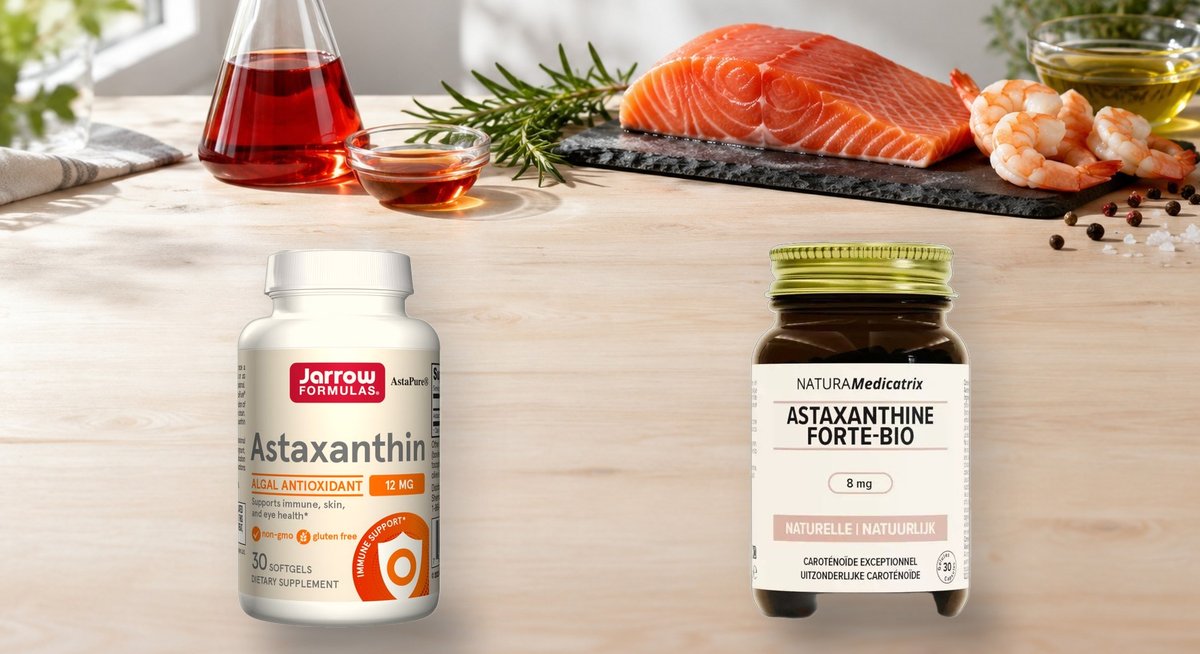
A micro-algae that turns red
Astaxanthin is a red-orange pigment in the carotenoid family, like the beta-carotene found in carrots. The one in our supplements comes from a freshwater micro-algae, Haematococcus pluvialis.
Its story is remarkable. Normally, this algae is green and multiplies calmly. When its environment becomes hostile (water drying up, light too intense, nutrients running low), it changes behaviour: it forms a cyst, stops dividing and produces astaxanthin in large amounts, turning it blood red. This pigment stays with it through its dormant period, sometimes for years.
Production mimics this mechanism: the algae is grown in its green phase, then deliberately “stressed” to trigger pigment production, before being extracted.
From salmon to capsule
In nature, astaxanthin passes from the algae to the small crustaceans that feed on it, then to the fish that eat these crustaceans. This is what gives wild salmon its pink flesh. A product page in our range notes that a farmed salmon fed without astaxanthin stays grey.
For a supplement, the pigment is extracted directly from the algae, then diluted in an oil, since astaxanthin is fat-soluble. That’s why both our products combine astaxanthin with an oil, in a softgel or a capsule.
How to choose: the four lines to read
Two boxes of astaxanthin can look identical. To compare them, we check four pieces of information at the counter:
- The source. The label should name Haematococcus pluvialis, sometimes with the name of a branded raw material.
- The dose per capsule, in milligrams of astaxanthin, not to be confused with the total weight of algae extract.
- The shell: animal gelatine or plant-based capsule, a point that matters for vegetarians.
- The carrier oil and added ingredients, such as natural vitamin E or rosemary extract used to protect the oil.
Two products, two approaches
Jarrow Formulas’ 12 mg astaxanthin uses the AstaPure raw material, derived from Haematococcus pluvialis. Each softgel provides 12 mg of astaxanthin, in safflower oil, with mixed tocopherols, extra virgin olive oil and rosemary extract. The shell is bovine gelatine. The box of 30 capsules lasts a month, at one a day; the box of 60 capsules covers two months. It is non-GMO, gluten-free, soy-free and lactose-free.
Naturamedicatrix’s Astaxanthine Forte Bio takes a different approach. Each capsule contains 80 mg of organic algae extract, including 8 mg of astaxanthin, in extra virgin olive oil. The shell is plant-based, and extraction is done without solvents. The dosage is a little lower, but the formula is organic and suits people who avoid gelatine.
Between the two, the choice mainly comes down to the shell, the organic label and the dose per capsule.
Which size to start with?
For a first try, a one-month box is often recommended: 30 capsules for Jarrow Formulas, 30 capsules for Naturamedicatrix. This gives time to get into the habit of taking it with a meal and to see whether the capsule suits you. If you already know you’ll take it over several months, Jarrow Formulas’ 60-capsule box is the most economical size. Its product page also states that the AstaPure raw material carries NAXA certification (Natural Algae Astaxanthin Association), which confirms the algal origin, and that the algae is grown in closed photobioreactors.
How to take it
The rule is the same for both: one capsule a day, with a meal containing fat. A drizzle of olive oil, an avocado, nuts or an oily fish are enough. Since astaxanthin is fat-soluble, this is when it’s best absorbed. Taken on an empty stomach with a simple glass of water, it’s absorbed less well.
Do not exceed the dose stated on the packaging. If pregnant, breastfeeding or undergoing medical treatment, speak to your doctor or pharmacist first. Astaxanthin is part of our antioxidants range, alongside other molecules covered in our article on CoQ10 and ubiquinol.
Frequently asked questions
Should it be taken in the morning or evening?
The time doesn’t matter. What matters is taking it with the meal that contains the most fat in your day, whether that’s lunch or dinner.
8 mg or 12 mg, what’s the difference?
It’s the amount of astaxanthin per capsule. Both are taken at one a day; the choice mainly depends on the shell and the organic label you prefer.
Can vegetarians take it?
Yes, as long as you choose a plant-based capsule, such as Naturamedicatrix’s. Jarrow Formulas’ softgels are in bovine gelatine.
How should the box be stored?
Somewhere cool and dry, away from light, out of children’s reach. Close the bottle properly after each use.
To compare the two boxes and read the labels together, come to 10 rue Théophile Roussel, in Paris 12th (Ledru-Rollin metro), Tuesday to Saturday.