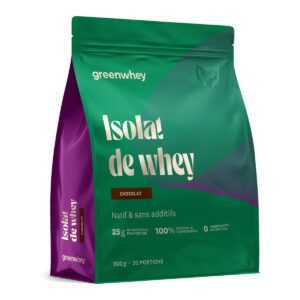
Greenwhey Organic Chocolate Whey Concentrate in Paris: 22 g of protein per serving
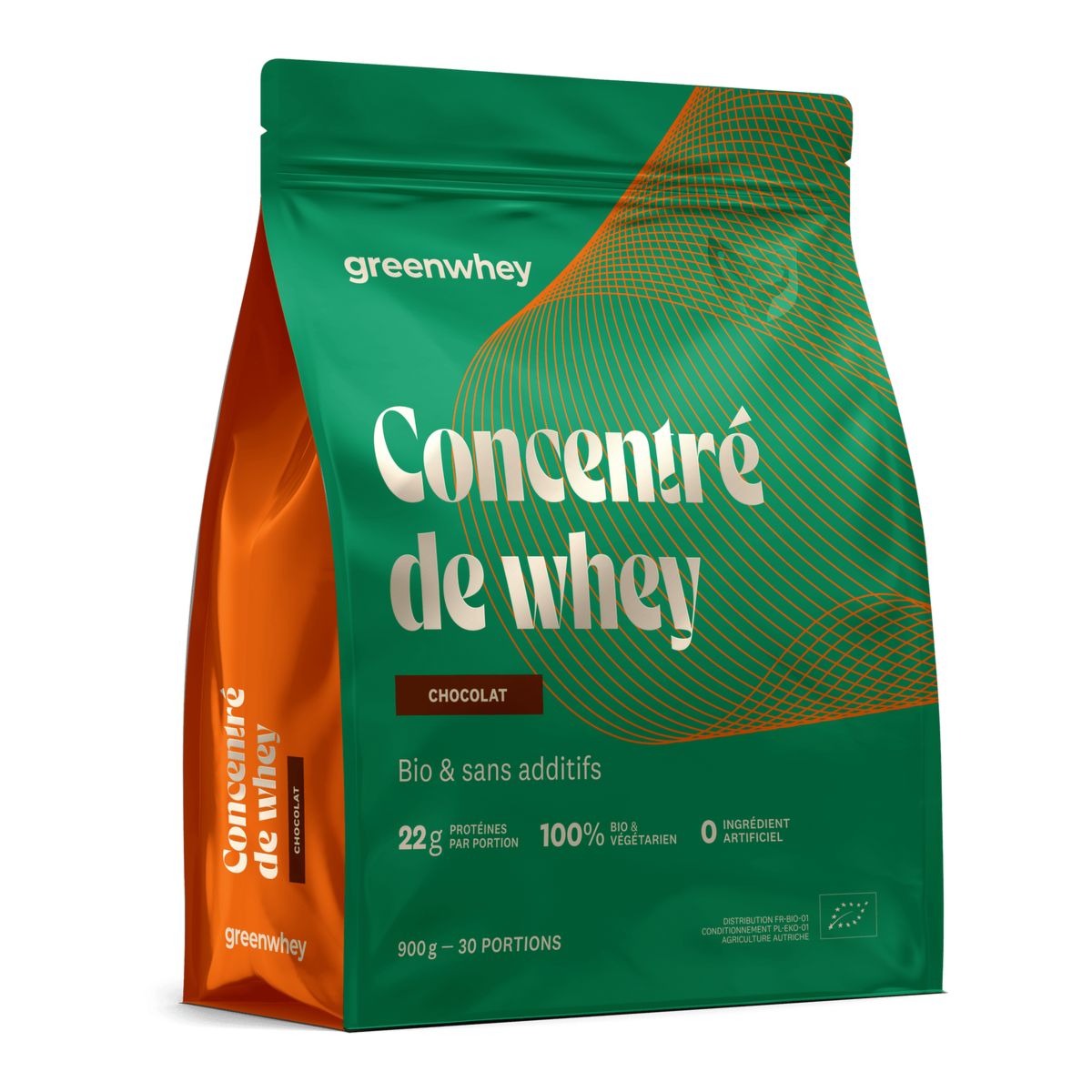
An organic whey made from fresh Alpine milk, with no additives or artificial sweeteners, providing 22 g of protein per 30 g serving.
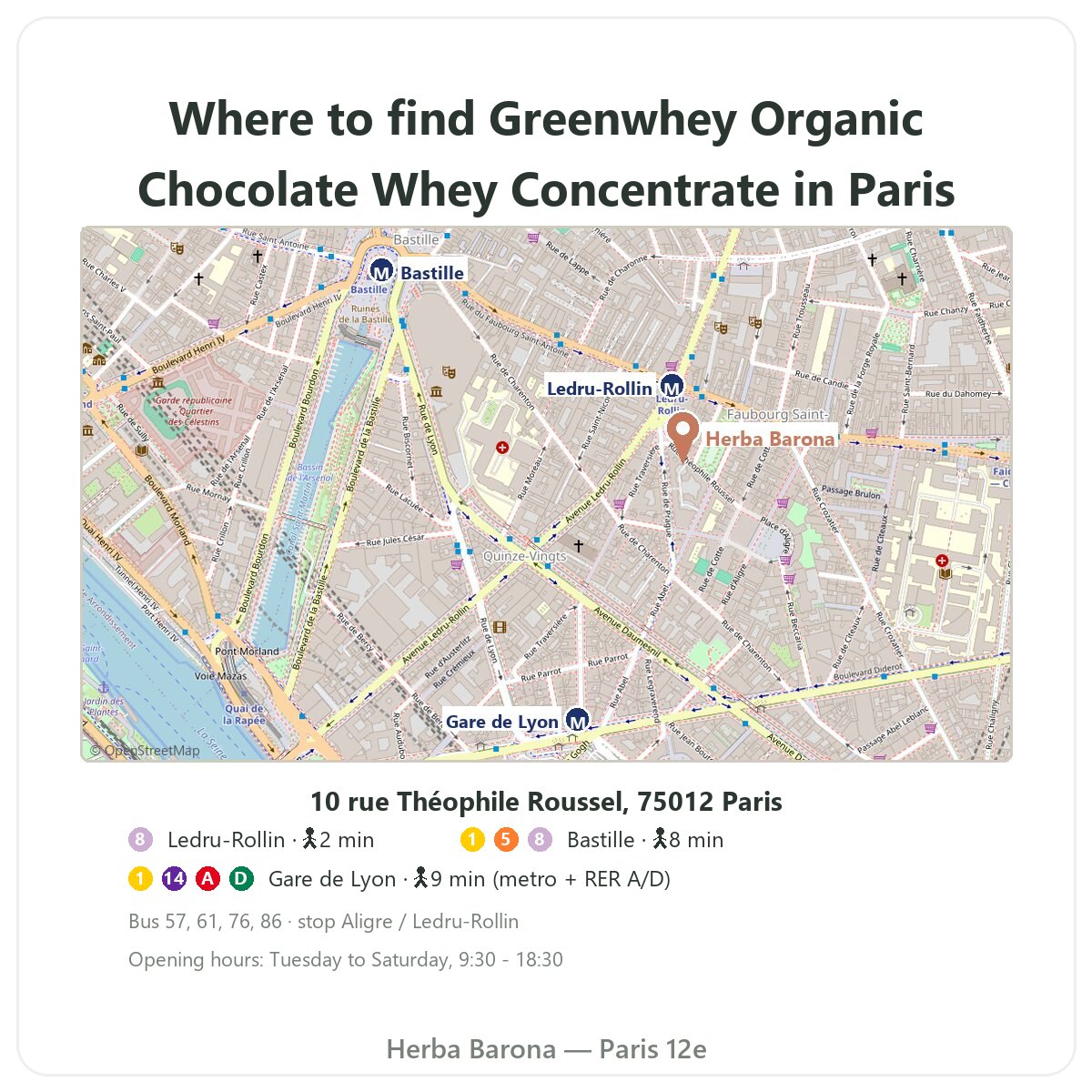
Available in Paris at Herba Barona, in a 900 g pouch.
▶ Concentré de Whey Bio Chocolat Greenwhey 900 g : la vidéo en 2 min 33
What an organic whey concentrate really is
Whey is the protein fraction of the liquid left over from milk. When cheese is made, the milk separates into two parts: the curd on one side and a clear liquid on the other. That clear liquid contains fast-digesting proteins with a very complete amino acid profile. The manufacturer’s job is to filter it, concentrate it and then dry it into a powder.
The word “concentrate” refers to the degree of purification. Here, the powder contains around 73 g of protein per 100 g: the rest is residual carbohydrate from lactose and a little milk fat. This non-protein fraction is not a flaw; it is what gives a concentrate its rounder texture and milkier taste than an isolate. Many people actually prefer concentrate to isolate for exactly that reason.
The difference from a conventional whey lies upstream. Organic standards govern what the cows eat: organic grass and fodder, with no GMOs. For a product taken daily, sometimes for years, that is a criterion that matters to many of our customers in Paris.
Organic Alpine milk, and why origin makes a difference
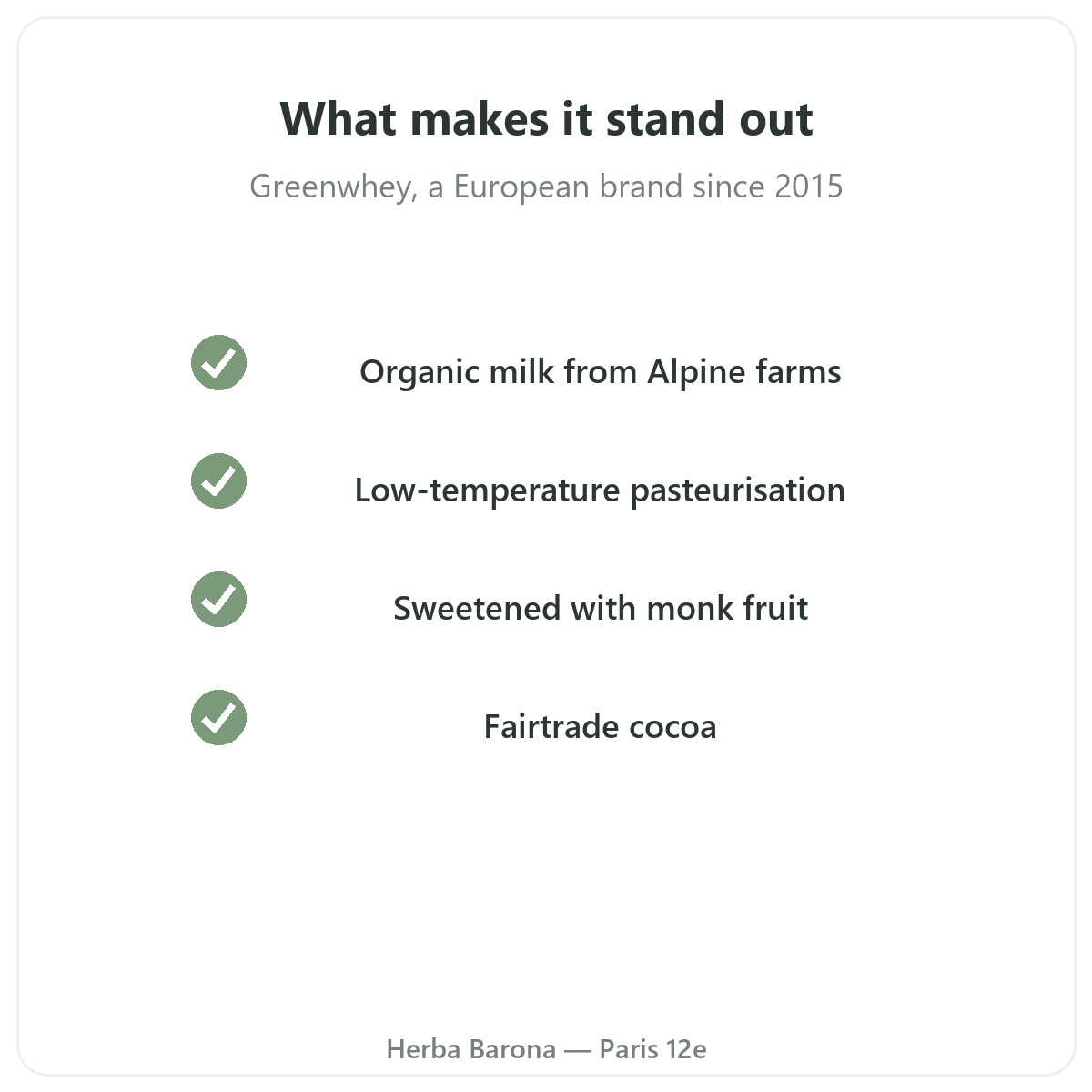
Greenwhey works with family farms in the Alps. The milk is collected fresh, then pasteurised at a low temperature before gentle microfiltration. Both technical points matter: the more heat is applied, the more the proteins are denatured, meaning they lose their original structure. Gentle pasteurisation better preserves the native fractions of the whey.
The packaging mentions Austrian agriculture, distribution under the code FR-BIO-01 and packing under PL-EKO-01. These are the codes of the certification bodies: they make it possible to trace the chain back. It is the kind of detail we always check before taking a brand into our shop in Paris 12th, because an “organic” claim without an identifiable certifier is not worth much.
No additives: what that means in practice
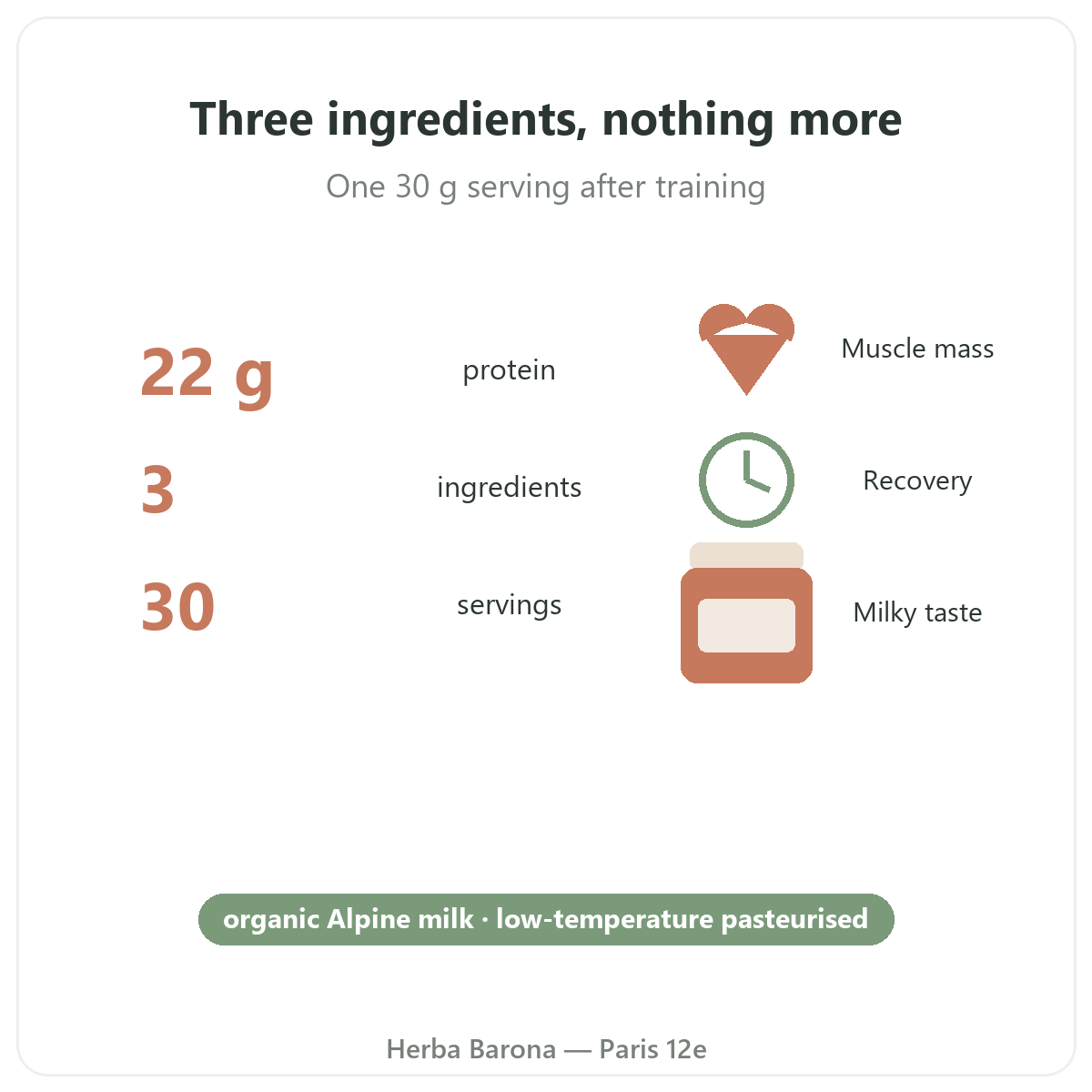
The ingredient list fits on three lines: organic milk whey protein concentrate (93 to 95%), organic Fairtrade cocoa (3 to 5%) and powdered monk fruit decoction (2%).
Monk fruit, or luo han guo, is the interesting part of this formula. It is a small fruit grown in southern China whose sweet compounds, mogrosides, have a very high sweetening power without providing carbohydrates. Here it replaces the sucralose or acesulfame-K found in many flavoured wheys on the market. The result is a taste that is noticeably less sweet than average: it can be surprising for the first few days if you are used to a standard whey, and then you never look back.
No xanthan gum, no lecithin, no artificial flavouring, no colouring. The honest trade-off is that the powder dissolves a little less instantly than a whey loaded with emulsifiers. A shaker with a mixing ball sorts that out in a few seconds.
Nutritional values and amino acid profile
Per 30 g serving: 116 kcal, 22 g of protein, 3.5 g of carbohydrates and 1 g of fat. Per 100 g of powder: 387 kcal, 73 g of protein, 12 g of carbohydrates and 3.5 g of fat.
The 900 g pouch provides about 30 servings, or a month at one serving a day. It is the size we recommend for a first try: enough to judge over time, without committing to the budget of a 2.7 kg bag.
As for amino acids, whey provides all nine essential amino acids, with a high proportion of leucine, isoleucine and valine, the three BCAAs. Leucine attracts the most attention in sports nutrition, because it is the one that preferentially triggers muscle protein synthesis. That is why, for the same amount of protein, whey remains one of the most effective sources for recovery.
How and when to take it
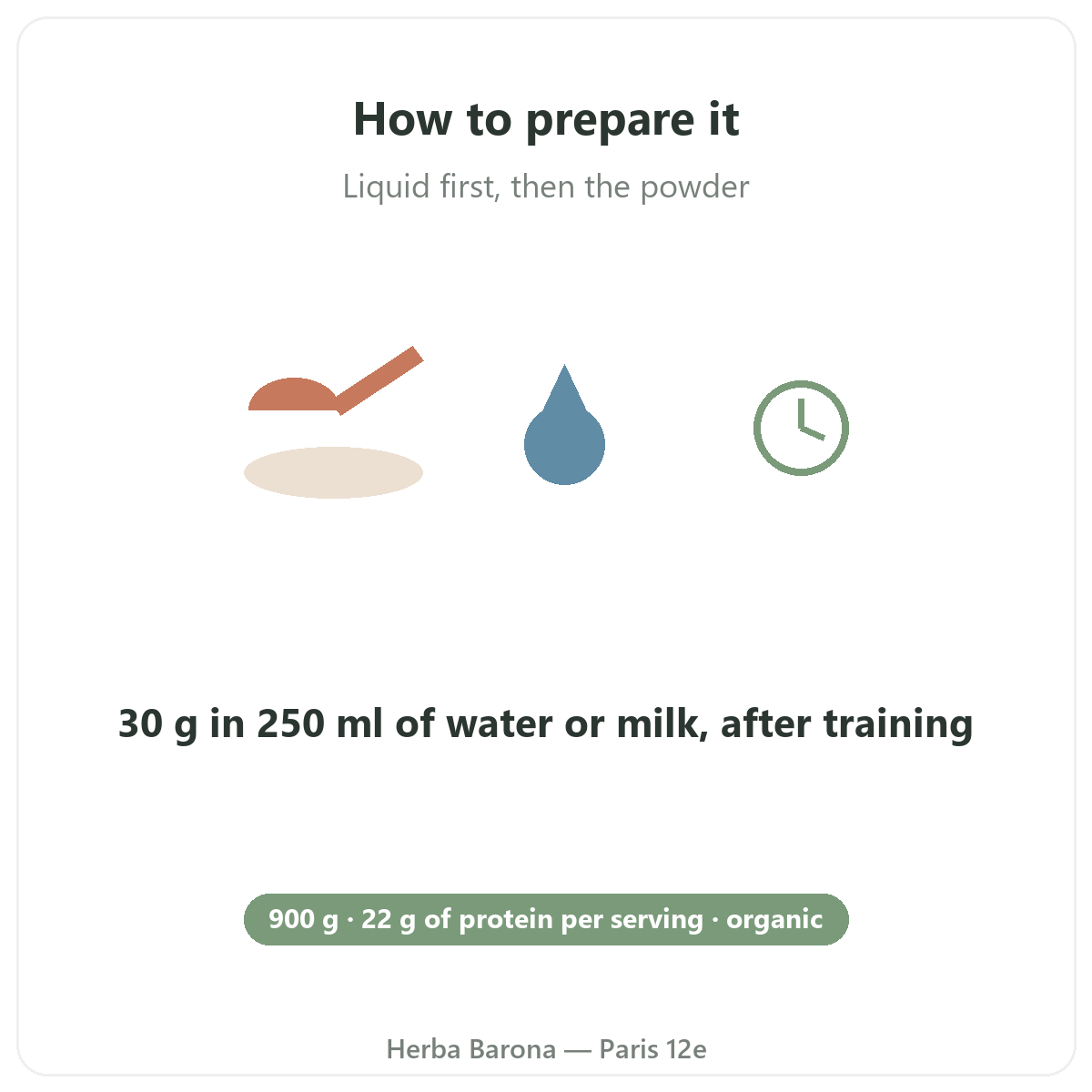
One serving is made with 4 measuring scoops, i.e. 30 g, in 250 ml of water or milk. Always pour in the liquid first and then the powder: the other way round leaves lumps at the bottom of the shaker.
The most common time is after training, within the following hour. But its use is by no means limited to sport. A serving as an afternoon snack keeps hunger at bay effectively, and whey works very well in porridge, yoghurt or pancake batter. The chocolate flavour lends itself particularly well to these recipes.
As for daily quantity, the logic is simple: whey complements your diet, it does not replace it. One to two servings a day cover the vast majority of situations. If you are unsure about your real needs, come and see us in Paris 12th: we will look at your diet with you before selling you anything at all.
Concentrate or isolate: which to choose
It is the question we are asked most often in the shop. The concentrate contains 73% protein and keeps a little lactose; the native whey isolate goes above 85% and retains almost none.
Choose the concentrate if you digest milk without difficulty, if you like a rounder texture and if value for money matters to you. Choose the isolate if lactose is a problem for you, if you keep a close eye on carbohydrates, or if you want the highest protein density per serving.
In practice, most people who come into the shop get on very well with the concentrate. The isolate becomes genuinely relevant for a confirmed lactose sensitivity or during a cutting phase when every gram of carbohydrate counts.
Certifications and allergens
The product is certified organic, gluten-free, vegetarian, kosher and halal, with V-Label certification. The cocoa comes from Fairtrade® sources.
It contains milk: this is a major allergen, so the product is not suitable for people allergic to cow’s milk protein. Be careful not to confuse this allergy with lactose intolerance, which is an entirely different mechanism and which points rather towards the isolate.
This product is a food supplement. It is not a substitute for a varied and balanced diet or a healthy lifestyle. Keep out of reach of children. Do not exceed the recommended daily dose.
Frequently asked questions
Is this whey very sweet?
No, and that is actually its signature. Monk fruit brings a subtle sweetness, far from standard flavoured wheys. People used to very sweet products often find the taste light for the first few days.
Can I take it on days when I don’t train?
Yes. Your protein needs do not stop on rest days, and that is often when recovery actually happens. A serving as a snack remains entirely appropriate.
How is it different from supermarket whey?
Mainly the milk source and the ingredient list. Some mass-market wheys are made with conventional milk and contain artificial sweeteners, artificial flavourings and emulsifiers. Here, there are three ingredients, all organic.
Can I collect it in the shop?
Yes, you can collect it at 10 rue Théophile Roussel, in the 12th arrondissement. We suggest checking the availability of your chosen flavour on this page before you come.
Herba Barona’s tip — take it within 30 to 60 minutes after your session, mixed with water if you want the lightest digestion, or with plant-based milk if you want to turn it into a proper snack.