
The Herba Barona blog › Sem categoria
Which plant-based protein to choose: pea, rice or blend
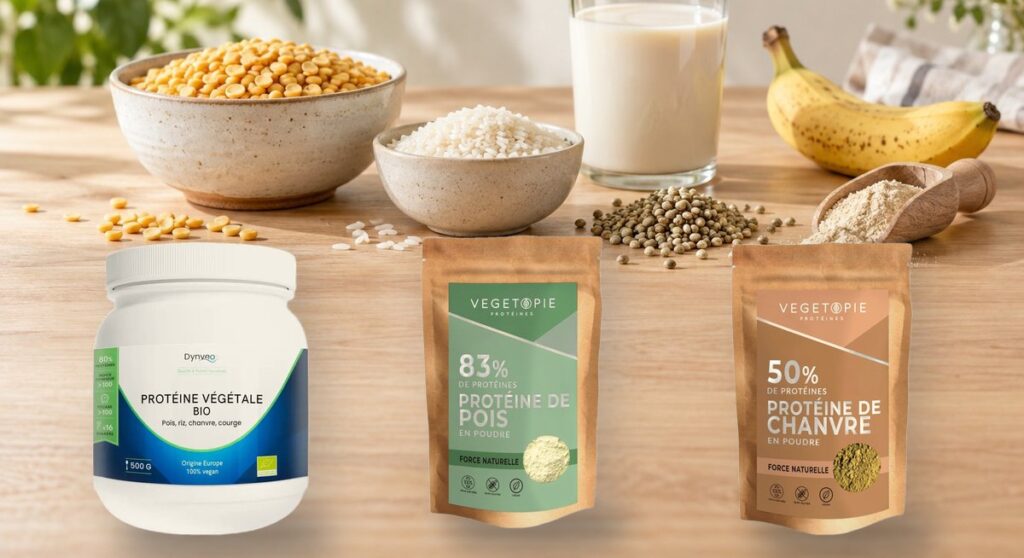
“I don’t take dairy, which protein powder can I use instead?” That’s often how the conversation starts at the counter. Pea, rice, hemp, a blend of several sources: the pouches look alike, but they don’t behave the same in the shaker or on the plate. Here’s how we help our customers sort through it at our Paris 12th shop, with the products we carry. All the items are gathered on our plant-based proteins in Paris page.
Why a plant-based protein?
The reasons vary: a vegetarian or vegan diet, dairy that doesn’t agree with you, or simply wanting to vary your sources. A plant-based protein powder is nothing mysterious: you take a seed or legume rich in protein (pea, rice, hemp, pumpkin) and concentrate its protein fraction, to a greater or lesser extent depending on the process.
As with any protein, the European Union authorises specific wording when the content is high enough: protein contributes to the growth of muscle mass, contributes to the maintenance of muscle mass, and contributes to the maintenance of normal bones. What changes from one powder to another is the source, the concentration, the taste and the texture.
Pea: the most common base
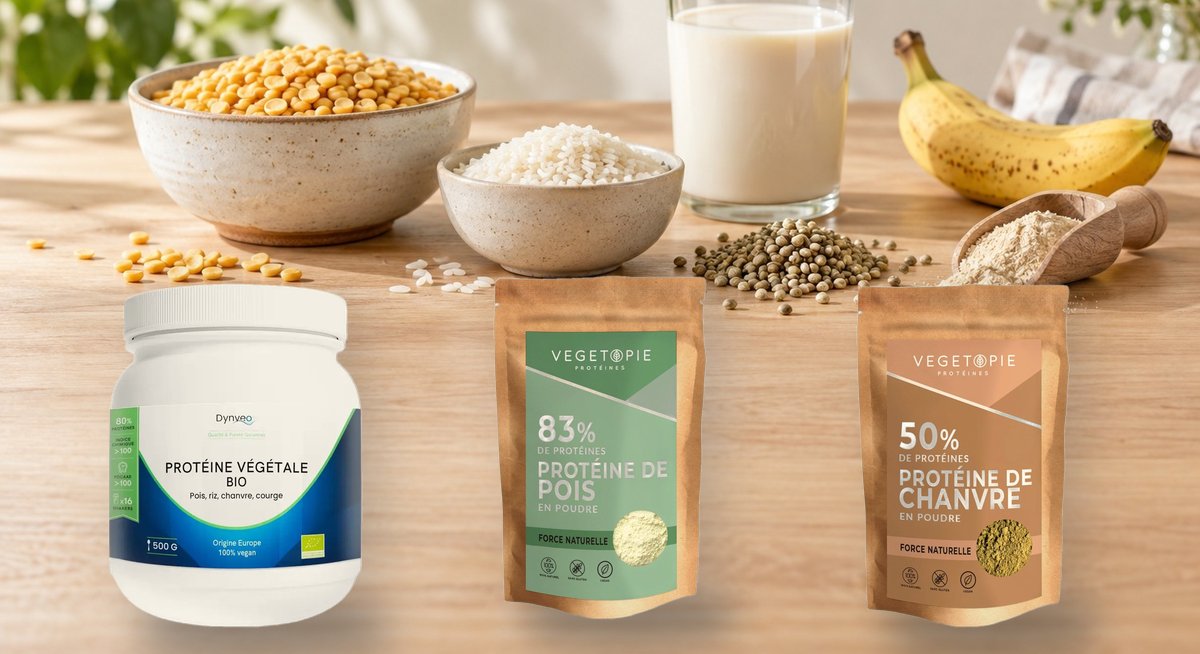
Yellow pea (Pisum sativum) is the most widespread plant-based protein. The protein fraction is extracted to obtain a fine isolate, with a mild taste. Vegetopie’s organic pea protein states at least 80% protein. It is dried at low temperature, without solvents, and contains only one ingredient: organic pea isolate. It is gluten-free, soy-free and lactose-free.
Its strength: lysine, an amino acid that pea provides in good quantity. Its weakness: methionine, lower in pea. That’s why it’s often paired with another source. The product page recommends 20 to 30 g per day, i.e. two tablespoons, in a shaker, a smoothie or yoghurt.
Rice: rarely alone, often paired
Rice has the opposite profile to pea: more methionine, less lysine. That’s why, in our range, it’s only found blended, paired with pea.
The simplest pairing is Nutripure’s Organic Plant Protein: 70% pea protein and 30% rice protein, both organic, with nothing else in the neutral version, no flavouring and no sweetener. A 30 g serving provides 24 g of protein. Like the whole Nutripure range, it is available in our shop only, with no delivery. One detail worth knowing: the powder contains 1.7 g of salt per 100 g, a common feature of plant-based isolates.
Blends of several sources
Some brands go further and combine three or four sources. Dynveo’s organic plant-based proteins bring together pea, rice, pumpkin and hemp, all organic and of European origin. The powder is 80% protein and the label states 14.2 g of BCAAs per 100 g, including 6.5 g of leucine. The taste is neutral, which allows it to be used in both sweet and savoury recipes.
The recommended dose is 30 g in 250 ml of water, a plant-based drink or a smoothie. The 500 g pouch gives around 16 servings; if you take it every day, there’s also a 1 kg size, giving around 33 servings.
And hemp?
Vegetopie’s organic hemp protein is a different case altogether. It is not an isolate: the seeds are cold-pressed to extract the oil, then the remaining cake is finely ground. The result is a powder that is 50% protein, which retains its fibre (around 10 g per 100 g), part of its fats with omega-3 and omega-6, and its minerals.
It’s chosen less for its protein quantity than for its whole-food character. Its vegetal, slightly nutty taste is more noticeable in a glass of water; with a banana, cacao or red fruits, it blends in very well. The product page recommends 15 to 30 g per day.
How to choose, in practice
At the counter, we generally ask four questions:
- Looking for the most protein per scoop? A pea isolate or a blend at 80% or more.
- Want the shortest ingredient list? Pea alone, or the pea-and-rice pairing in the neutral version.
- Mostly using it in cooking? A neutral taste, which blends into pancakes, porridge or soup.
- Looking for a whole food rather than a concentrate? Hemp, with its fibre and fatty acids.
If you’re torn between a plant-based protein and a whey, our article on which whey to choose explains the differences on the dairy side. And the whole of our protein powders, animal and plant-based, are found in the protein range.
Frequently asked questions
Does plant-based protein taste bad?
The neutral versions have a mild pea taste when drunk in water. In a plant-based milk, a smoothie or a recipe, it becomes faint. Hemp has a more noticeable vegetal, slightly nutty taste.
Should pea and rice be combined yourself?
It’s not required. Ready-made blends do it for you, in fixed proportions. If you already have a pea protein, you can also vary your sources throughout the rest of the day.
Can a plant-based protein powder be cooked?
Yes, the product pages suggest pancakes, crêpes, porridge or muffins. Mix the powder with the dry ingredients before adding the liquid, to avoid lumps.
How long does an opened pouch keep?
Close it well and keep it dry, away from heat and light. Use a dry scoop each time. If pregnant or under special medical supervision, ask your doctor for advice.
The simplest way is to compare the pouches in person: we’re waiting for you at 10 rue Théophile Roussel, just steps from Ledru-Rollin metro station, Tuesday to Saturday, 9:30am to 6:30pm.