
The Herba Barona blog › Actualités
Shilajit Resin or Capsules: Which Should You Choose?
This is THE question customers ask us in store, sometimes even before saying hello: “resin or capsules?” And the honest answer is: it depends on you. Not on the product — on you. Both come from the same raw material, that mineral exudate harvested at altitude in the Himalayas. But day to day, the experience is completely different. Let us explain it the way we would in the shop.
Resin is the original form
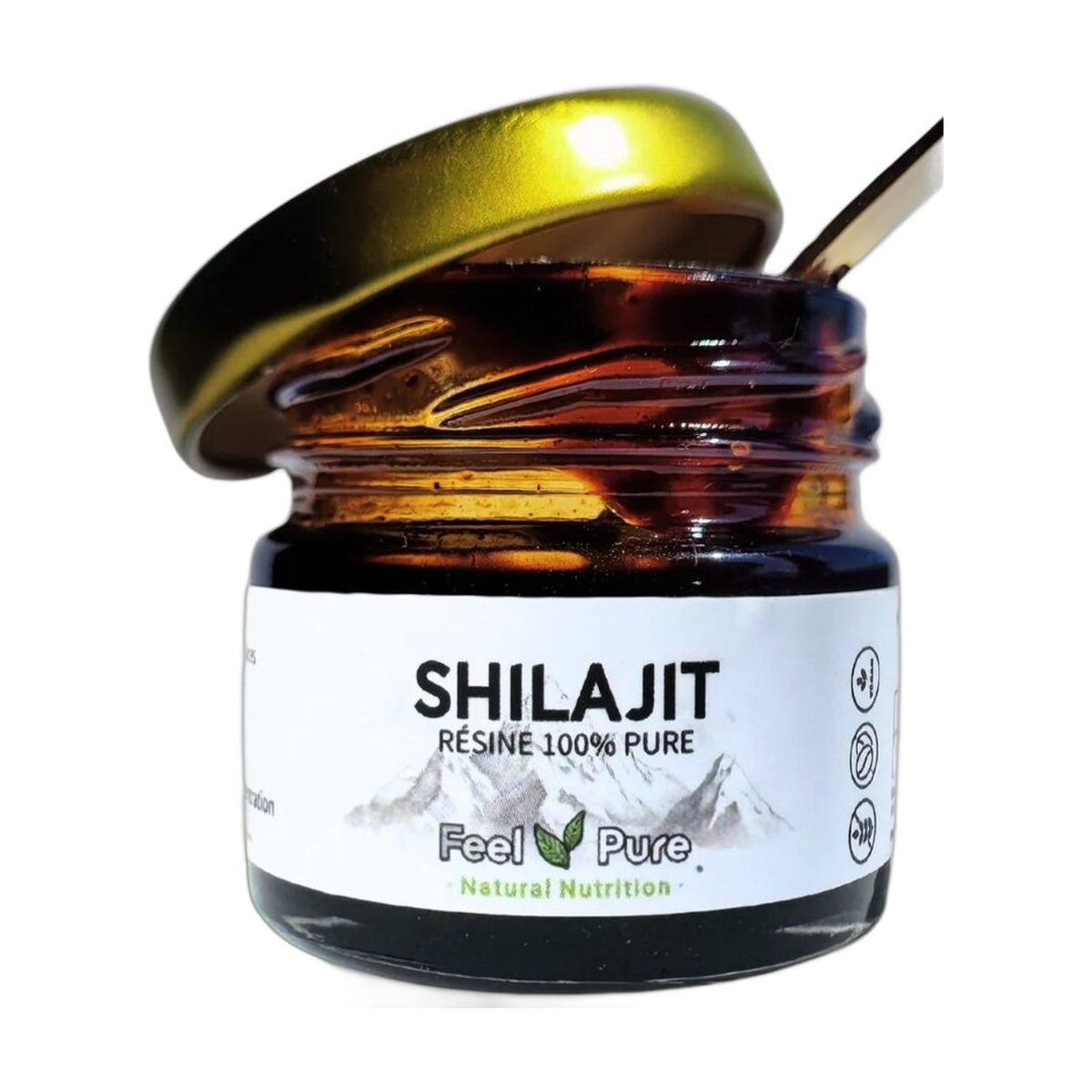
The Feel Pure resin we carry in store — 75% fulvic acid.
Open the jar: a black, glossy paste, with a mineral smell you won’t forget. Some people love it, others pull a face. That’s actually the first real selection criterion, and nobody likes to admit it: taste. Strong, bitter, earthy. It won’t suit everyone, so it’s best to know that before buying.
What resin has going for it, on the other hand, is substance. First, concentration: ours test between 75 and 79% fulvic acid, the reference marker for shilajit. Second — and this is a point we repeat often in store — resin can’t hide anything from you. Its colour, texture, smell: a mediocre product shows itself immediately. A powder sealed inside a capsule shows nothing at all.
The ritual itself comes from Ayurvedic tradition: a portion the size of a grain of rice, dissolved in warm water or a warm drink — never boiling. A small morning ritual. It takes two or three days to get the hang of it, then it becomes second nature.
Capsules mean convenience

The same shilajit, dried and encapsulated — 70% fulvic acid, zero taste.
No taste, no preparation, the same dose every day. The pill organiser follows you to the office, on a trip, to the gym. Plenty of customers who had given up on resin “because of the taste” stick to their routine easily with capsules — and a routine you actually keep is always better than a perfect one you abandon.
The trade-off? You have to trust the label, since you can’t see the raw material. Hence our rule in store: only capsules with a published fulvic acid level — ours state 70% fulvic acid — backed by purity testing, heavy metals included. And per gram, capsules cost a little more than resin. That’s the price of convenience.
Head to head, at a glance
| Criterion | Resin | Capsules |
|---|---|---|
| Fulvic acid | up to 79% | up to 70% |
| Taste | strong, mineral | none |
| Ease of use | small ritual | instant |
| Visual check | full 👀 | not possible |
| Portability | average | excellent 🎒 |
| Price per gram | gentler | a bit higher |
The morning ritual, in pictures
So, which one should you pick?
Here’s what we really see in store, after years of selling shilajit: there are two kinds of customers. Those who want the full experience — the texture, the ritual, maximum concentration — who go for Feel Pure resin at 75% or SIHO at 79%. And those who want it to fit into life without changing anything — for them, Feel Pure capsules or SIHO chilagite do the job perfectly.
There are also the clever ones who take both: resin at home, capsules on the go. Honestly, that’s not a bad idea at all.
Questions we’re often asked
1Can I switch between resin and capsules?
Yes, no problem at all: it’s the same substance in two forms. In fact, quite a few of our regulars do exactly that.
2Is resin “stronger” than capsules?
At an equivalent fulvic acid level, the form mainly changes the user experience. What matters is the fulvic acid concentration and the quality of the raw material — not the format.
3How should resin be stored?
Keep the jar tightly closed, away from heat and humidity. Its texture changes with room temperature — firmer in winter, softer in summer. That’s normal and doesn’t affect the product.
Want to see both forms side by side before choosing? Come visit us at Herba Barona, in Paris — we’ll open the demonstration jars, compare them together, and you’ll leave with what fits your daily life. To go further: our shilajit comparison guide and the shilajit category page.