
Home › Podcast › The photograph from twenty years ago
The photograph from twenty years ago
Episode in French. The full text can be read below in English.
The text of the episode
Welcome to Herba Barona, a food supplements shop in Paris. Every episode tells a story we know badly, and you leave with one thing to remember. Today our series on mitochondria continues with the subject nobody likes to look at squarely: the passing of time.
The mirror experiment
Try the experiment. Take out a photograph of yourself from twenty years ago. Look at it. Then look at yourself in a mirror.
What exactly has changed? The skin, a little. The features, a little. Nothing spectacular from one year to the next — and yet, added end to end, something has happened. That something has a name you know well, but not in the place you would expect it: rust.
Rust
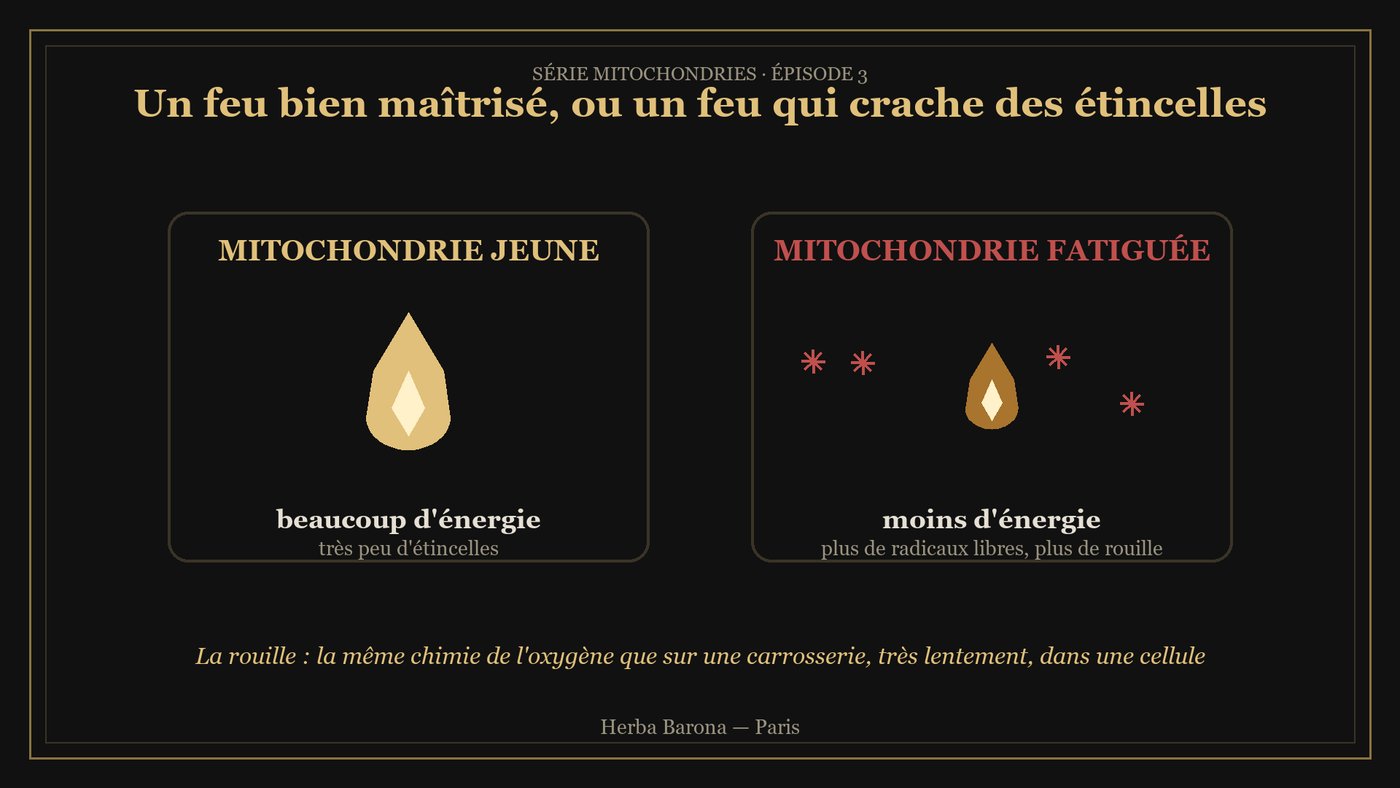
Yes, rust. The same chemistry that eats away at a car body eats away, very slowly, at a cell. The culprit is the same: oxygen. We need it to live, but it is a brutal partner — it tears electrons off everything it meets. When it runs wild, it produces what we call free radicals: unstable molecules that damage everything in their path, including our precious genetic recipes. Researchers have in fact run the experiment: mice raised in oxygen-enriched air age noticeably faster. Too much fire in the fireplace, and it is the house that burns.
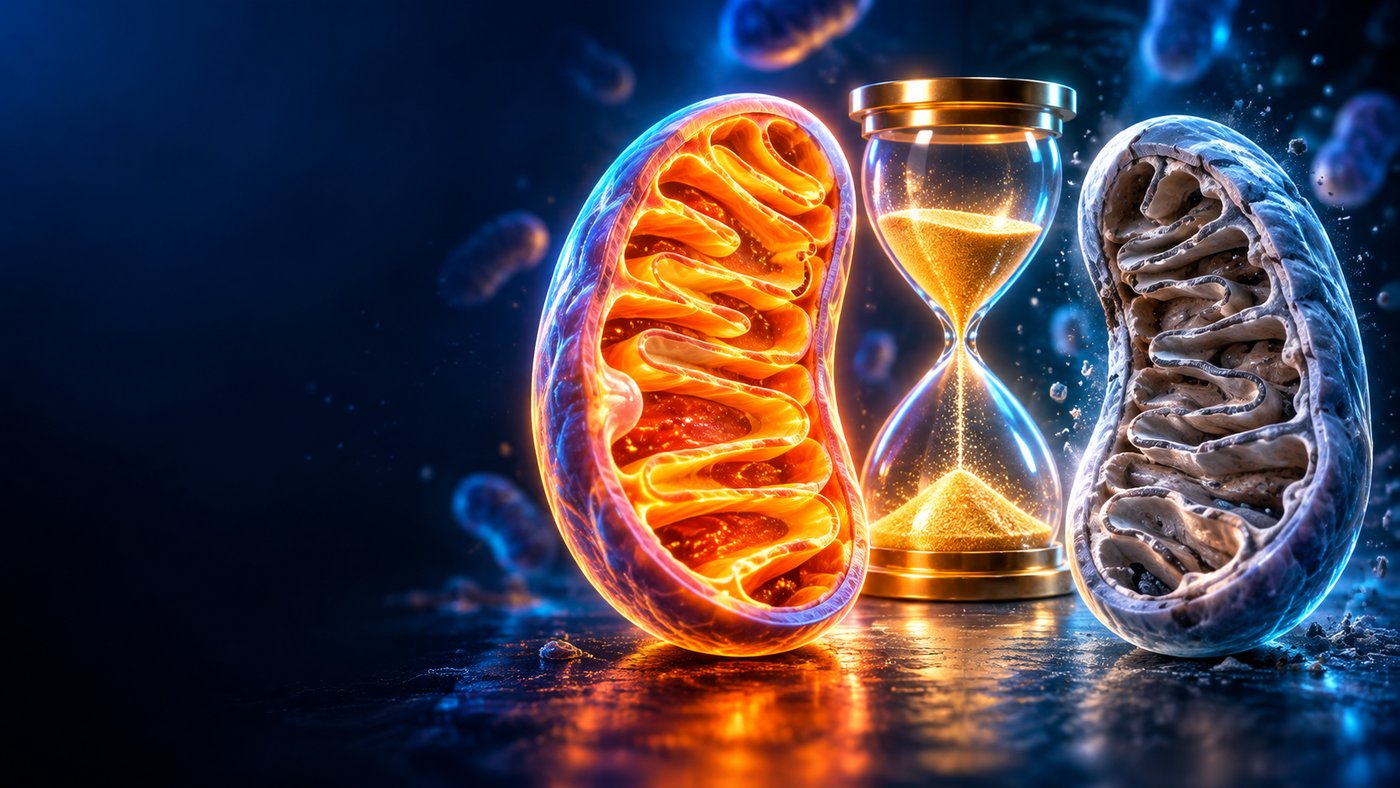
Now, where does most of this chemistry of fire take place? In the mitochondria, the power plants of our cells. That is where oxygen is used, tamed, turned into energy. A young mitochondrion in good shape is a well-controlled fire: plenty of energy, very few sparks. A tired mitochondrion is the opposite: less energy… and more sparks. More free radicals. More rust.
All roads lead to the mitochondria
And this is where the science of ageing made a fascinating discovery. One scientific paper summed it up in a title that became famous: "Ageing: all roads lead to the mitochondria." Whichever theory you pull on — wear and tear on the genes, inflammation, the build-up of waste — when you follow the thread, you always land back on them.
Mitophagy
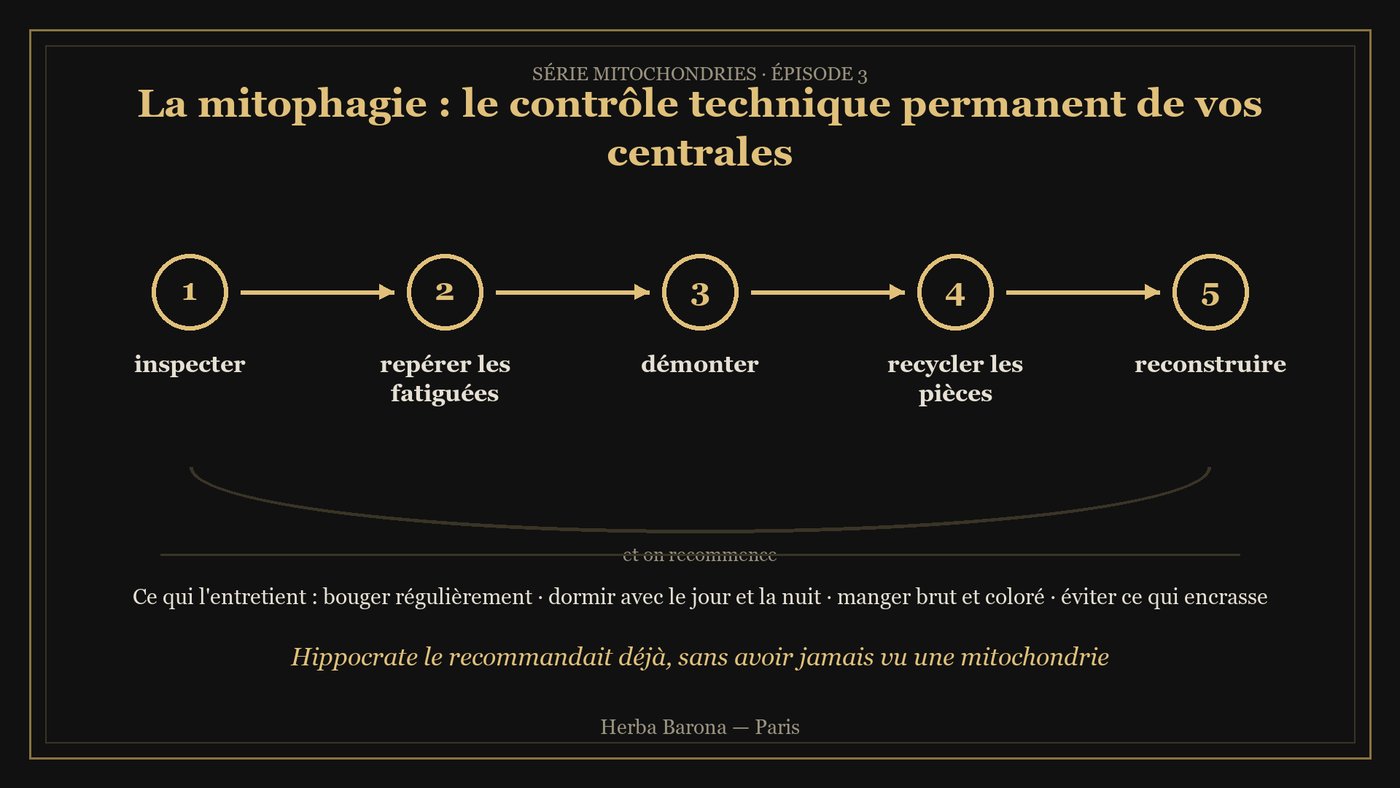
But the body did not stay defenceless. It invented a system of wild elegance: mitophagy. Literally, "eating the mitochondria". At regular intervals, the cell inspects its fleet of power plants, spots the most tired ones — those throwing out more sparks than energy — dismantles them, recycles the parts, and builds new ones. A permanent safety inspection, with scrapyard and factory built in.
What keeps the sorting going
Ageing well, in the end, would mostly be that: keeping that sorting active. And what keeps it going is nothing mysterious — it is in fact disarmingly ordinary. Regular physical activity, which stimulates renewal. Sleep, lined up with day and night, the way it was before screens. A plate of raw, unprocessed produce, with real colours in it. And as little as possible of what clogs things up: tobacco, excess, pollutants when they can be avoided.
Hippocrates, two thousand four hundred years ago, was already recommending all of that, without ever having seen a mitochondrion.
The photograph from twenty years ago is not coming back. But the one from twenty years' time has not been taken yet.
That was an episode of the Herba Barona podcast, recorded in Paris. See you soon.