Home › Podcast › The molecule discovered in a beef heart
The molecule discovered in a beef heart
Episode in French. The full text can be read below in English.
The text of the episode
Welcome to Herba Barona, a food supplements shop in Paris. Every episode tells the story of a product we know badly, and you leave with one thing to remember. Today: coenzyme Q ten.
1957, University of Wisconsin
Nineteen fifty-seven. University of Wisconsin, United States. A researcher named Frederick Crane spends his days bent over beef hearts.
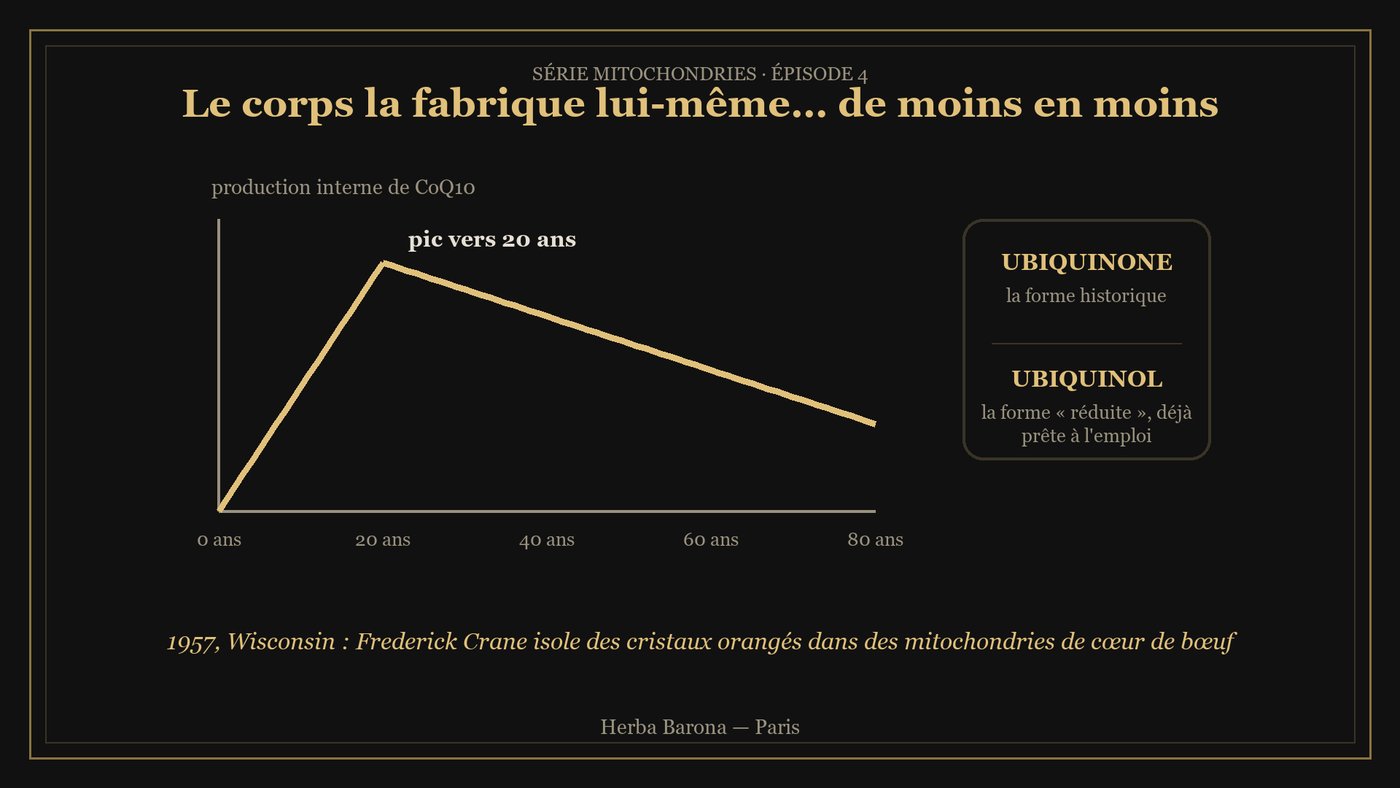
This is not a butcher's whim. Crane studies energy, and he knows the heart is the most energy-hungry organ there is — a muscle that beats without a pause, from birth to the last breath. If there is a key molecule of energy, that is where it will be hiding. And one day, in his extracts of beef-heart mitochondria, he isolates small orange-yellow crystals. An unknown substance.
Ubiquinone, present everywhere
It will be given a scholar's name: ubiquinone. From "ubiquitous" — present everywhere. Because it will soon become clear: this molecule is in every one of your cells, without exception. You know it by its stage name: coenzyme Q ten.
The ferryman of the power plant
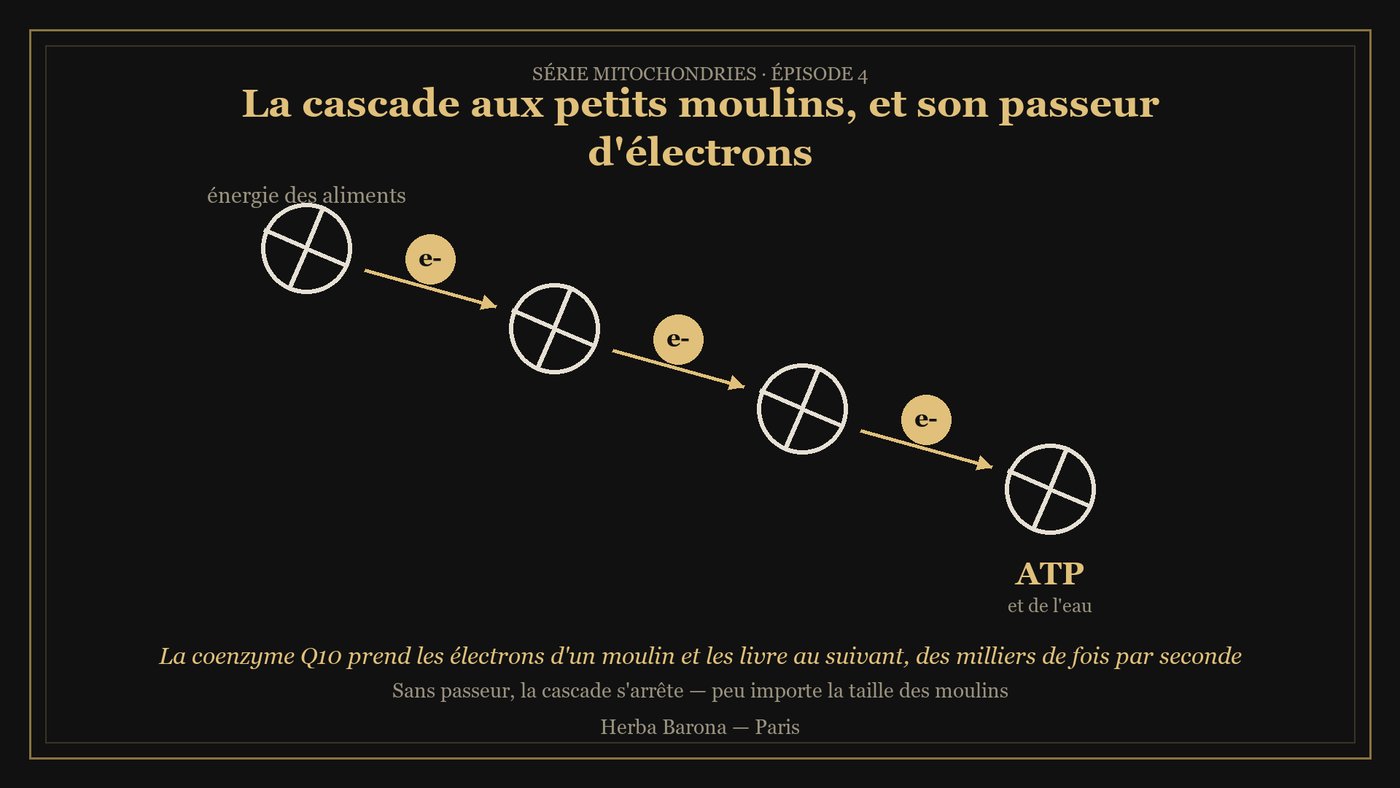
So what does this molecule do? Remember the cascade of little mills — that chain, inside the mitochondria, where the energy from food comes down step by step to become ATP, the body's energy currency. Between the mills, somebody has to carry the electrons across. That carrier is her. Coenzyme Q ten is the ferryman of the power plant: she takes the electrons on one side, delivers them on the other, and starts again, thousands of times a second. Without a ferryman, the cascade stops — no matter how big the mills are.
And that is not her only talent. Between two deliveries, coenzyme Q ten also plays firefighter: she is an antioxidant, one of those that put out the famous sparks — the free radicals — that any running power plant inevitably produces.
A production that declines
The most interesting part is that your body knows how to make her itself. It has never needed to find her on the plate: it produces her, cell by cell, according to its needs. But there is a "but". That internal production follows a curve nobody likes to look at: it peaks around the age of twenty… then declines, quietly, decade after decade. An older person's heart contains distinctly less coenzyme Q ten than that of a young adult. The power plant is still there. It is the ferryman who has become scarce.
Ubiquinone or ubiquinol
That is what has made this molecule so popular in the world of food supplements: it comes in a version called ubiquinone, the historical form, and in a ubiquinol version, its so-called "reduced" form, already ready to use. Two faces of the same molecule, the one from those orange crystals in Wisconsin.
Seventy years almost to the day after its discovery, coenzyme Q ten is probably the most famous of the mitochondrial molecules. Not bad, for a substance dug out of a beef heart.
Which goes to show that the great energy stories rarely begin where you expect them to.
That was an episode of the Herba Barona podcast, recorded in Paris. See you soon.