
Home › Podcast › Hitting the wall in the marathon
Hitting the wall in the marathon
Episode in French. The full text can be read below in English.

The text of the episode
Welcome to Herba Barona, a food supplements shop in Paris. Every episode tells a story we know badly, and you leave with one thing to remember. Today, our series on mitochondria continues: sport. And a story every runner knows.
The thirtieth kilometre
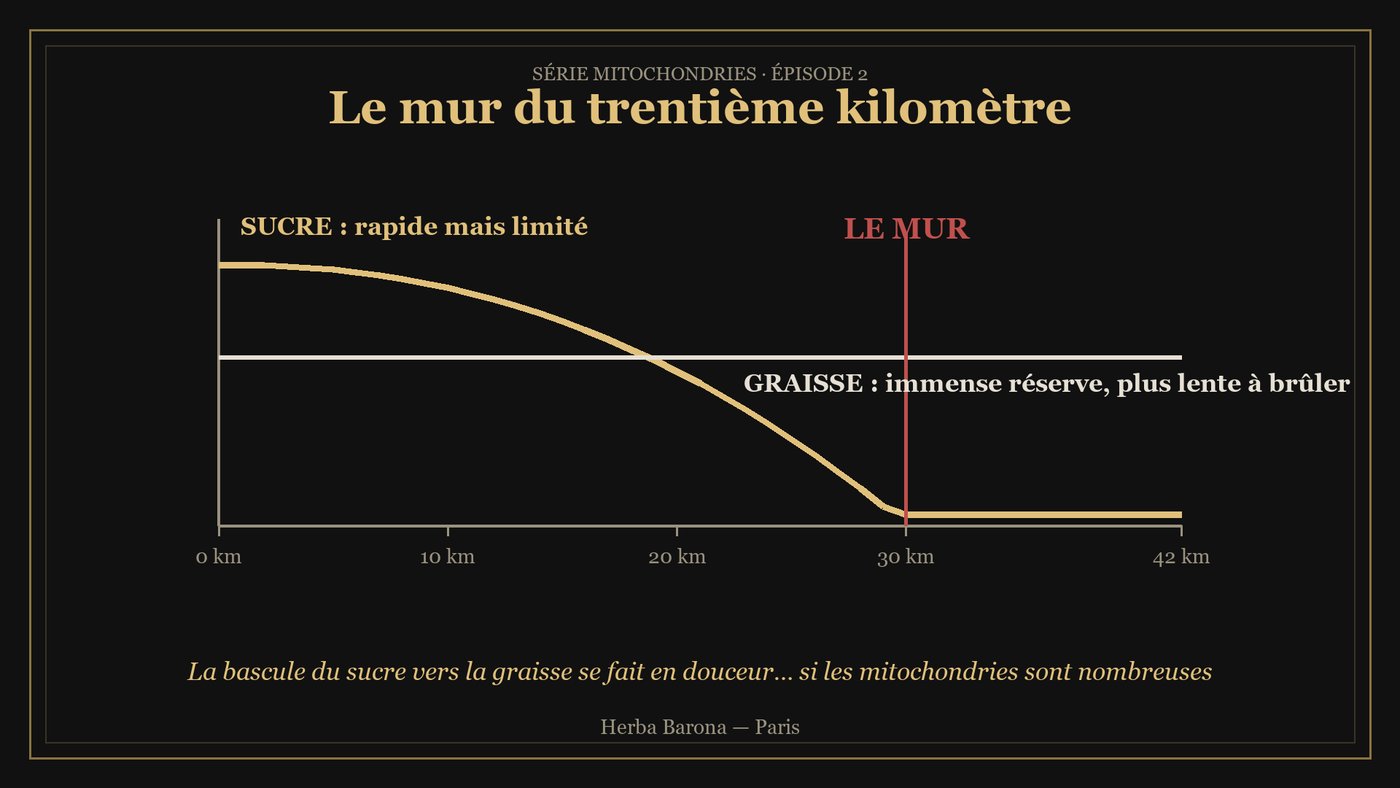
Every marathon runner knows it. It arrives around the thirtieth kilometre. They call it "the wall".
A runner who was doing fine, steady stride, clear head, and suddenly, within a few hundred metres, the legs turn to concrete, the brain goes into fog, every step becomes a negotiation. This is not ordinary tiredness. It is a breakdown. A fuel breakdown.
And to understand what is happening, you have to go down into the muscle, all the way to the power plants of the cell: the mitochondria.
Two fuels
A working muscle is a consumer of ATP, the body's energy currency. When you move your arm, you spend billions of ATP molecules. And ATP cannot be stored: it has to be made continuously, at the very moment it is spent. The mitochondria take care of that, with two main fuels: sugar, fast but limited — and fat, an enormous reserve, but slower to burn.
Hitting the wall is the moment when the sugar stores run out and the body has to switch over to fat. In a poorly prepared runner, the switch goes badly. In a trained runner, it goes smoothly. The difference between the two? In large part… the number and the quality of their mitochondria.
Mitochondrial biogenesis
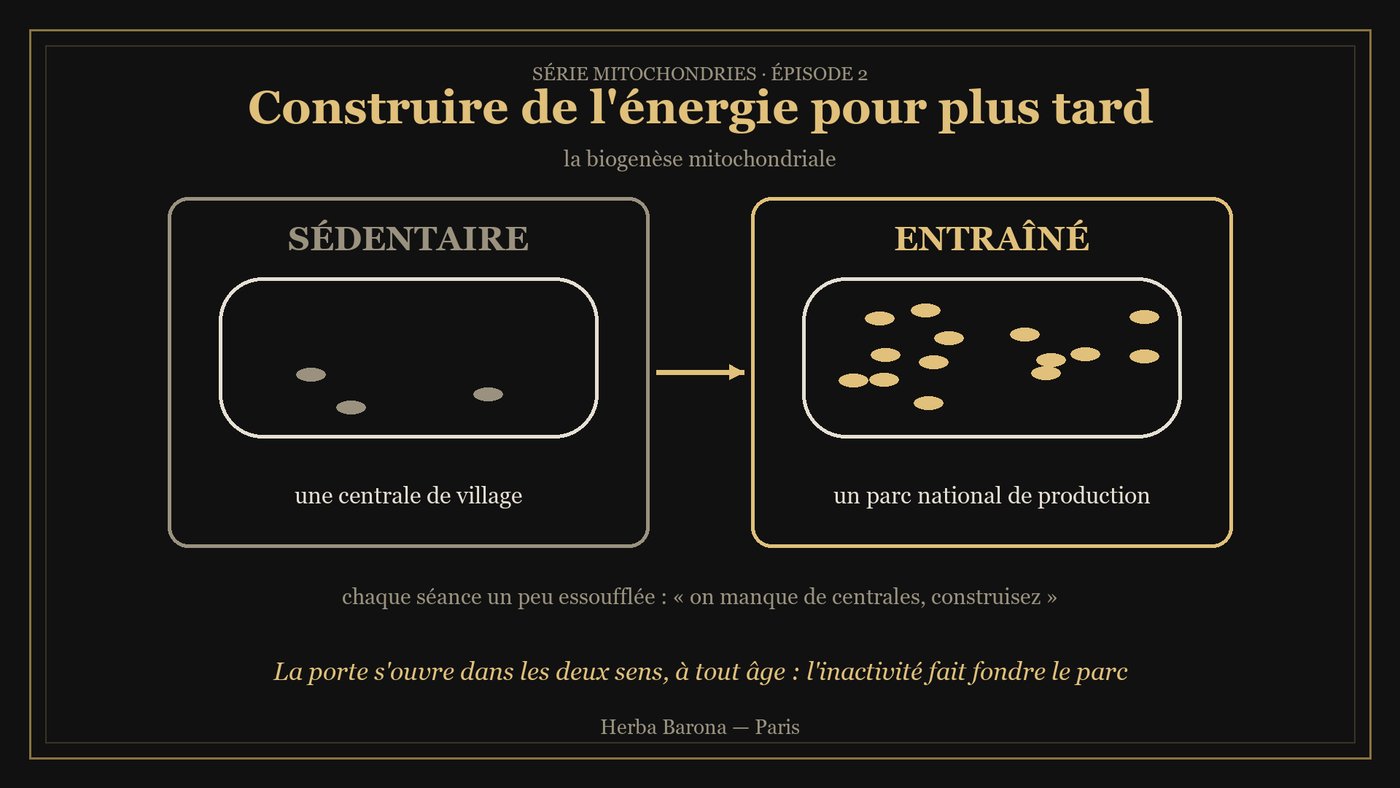
Because that is the best-kept secret of endurance: training does not only build muscle. It pushes your muscle cells to build new mitochondria. The phenomenon has a magnificent name: mitochondrial biogenesis. Literally, the birth of new power plants. Every slightly long outing, every session where you are a little out of breath but still able to hold on, sends the same message to your muscles: "We are short of power plants. Build." And the muscle obeys. An endurance athlete can have, in the very same muscle fibres, a density of mitochondria far higher than that of a sedentary person.
That is why a beginner suffers where a regular is out for a stroll. It is not a question of willpower. One is running on a village power station, the other on a national grid of production.
It works both ways
And the reverse is true too. Inactivity melts that grid away. A few weeks of complete rest, and the plants are dismantled — the body does not keep what it does not use. The good news is that the door swings both ways, at any age: brisk walking, cycling, swimming, taking the stairs… anything that leaves you slightly out of breath, regularly, restarts the building work.
In the end, endurance sport may be the only human activity where you literally build energy for later.
The wall at the thirtieth kilometre has not moved. But the bigger your fleet of power plants… the further back the wall goes.
That was an episode of the Herba Barona podcast, recorded in Paris. See you soon.