
Le blog Herba Barona › Sem categoria
Phycocyanin: liquid, capsules or powder, how to choose
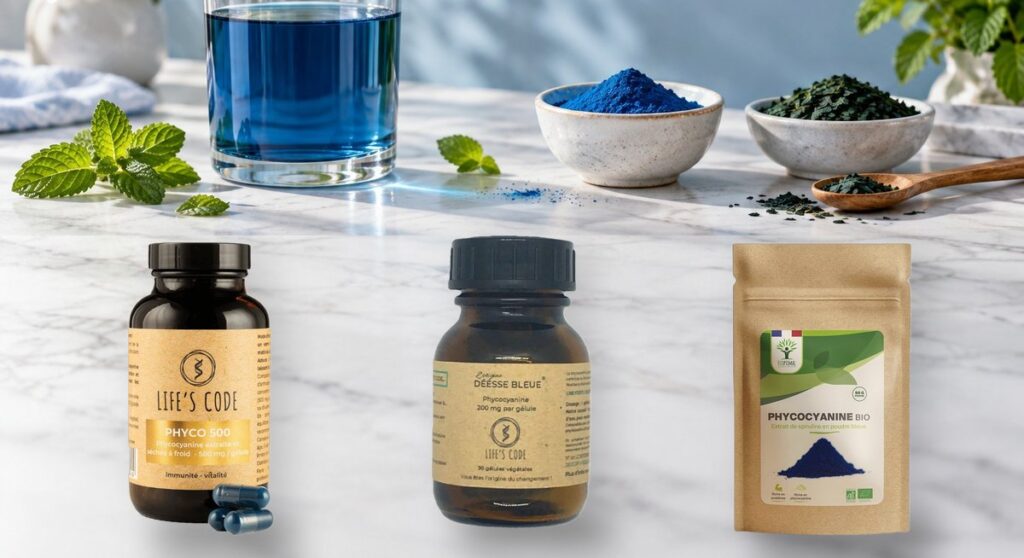
Phycocyanin first intrigues through its colour: an intense, almost surreal blue, not what you’d expect from a food supplement. Then comes the practical question: should you take it as a liquid, in capsules or as a powder, and how do you know if it’s good quality? This question comes up regularly in the shop, often from people who already take spirulina. All our products are gathered on the phycocyanin in Paris page.
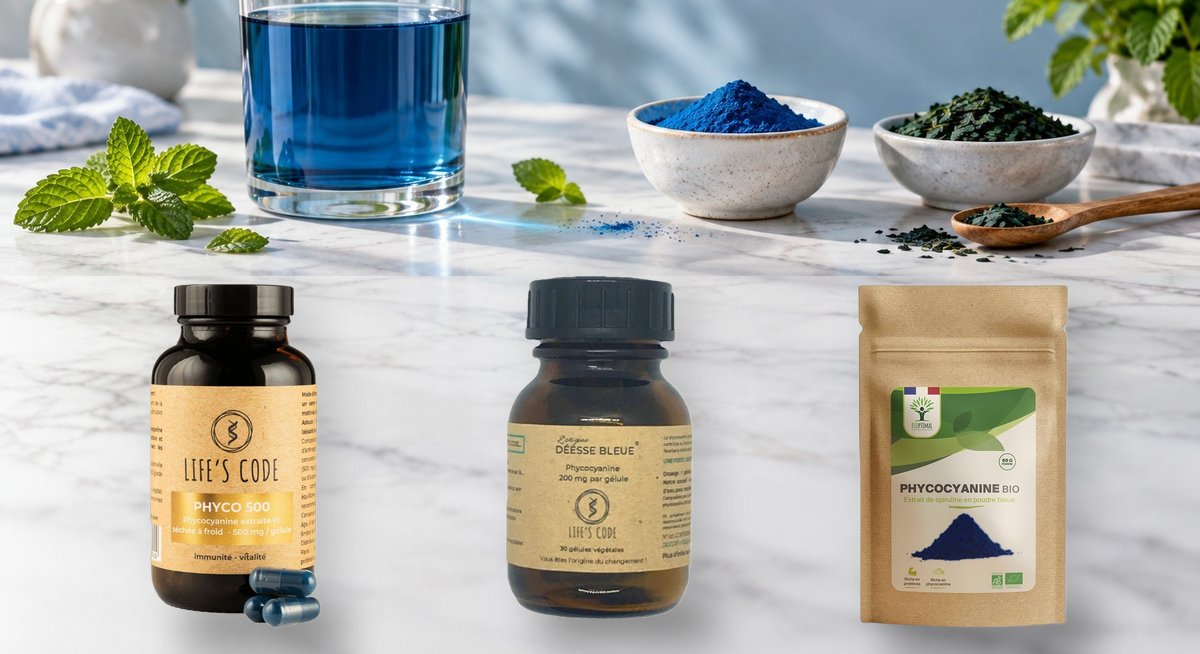
Phycocyanin, the blue of spirulina
Spirulina (Arthrospira platensis) is a green micro-algae, or more precisely a cyanobacterium. Its green colour actually hides two pigments: chlorophyll, green, and phycocyanin, blue. The latter is both a pigment and a protein, which spirulina uses to capture light.
To obtain phycocyanin, you start from spirulina and extract the blue fraction, which is then concentrated. It’s no longer a whole food like whole spirulina, but a targeted extract. This should be known: no medical claim is currently authorised for phycocyanin in the European Union. We present it for what it is, a natural pigment from spirulina, pure and concentrated.
Liquid, capsules or powder: the three forms on the market
Liquid is the best-known form among the general public: a bottle, a few millilitres in a glass of water. It generally needs to be kept cool once opened, and the concentration varies widely from brand to brand. We don’t currently carry it: we chose dry forms instead, which are more stable.
Capsules contain a dried phycocyanin, often freeze-dried. No taste, no bottle to keep in the fridge, a precise dose. Life’s Code’s Phycocyanin 200 mg provides 200 mg per capsule, extracted and cold-dried, in a plant-based pullulan capsule. The same formula comes in 30 and 90 capsules: only the amount changes.
Powder is dosed by the spoonful and mixed into a drink or a recipe. Bioptimal’s organic blue spirulina powder is a water-based spirulina extract standardised to at least 55% phycocyanin: half a teaspoon, or 1.5 g, provides at least 825 mg. It has no excipient, and also works as a natural food colouring in cooking.
How to read a phycocyanin label
The figures shown don’t all mean the same thing. Here’s what we look at with you at the counter:
- The amount of phycocyanin per dose, in milligrams, not just the weight of the capsule or powder.
- The standardisation, in the case of a spirulina extract: it states the actual share of phycocyanin in the powder.
- The purity index, sometimes noted A616/A278. This is a ratio measured in a laboratory between phycocyanin and the other proteins in the extract: the higher it is, the purer the extract. Phyco-500 states an index of 2.82.
- The drying method: phycocyanin is a protein that’s fragile under heat, hence the value of cold extraction and drying.
200 mg or 500 mg capsules?
Both our capsule products come from the same lab, Life’s Code, but aren’t aimed at the same use. Phycocyanin 200 mg is the entry point: one capsule a day, a 30-capsule size for a first month, then the 90 if it suits you. This is in fact the advice given on the product page: don’t buy three months’ worth of a product you’ve never tried.
Phyco-500 concentrates 500 mg of freeze-dried phycocyanin per capsule, using a process called Phyco-Lyo, with no additive. It’s the choice for those who want a stronger dose in a single capsule. The bottle of 30 capsules covers one month at one capsule a day.
How to take it day to day
Capsules are swallowed with a glass of water, preferably before breakfast or lunch, as stated on Phyco-500’s product page. The same product page gives a tip: open the capsule and pour its contents into a glass of water to see the blue appear.
For the powder, mix it into a cold or lukewarm drink, a smoothie, a yoghurt, a plant-based milk. Avoid boiling water and long cooking: heat damages the protein, and the blue turns dull. Life’s Code’s product page actually uses this as a marker: a well-extracted, well-dried phycocyanin gives a deep blue.
If pregnant, breastfeeding or undergoing treatment, ask your doctor or pharmacist for advice before starting.
Phycocyanin or whole spirulina?
The two don’t replace each other. Whole spirulina is a complete food, rich in protein, taken as tablets, flakes or powder. Phycocyanin keeps only a fraction of it, concentrated. In our Paris 12th shop, we often recommend starting with spirulina and adding phycocyanin afterwards. To choose the former well, read our article on French spirulina, or browse our spirulina, chlorella and Klamath range.
Frequently asked questions
Does phycocyanin have a taste?
None in capsules. Bioptimal’s powder is described as having no pronounced taste or smell, which allows it to be slipped into almost any recipe.
Why does phycocyanin cost more than spirulina?
Because a large amount of spirulina is needed to extract a small amount of blue pigment, then dry it without damaging it.
Can it be put in a hot drink?
Better to avoid it. Phycocyanin is a heat-sensitive protein: a cold or lukewarm drink preserves it.
How should the powder be stored?
In its tightly closed pouch, dry and away from light. A damp spoon in the pouch is enough to cause clumping.
Want to see the difference between the powder and the capsules? The shop is waiting for you on rue Théophile Roussel, Tuesday to Saturday, 9:30am to 6:30pm.