
Le blog Herba Barona › Sem categoria
Sea buckthorn and omega-7: oil, capsules, how to use them
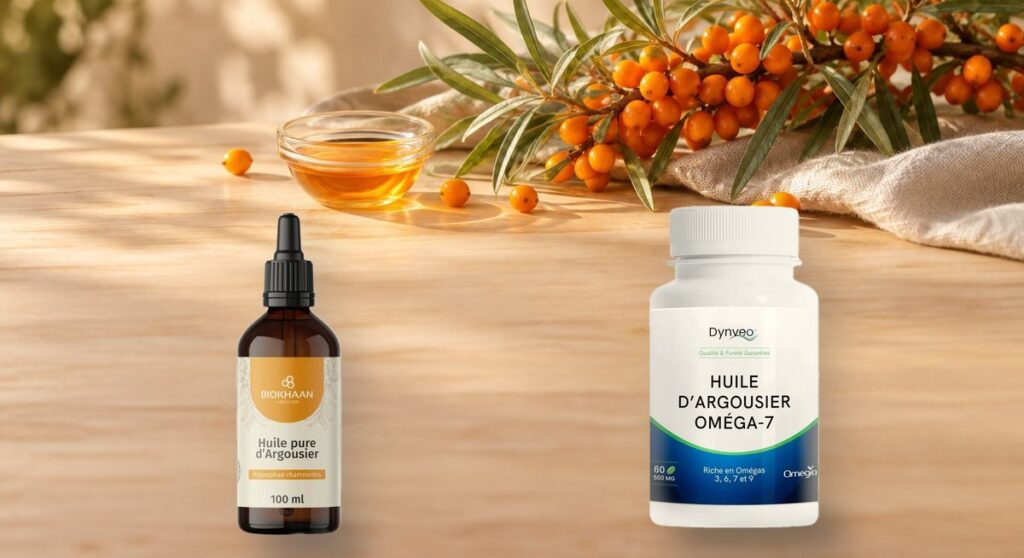
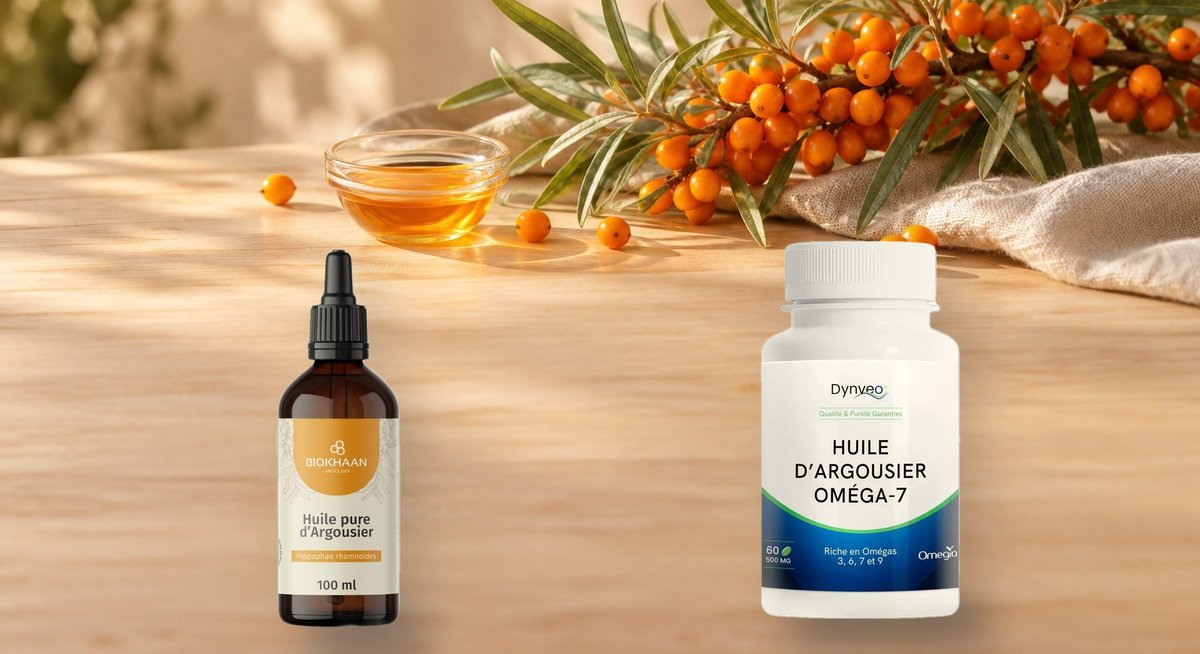
Many people discover sea buckthorn through its oil, a deep orange colour, or through the word “omega-7” read on a box of capsules. And the first question is often the same: bottled oil or capsules, is it the same thing? Not quite, and the choice mainly depends on how you’ll use it. Here are the pointers we give at the counter. All our products are gathered on the sea buckthorn oil and omega-7 in Paris page.
Sea buckthorn, a shrub from cold climates
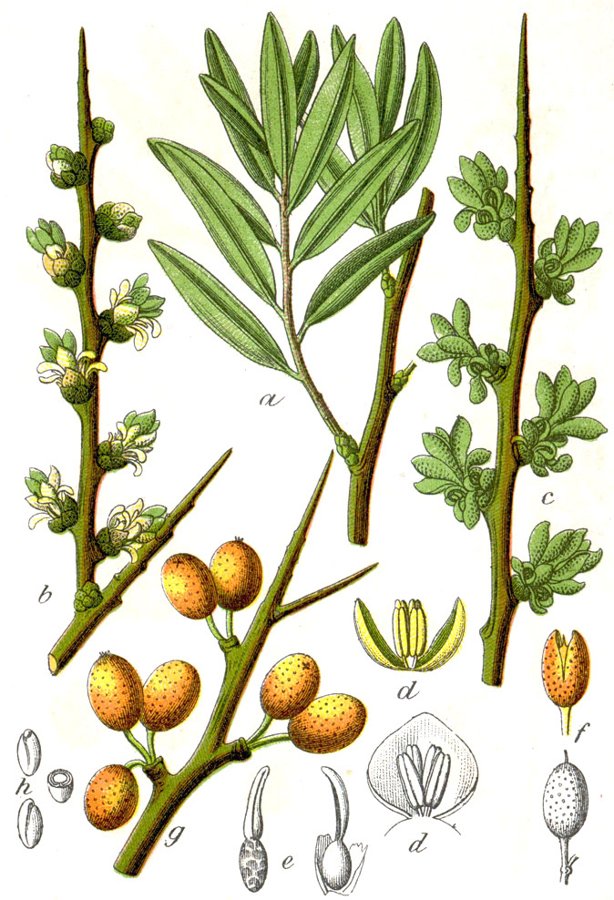
Sea buckthorn (Hippophae rhamnoides) is a thorny shrub native to Central Asia, widespread in Mongolia, Siberia and the Himalayan regions. It produces small orange berries, tightly packed along its branches, harvested when ripe. Traditional Mongolian and Tibetan medicine have used it for centuries.
The oil extracted from it has a very distinctive red-orange colour, due to its high carotenoid content. It stands out above all for a fatty acid found in few plant oils: palmitoleic acid, also known as omega-7. It is uncommon in everyday food, which explains the interest in sea buckthorn.
Bottled oil: mainly for the skin
Biokhaan’s organic sea buckthorn vegetable oil is a 100% pure oil, obtained by first cold pressing of the berries, sold in a 100 ml glass bottle that protects it from light. It contains no preservative, additive or carrageenan.
It is mainly used topically. The product page suggests several uses:
- A few drops on the face or body, on dry areas.
- As a serum, before your day or night cream.
- Mixed into a massage oil or a homemade cosmetic preparation.
- In the evening, after a day spent in the sun.
A practical tip: its colour is intense. A few drops are enough, and it should be well absorbed before getting dressed. The product page also mentions oral use, a few drops in a glass of water or in a smoothie, following the manufacturer’s recommendations.
Capsules: for a measured dose
If you’re looking for sea buckthorn for daily intake, capsules are simpler: the dose is fixed and you don’t taste it. Dynveo’s sea buckthorn omega-7 oil uses an organic Omegia oil, from the fruit and seeds, extracted with supercritical CO₂ and enclosed in tapioca-based plant capsules, with no carrageenan.
The label is detailed. For four capsules, i.e. 2,000 mg of oil, it states at least 30% omega-7 (600 mg), 18% omega-9, 13% omega-3 and 10% omega-6, with 10 mg of vitamin E and 3 mg of beta-carotene. Vitamin E contributes to the protection of cells from oxidative stress.
The product page recommends one to four capsules a day, with meals. The 60-capsule size is good to start with; for use over several months, there’s a 180-capsule box.
How to read an omega-7 label
Not all sea buckthorn oils are equal on paper. Four lines allow for comparison:
The percentage of omega-7. This is the central piece of information. A good label states it both as a percentage and in milligrams per dose.
The part of the fruit used. The oil may come from the pulp, the seeds, or both. The fatty acid profile isn’t the same, which is why it’s worth looking for this detail: Dynveo’s capsules, for example, specify “fruit and seeds”.
The process. Cold pressing or supercritical CO₂: two gentle processes, with no chemical solvent.
Naturally present vitamins, vitamin E and carotenoids, when given a figure.
If you’re comparing with other fatty acids, our guide on omega-3 EPA, DHA, plant or marine explains the differences between families. And sea buckthorn also has a place in our beauty range.
Bottle or capsules: how to decide
At the counter, the question we ask is simple: what will you use it for? If it’s for the face, hands or a massage oil, the bottle is the obvious choice, since capsules are only for oral use. If it’s for regular intake, capsules save you from counting drops and tasting the oil. There’s nothing stopping you from having both: the bottle in the bathroom, the capsules in the kitchen, alongside your other morning supplements.
Precautions to know
Dynveo’s product page advises against the capsules for people on anticoagulant treatment, as well as for active smokers. Pregnant or breastfeeding women should ask their doctor’s advice before taking them. For the oil applied topically, do a patch test on a small area of skin before applying it to the face.
Frequently asked questions
Does sea buckthorn oil stain?
Its orange colour is very intense. Applied neat and in quantity, it can mark light-coloured fabric. Hence the rule: just a few drops, well massaged in.
Can the bottled oil be taken orally?
Biokhaan’s product page allows for this, at a rate of a few drops in a glass of water or in a drink. For a precise daily dose, capsules remain simpler.
What time should the capsules be taken?
With a meal, as the product page recommends. The time of day matters little, what matters is consistency.
How should the oil be stored?
In a cool place, away from light and heat, bottle tightly closed after each use.
Bottle or capsules, the simplest thing is to discuss it in front of the shelf: come to rue Théophile Roussel, in Paris 12th, Tuesday to Saturday, 9:30am to 6:30pm.