
The Herba Barona blog › Sem categoria
Which Vitamin D to Choose: D3, K2, Drops or Capsules
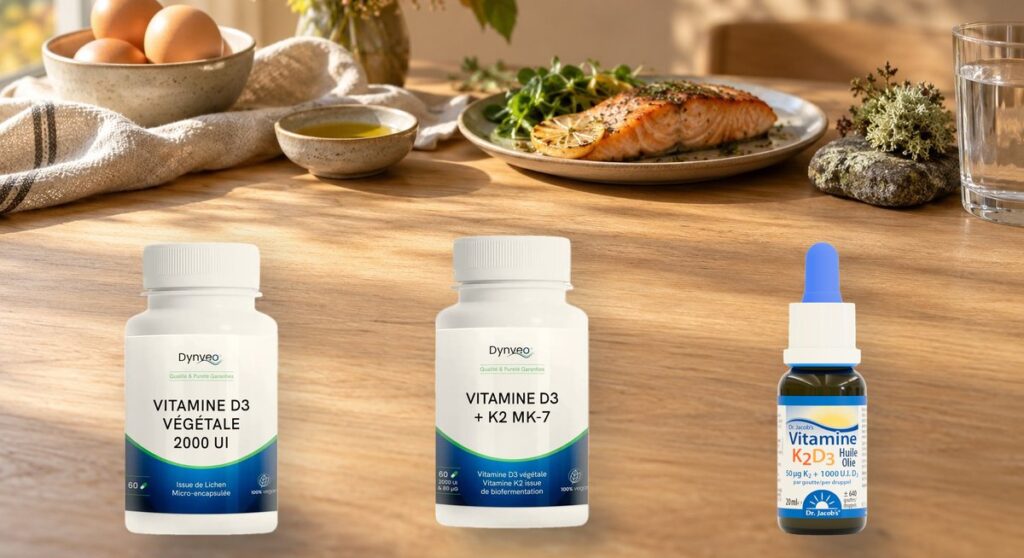
“Which one do I take?” In front of the vitamin D shelf, the question comes back every autumn, and we understand why: drops or capsules, D3 alone or with K2, lichen, algae or fish origin, doses written sometimes in IU, sometimes in µg. The labels look alike, yet the differences are real. At the counter, at Herba Barona in Paris’s 12th arrondissement, we sort it all out with four questions: origin, form, pairing with K2, and dose. All our products are gathered on our vitamin D3 in Paris page.
D3: the form found on the shelf, and its origins
Vitamin D in supplements comes in two forms, D2 (ergocalciferol) and D3 (cholecalciferol). All the products featured here are D3, the form the skin produces in sunlight. What changes from one bottle to another is the origin of that D3.
Most vitamin D3 on the market is derived from lanolin, the grease from sheep’s wool. For vegetarians and vegans, there are plant-based D3 options: extracted from lichen at Dynveo, extracted from algae at Novoma. Finally, the oldest route is still cod liver oil, which naturally provides vitamin D along with vitamin A.
As for its role, we stick to authorised claims: vitamin D contributes to the maintenance of normal bones, to the normal function of the immune system, and to the maintenance of normal muscle function.
Drops or capsules: mostly a matter of habit
Drops are vitamins dissolved in an oil. The Dr. Jacob’s Vitamin D3 K2 Forte provides 2,000 IU of D3 and K2 MK-7 in a coconut oil (MCT) base, once a day, with a meal. Drops are taken directly in the mouth or on a spoon: it’s the form we recommend to people who struggle to swallow capsules.
Capsules avoid counting drops. The Dynveo vegan vitamin D3 is extracted from lichen and micro-encapsulated: 50 µg (2,000 IU) per capsule, with a glass of water. According to the manufacturer’s data sheet, this micro-encapsulation makes it water-dispersible, which means it can be taken without a fatty meal.
Cod liver oil is taken by the spoonful. LYSI cod liver oil provides, per teaspoon, 10 µg of vitamin D, 250 µg of vitamin A and omega-3 EPA and DHA. It should be kept refrigerated after opening. It’s chosen as much for its omega-3 as for its vitamin D.
With or without vitamin K2?
K2 almost always comes up in the conversation. The two vitamins are often paired because they work on the same ground: vitamin D contributes to the normal absorption and utilisation of calcium and phosphorus, and vitamin K contributes to the maintenance of normal bones. On the label, look for the MK-7 form (menaquinone-7), a long chain taken just once a day.
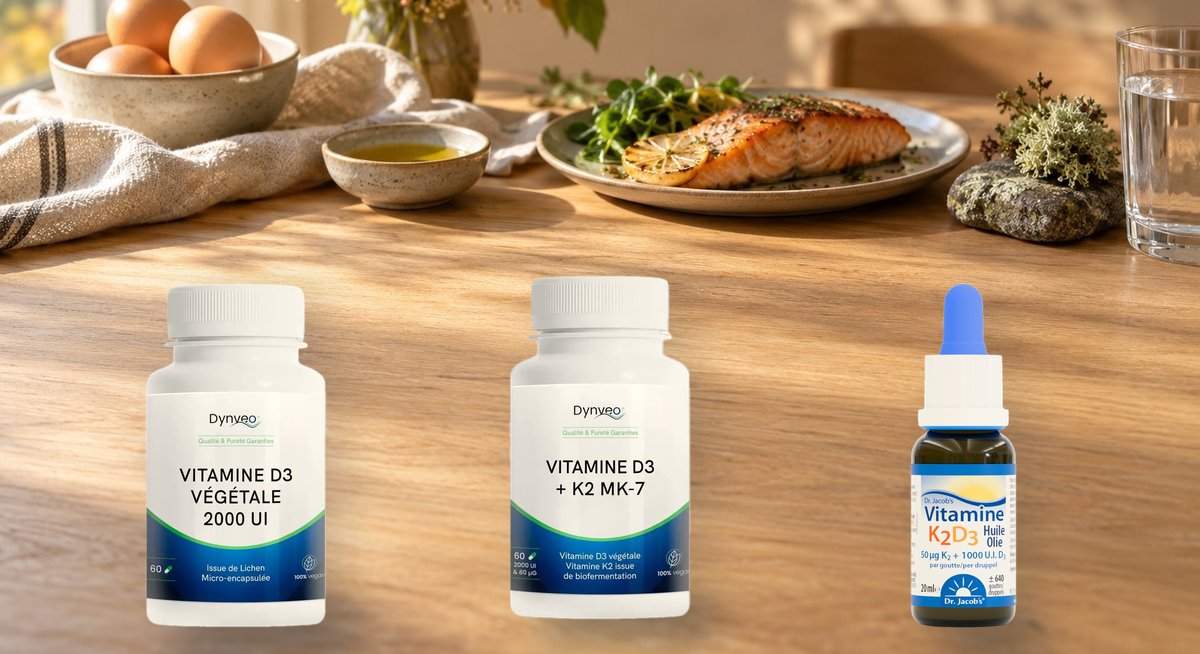
The ratio between the two varies a lot from one product to another. Dynveo’s vitamin D3 + K2 MK-7 combines 50 µg of D3 and 80 µg of K2 per capsule. Dr. Jacob’s Vitamin K2D3 does the opposite: 50 µg of K2 to 1,000 IU of D3 per drop, for those looking mainly for K2.
One precaution really matters: vitamin K contributes to normal blood clotting. If you’re on anticoagulant medication, don’t start K2 without first speaking to your doctor.
IU, µg, NRV: how to read the dose
Two units coexist on labels. The microgram (µg) is the official unit, the international unit (IU) the common one. On our bottles, 25 µg corresponds to 1,000 IU and 50 µg to 2,000 IU. The NRV percentage (nutrient reference value) shows what share of the daily reference is covered: 50 µg represents 1,000% of the NRV.
This figure often surprises people. It’s common for vitamin D, but it comes with three simple rules:
- Follow the dose on the label, without increasing it yourself.
- Don’t stack several products that contain it: D3 drops, cod liver oil and a multivitamin, for example.
- Count the daily dose: one capsule for Dynveo’s vegan D3, two for Novoma’s.
When and how to take it
Vitamin D is fat-soluble: it’s absorbed better with a meal that contains a little fat. That’s the instruction for oil-based drops as well as Dynveo’s D3 + K2 capsules. The micro-encapsulated vegan D3 is an exception, and can be taken with a glass of water whenever suits you. Timing matters less than regularity: the simplest approach is to pair it with the most substantial meal of the day.
In Paris, demand picks up from October, as the days get shorter. If you want to know your status before choosing a dose, that’s a question for your doctor, who can arrange a blood test. For context, read our article on vitamin D and lack of sunlight, and browse our winter shelf.
Frequently asked questions
Is plant-based vitamin D really D3?
Yes. Versions extracted from lichen or algae are cholecalciferol, exactly like D3 derived from lanolin. Only the origin changes, which makes them compatible with a vegan diet.
Should it be taken every day?
Our products are designed for daily use. Simply follow the rhythm stated on the packaging and don’t exceed the recommended daily dose.
What about during pregnancy?
Ask your doctor or midwife for advice before choosing a product: the dose needs to be adapted to your situation. Cod liver oil, being rich in vitamin A, is in fact not recommended for pregnant women.
How should a bottle of drops be stored?
Well closed, away from light and at room temperature. Cod liver oil, on the other hand, goes in the fridge once opened.
The simplest way is to compare the bottles in person: we’re waiting for you at 10 rue Théophile Roussel, in the 12th arrondissement, a short walk from Ledru-Rollin metro station, Tuesday to Saturday.