
The Herba Barona blog › Sem categoria
PQQ: what it is and how to take it
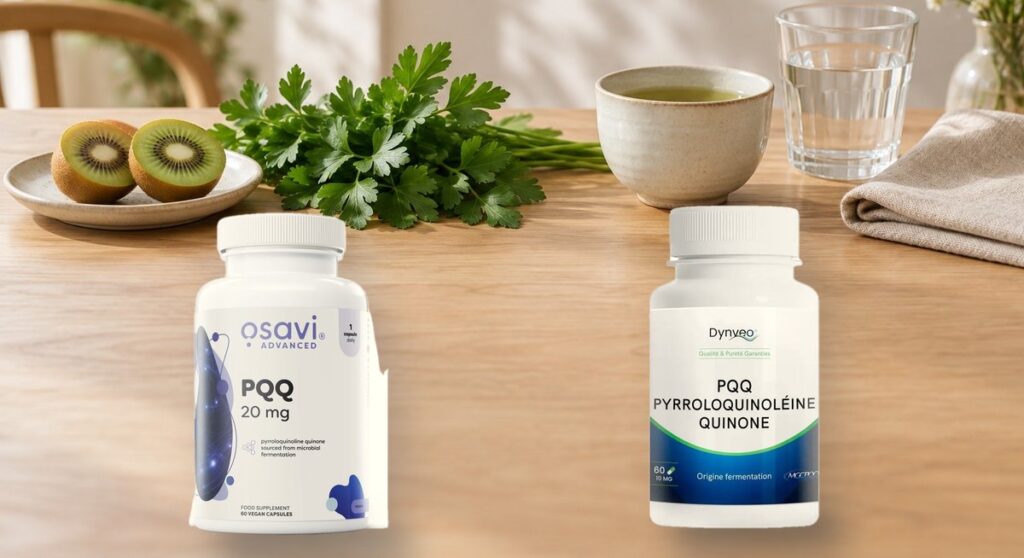
Pyrroloquinoline quinone: the name alone is enough to put people off, which is why everyone just says PQQ. We’re mainly asked about it in the longevity range, often alongside coenzyme Q10. But what is it, where does it come from, and how do you take it without getting the dose wrong? The answers come down to a few simple facts, and we give them every day at the counter, in Paris. Our two products are gathered on the PQQ (pyrroloquinoline quinone) page.
A molecule discovered in bacteria
PQQ was identified in 1979 by biochemist Minoru Ameyama, while studying so-called methylotrophic bacteria. It was first described as an enzymatic cofactor, meaning a small molecule that helps certain enzymes function. Interest in it for nutrition came much later, from the 2000s onward.
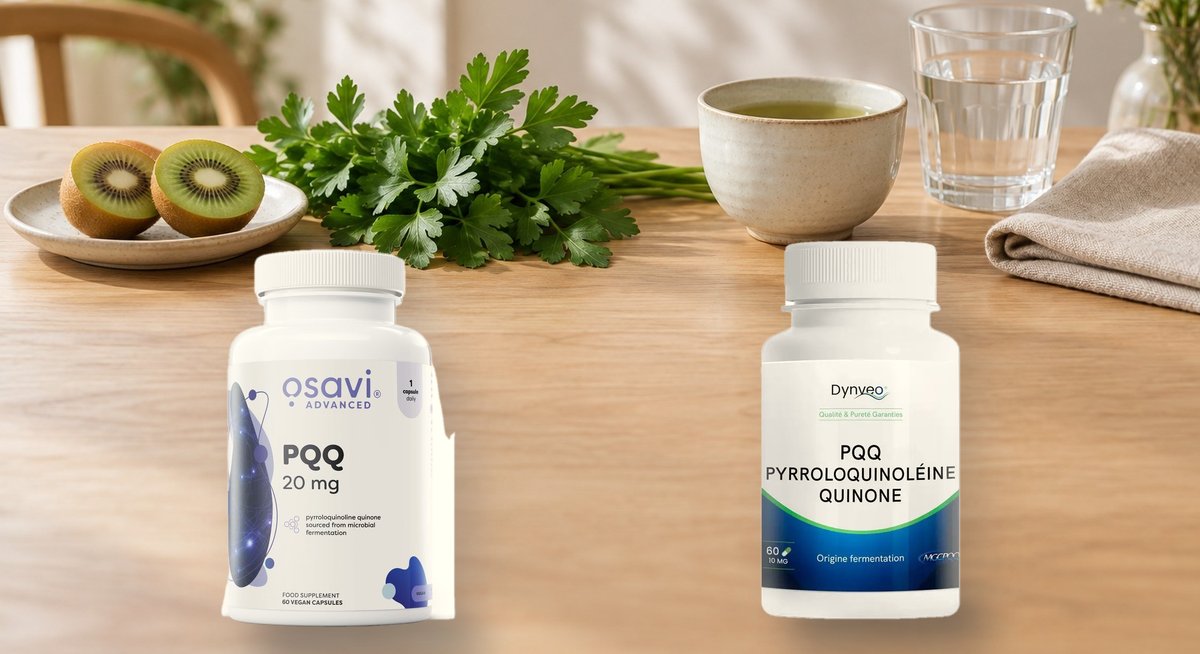
It’s neither a vitamin nor a plant. Tiny amounts are found in everyday food: kiwi, parsley, green tea, natto (a Japanese fermented soybean dish) or cacao all contain a little. But these amounts remain nowhere near the 20 mg found in a capsule.
How is it made?
The PQQ in supplements isn’t extracted from food: it’s produced through fermentation, using micro-organisms. On both our products, it appears on the label as disodium salt, the stable form used in nutrition.
Dynveo’s PQQ uses a patented raw material, MGCPQQ, made in Japan by biofermentation with non-genetically-modified micro-organisms. Dynveo states a purity of at least 99%, verified by HPLC, and specifies that this raw material has Novel Food status in Europe.
Osavi’s PQQ 20 mg, a Polish brand certified GMP, is also obtained through bacterial fermentation.
20 mg a day, in one or two capsules
Both products provide the same amount, 20 mg of PQQ a day. What changes is how you get there:
- Osavi: 20 mg in a single plant-based capsule, with inulin as a carrier. The bottle of 60 capsules lasts two months.
- Dynveo: 20 mg across two pullulan capsules, with organic acacia fibre as the only carrier. The bottle of 60 capsules lasts one month. The two capsules can be taken together or split across two meals.
In other words, one Osavi capsule corresponds to two Dynveo capsules. This is the first thing to check if you switch brands: compare milligrams of PQQ per day, not the number of capsules.
With a meal, and with what?
Both makers give the same instruction: the capsule is taken with a meal, with a glass of water. Breakfast or lunch are the easiest moments to stick to over time, and it’s consistency that matters. If you already take other supplements at breakfast, PQQ can join the same meal: just check that none of your other products already contain it, as some longevity formulas add a small dose.
PQQ is very often bought alongside coenzyme Q10. Yet these are two quite distinct molecules, dosed in completely different amounts: PQQ figures are given in double-digit milligrams, while CoQ10 is often dosed much higher. Our coenzyme Q10 range gathers the different forms, and our article on CoQ10 and ubiquinol explains the difference between the two.
What we know, and what we don’t know yet
Let’s be honest: PQQ is a recent molecule in supplementation. It’s the subject of a lot of research, particularly on mitochondria, but no medical claim is currently authorised for it in Europe. So we won’t promise you any effect. What we can tell you is what’s in the bottle, where the raw material comes from and how to follow the dose.
If this topic interests you more broadly, our anti-ageing and longevity range gathers other molecules that raise the same kind of questions.
Precautions for use
Do not exceed 20 mg a day, i.e. one Osavi capsule or two Dynveo capsules. PQQ is not recommended for pregnant or breastfeeding women without medical advice. If undergoing treatment, ask your doctor or pharmacist for advice before starting. Store the bottle away from heat, moisture and light, out of children’s reach.
Frequently asked questions
What’s the difference between PQQ and CoQ10?
They’re neither the same molecule nor the same family: CoQ10 is sold in two forms, ubiquinone and ubiquinol, PQQ as a disodium salt. If you take both, read each label separately and follow each one’s dose.
Does PQQ suit vegans?
Yes for both our products: a plant-based HPMC capsule for Osavi, pullulan for Dynveo, and a fermentation-derived PQQ.
Is it gluten-free?
Osavi states a gluten-free, lactose-free, soy-free and non-GMO formula. Dynveo also states the absence of gluten, dairy derivatives and GMOs.
Can it be taken continuously?
Osavi presents it for daily use, within the stated dose. For use over several months, especially alongside other supplements, professional advice remains a good idea.
Want to see both bottles before choosing? They’re kept side by side at our Paris 12th shop, open Tuesday to Saturday: just ask, and we’ll bring them out for you.