
Le blog Herba Barona › Sem categoria
Yellow, red or black maca: what are the differences
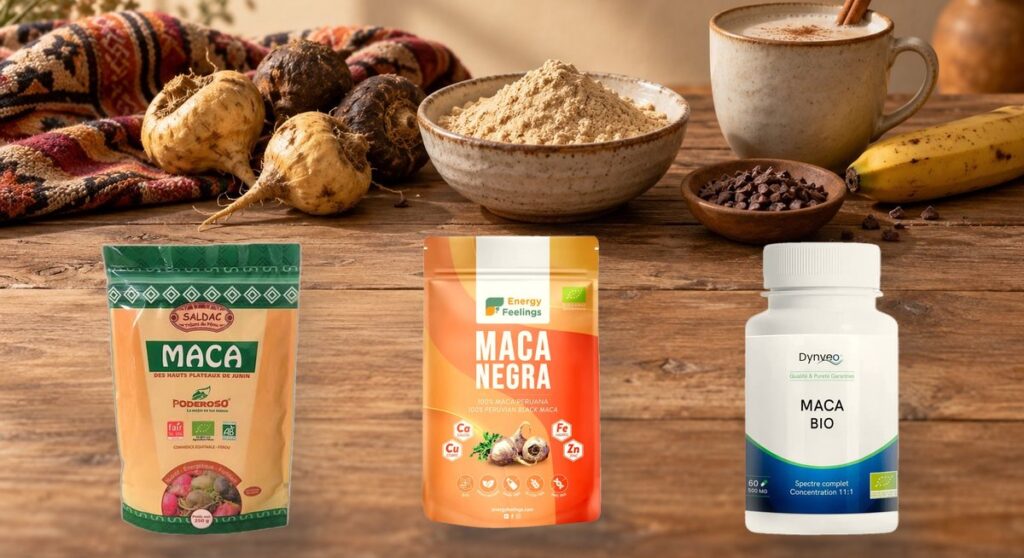
Yellow, red, black: maca comes in several colours, and customers who reach the shelf almost always ask us which one is “the right one”. The honest answer is that it’s the same plant, and the differences mainly come down to the colour of the root, its rarity and its taste. Let’s explain what sets each maca apart, and how to take it. Our products are gathered on the organic Peruvian maca in Paris page.
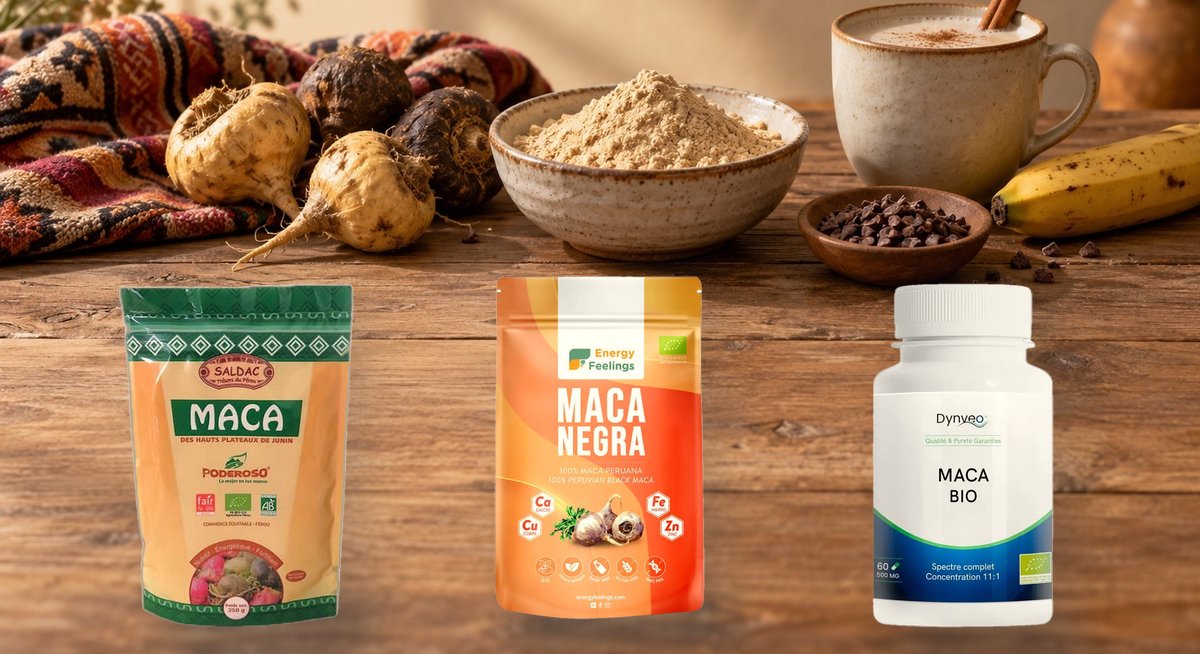
Maca, a root from the high Andean plateaus
Maca (Lepidium meyenii) is a plant in the brassica family, the same as cabbage, broccoli or radish. It’s the root that’s consumed, a small swollen tuber that grows on the high plateaus of the Peruvian Andes, between 3,800 and 4,500 metres altitude. Cold, wind and sun are intense there, and few other food crops can survive it.
The Junín region, in central Peru, is its historical home. Andean peoples have grown it for over 2,000 years; maca milk, served hot with honey and cinnamon, is presented as a traditional Peruvian recipe. What’s bought today is the dried root ground into powder, or an extract of this root in capsules.
Yellow, red, black: where do the colours come from?
These are not three different species, but three root colours in the same field. The colour depends on genetic factors and the environment, and growers cannot predict in advance the proportion of each colour in their harvest. Our product pages give these rough figures:
- Yellow maca: around 60% of the harvest. It’s the most common and the most accessible.
- Red maca: around 25% of the harvest. Less commonly found.
- Black maca: around 15% of the harvest. The rarest of the three.
Each colour has its own reputation, and plenty is written about their respective uses. At the counter, we prefer to talk about what can be observed: rarity, powder colour, and above all, taste.
What really changes: the taste
This is the difference noticed from the very first spoonful. Saldac’s organic Pederoso yellow maca has a neutral, slightly nutty taste, easy to slip into a smoothie or porridge. It’s often the one we recommend starting with.
Saldac’s organic Pederoso black maca is more intense and earthier. The product page recommends pairing it with cacao or banana to soften its bitterness. Both Saldac macas are grown at 4,200 metres altitude, in the Junín region, and carry the Fair For Life fair trade label.
We also carry Energy Feelings’ organic black maca, in a 500 g pouch, a Spanish brand. Its taste is described as slightly malty and caramelised, stronger than the yellow one. Black maca pairs very well with cacao: if you have some at home, our cacao beans, powder or butter range will give you what you need to make a maca hot chocolate.
Powder or capsules?
Powder remains the traditional form. Saldac’s product pages recommend 3 to 5 g per day, one to two teaspoons, preferably in the morning or early afternoon, starting with 1 g a day then gradually increasing over a week. For the Energy Feelings pouch, the label sets a maximum of 10 g per day.
For those who don’t like the taste, Dynveo’s concentrated organic maca is a dry extract of organic root at an 11:1 ratio: each 500 mg capsule of extract corresponds to 5.5 g of maca powder. The dose goes up to two capsules a day, preferably in the morning or around midday; the extract has no excipient, in a plant-based capsule.
How to fit it into daily life
Maca powder mixes into almost anything, as long as it isn’t boiled for long. Product pages suggest a fruit smoothie, a hot plant-based milk with honey and cinnamon, yoghurt, fruit compote, porridge, or even pancake batter, replacing 10 to 20% of the flour. In a soup, add it at the end of cooking.
One point comes up on every product page: avoid taking it in the evening. And a few precautions apply. Maca is not recommended for pregnant or breastfeeding women without medical advice. It contains glucosinolates, like other brassicas, and the product pages advise against it in cases of thyroid conditions. If undergoing hormonal treatment, ask your doctor’s advice before taking it. For other traditional plants, our article on the great classics of men’s wellbeing covers the range.
Frequently asked questions
Is black maca “stronger” than yellow?
It’s rarer and has a more intense taste. Beyond that, a lot of claims circulate; we recommend choosing first based on taste and budget.
Can several colours be mixed?
Yes, nothing stops you. You could easily take yellow daily and black now and then, in a hot chocolate or a cacao smoothie.
How long does a 250 g pouch last?
At 3 to 5 g per day, Saldac’s product page estimates it at around 50 to 80 days.
Should breaks be taken?
Saldac’s product pages suggest courses of one to three months, with a one-week break every four weeks.
The clearest way to decide is to compare the powder colours: come and see them at our Paris 12th shop, Tuesday to Saturday, at 10 rue Théophile Roussel.