
Le blog Herba Barona › Sem categoria
Red Ginseng, Korean or Fermented Tea: How to Choose Your Ginseng
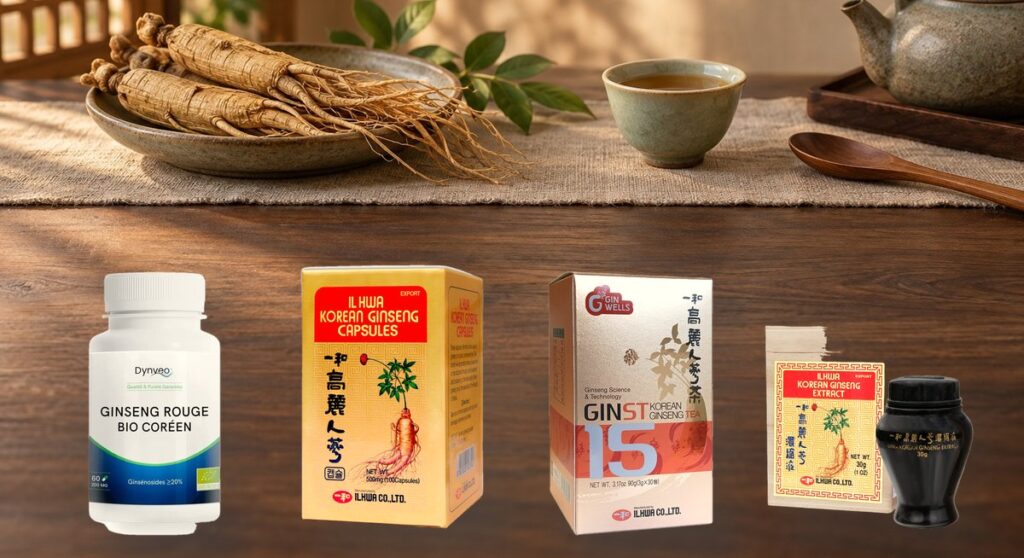
White ginseng, red ginseng, standardised extract, root powder, paste to dilute or fermented tea: the ginseng shelf is one of the most varied in the shop, and one of the easiest to get lost in. Yet it all comes from the same plant, Korean ginseng. What changes is how the root is prepared, the form, and how to read the label. Here’s how we help our customers choose, with the products on our ginseng in Paris page.
A single plant: Panax ginseng
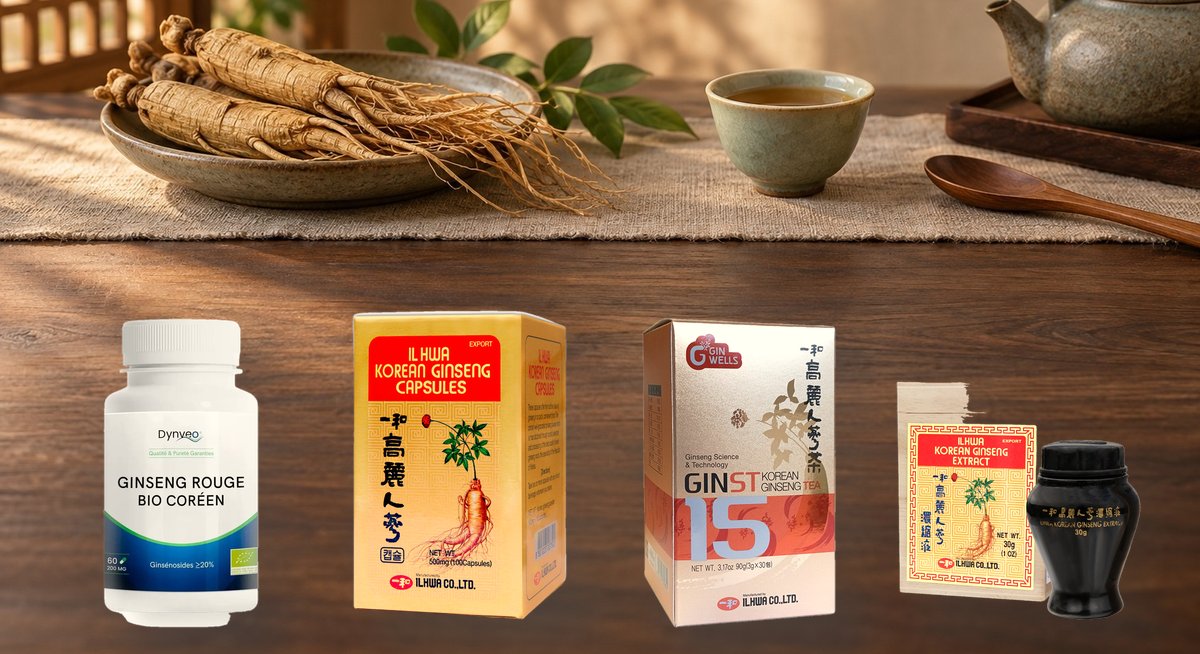
The ginseng on our shelves is Panax ginseng C.A. Meyer, Korean ginseng. It’s the root that’s used, after several years of growth: IL HWA’s capsules and Dynveo’s organic red ginseng come from six-year-old roots. In Asian tradition, ginseng is one of the oldest and most valued plants, consumed for centuries as a root, infusion or extract.
Its characteristic compounds are called ginsenosides. There are several dozen of them, and their content serves as a benchmark for comparing extracts.
White or red ginseng?
“Red” is not a variety: it’s a preparation. White ginseng is a root simply dried after harvest. Red ginseng is gently steamed, then dried. This heat transforms some of the ginsenosides and brings out so-called “rare” ginsenosides, such as Rg3, Rg5 or Rk1, while giving the root its amber colour.
IL HWA Korean ginseng capsules are white ginseng: 500 mg of whole root powder per capsule, with no extraction. At Dynveo, there are two red ginsengs. Dynveo’s organic red ginseng is an extract standardised to 20% ginsenosides, 200 mg per capsule. The Premium red ginseng is standardised to 12% ginsenosides, including 10% rare ginsenosides; it’s grown hors-sol, which explains why it isn’t certified organic.
Capsules, paste or fermented tea
The form is often what decides, even more than the colour.
- Capsules: the simplest form, fixed dose, no taste. Note that IL HWA’s capsules are gelatine-based, while Dynveo’s capsules are plant-based.
- Paste: IL HWA’s pure Korean ginseng extract paste is 100% extract. About 1 g is taken with the measuring spoon and dissolved in a cup of hot or warm water to make a Korean-style ginseng tea.
- Fermented tea: IL HWA’s Ginst15 comes in 3 g sachets to dissolve in hot or cold water. Each sachet combines a fermented ginseng root extract with a whole root extract. Its taste is typical of ginseng, slightly bitter and earthy, with a sweet note.
How to read a ginseng label
Four pieces of information are enough to compare two products. First, the species: Panax ginseng, not to be confused with other plants sold under the name ginseng. Then the part of the plant: whole root powder or extract. The ginsenoside standardisation, when it’s an extract. And the preparation, white or red.
Beware of comparisons by weight. Two IL HWA capsules provide 1,000 mg of root powder, one Dynveo organic red ginseng capsule 200 mg of standardised extract. These aren’t the same thing, and the figures can’t be compared directly.
When to take it, and for how long
Ginseng is taken in the morning, at breakfast, or in the early afternoon at the latest. The data sheets advise against taking it in the evening, so as not to interfere with falling asleep. It’s also best not to combine it with a lot of coffee.
It’s used in courses: around fifty days with the box of 100 IL HWA capsules, followed by two weeks off before restarting if needed; one to three months for Dynveo’s organic red ginseng or Ginst15. Ginseng is not recommended for pregnant or breastfeeding women or for children. If you’re on treatment, particularly anticoagulant or antidiabetic medication, ask your doctor for advice before starting. To place ginseng among other plants in the same family, read our adaptogen comparison, or browse the IL HWA in Paris range.
Frequently asked questions
Is red ginseng stronger than white?
It isn’t “stronger”, it’s prepared differently: steaming changes the nature of its ginsenosides, not their “strength”. To choose, look instead at the form and the standardisation stated on the label.
Is IL HWA ginseng suitable for vegetarians?
The capsules are gelatine-based. The paste and Ginst15 are gelatine-free, and Dynveo’s capsules are plant-based.
How should Ginst15 be drunk?
One sachet a day in a cup of water, hot or cold, preferably in the morning or early afternoon.
How long does the paste keep?
Close the jar well after use and keep it away from heat and moisture. The date stated on the packaging applies.
The best way to understand is to see the root, the paste and the tea side by side: we’ll show them to you in our Paris 12th shop, a short walk from Bastille, Tuesday to Saturday.