
Home › Podcast › The bacterium your body never digested
The bacterium your body never digested
Episode in French. The full text can be read below in English.
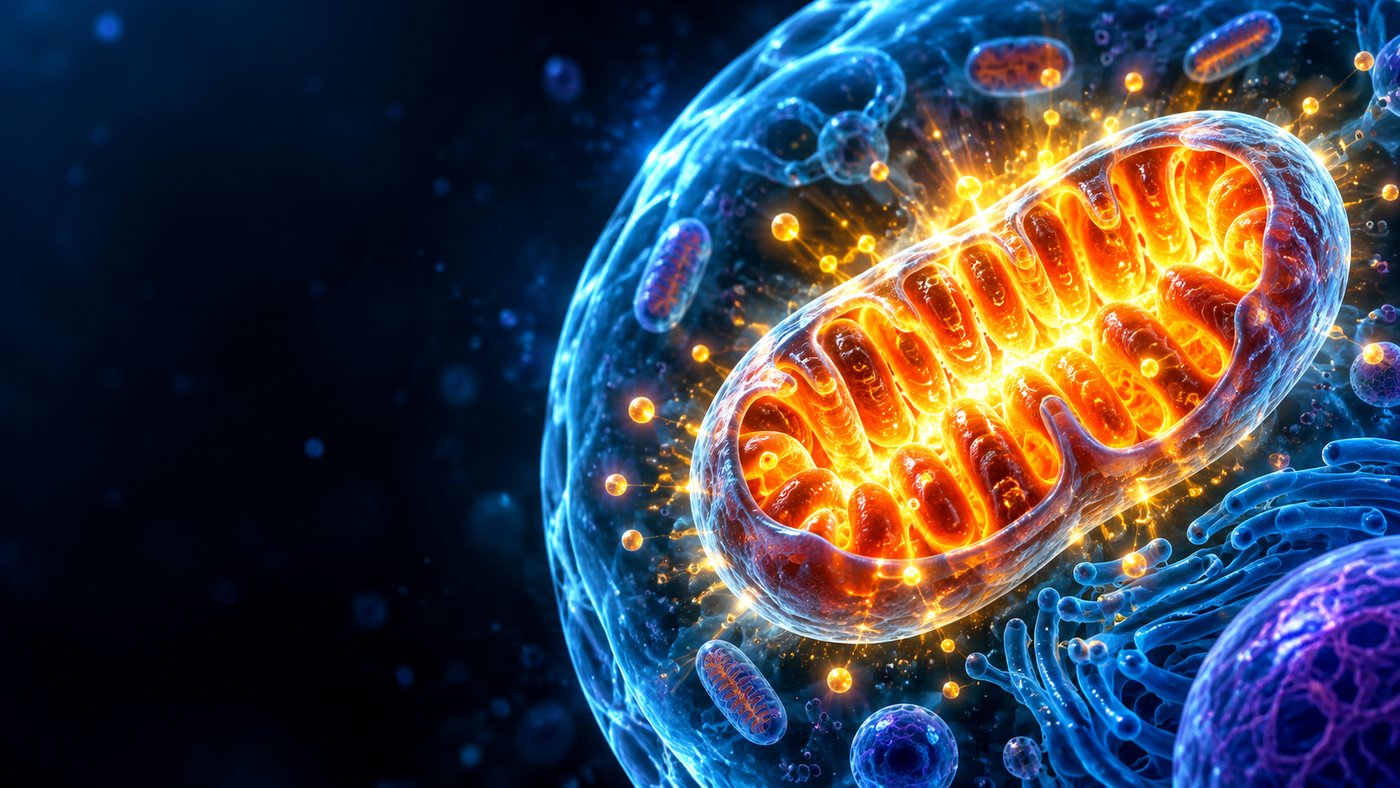
The text of the episode
Welcome to Herba Barona, a food supplements shop in Paris. Every episode tells a story we know badly, and you leave with one thing to remember. Today we are opening a series on mitochondria — and it starts with a very, very old story.
A very old story
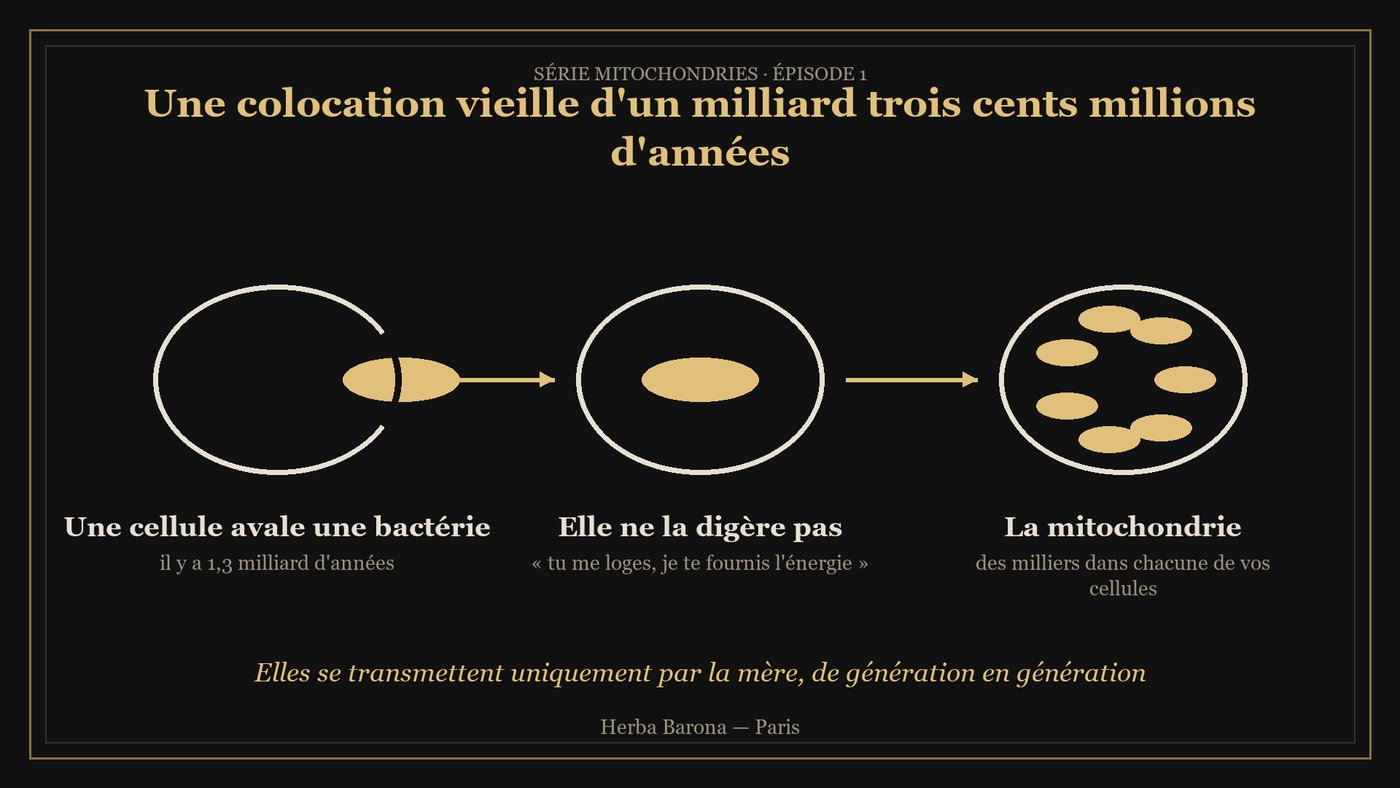
About one billion three hundred million years ago, a cell swallowed a bacterium. And something unusual happened: it did not digest it.
The bacterium stayed. It settled in. And it struck a deal with its host cell, a deal that still holds today, at this very second, inside every one of your cells: "You house me, you feed me. In exchange, I supply the energy."
Numbers that make your head spin
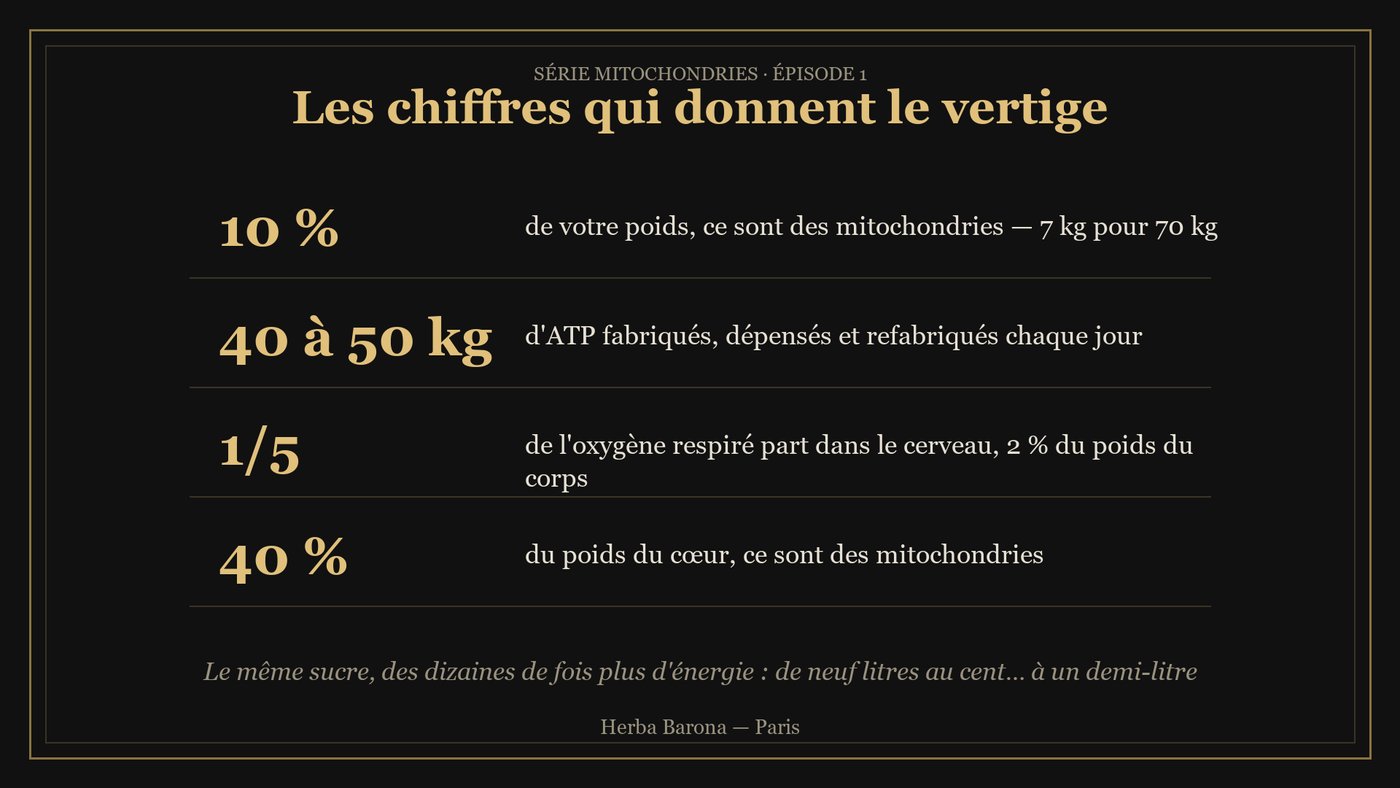
That bacterium is what we now call the mitochondrion. And if you have never heard of it, hold on tight, because the numbers make your head spin. You have thousands of them in almost every one of your cells. All together, they make up around ten per cent of your body weight. For a seventy-kilo person, that is seven kilos. Seven kilos of former bacteria, that you are carrying around right now.
Their job? To make a small molecule called ATP. ATP is the energy currency of all living things. Every heartbeat, every thought, every blink is paid for in ATP. And your body makes — brace yourself — the equivalent of forty to fifty kilos of it a day. Almost your own body weight, made, spent and remade every day. No stock. Permanent just-in-time.
Taming oxygen
To manage that, the mitochondrion pulled off a feat: it tamed oxygen. Because oxygen, at heart, is an aggressive gas. It tears electrons away from everything it touches — that is exactly what makes iron rust. The mitochondrion invented a kind of cascade with little mills: the energy from food comes down step by step, each mill takes a little on the way, and at the very bottom the pacified oxygen leaves as a simple molecule of water. The result: from the same sugar, the mitochondrion extracts dozens of times more energy than a cell working without one. It is as if your car went from nine litres per hundred kilometres… to half a litre.
The organs that consume the most are packed with them. Your brain, two per cent of your weight, burns a fifth of the oxygen you breathe. Your heart? Close to forty per cent of its weight is mitochondria. The drumbeat of life runs almost half on these ancient bacteria.
A maternal inheritance
And here is the detail I like best. These mitochondria came to you from one single person: your mother. The sperm cell passes on almost none; the egg, on the other hand, is full of them. The power plants keeping you alive this evening are the direct descendants of your mother's, of your grandmother's, and so on, from mother to daughter, over thousands of generations.
So the next time you feel your energy come back after a good night's sleep, a real walk in the open air, a simple unprocessed meal — think of them. Billions upon billions of little tenants, moved in a billion years ago, who have never once left you.
You are not only you. You are a flat-share. And it dates from before the dinosaurs.
That was an episode of the Herba Barona podcast, recorded in Paris. See you soon.