
Home › Podcast › Magnesium: the salt of an English spring
Magnesium: the salt of an English spring
Episode in French. The full text can be read below in English.

The text of the episode
Summer 1618. A drought grips the south of England. Some twenty kilometres from London, on Epsom common, a cowherd named Henry Wicker is desperately looking for water for his animals. He finally finds a pond. He leads his herd to it. And then something strange happens: the thirsty cows refuse to drink.
A bitter water
At least, that is what local tradition says. Henry Wicker, intrigued, tastes the water himself. It is bitter. Truly bitter. And it has, on those who drink it, an effect as quick as it is unexpected: it loosens the bowels. A powerful natural laxative, welling up from a hole in the common.

In the 17th century, nothing more is needed to make a fortune. The news spreads. Londoners come to drink the water of Epsom, then take it away in bottles. The little village becomes a fashionable spa town, with its strollers, its inns, its entertainments. By the middle of the century, the waters of Epsom are talked about as far as the Continent.
From salt to metal
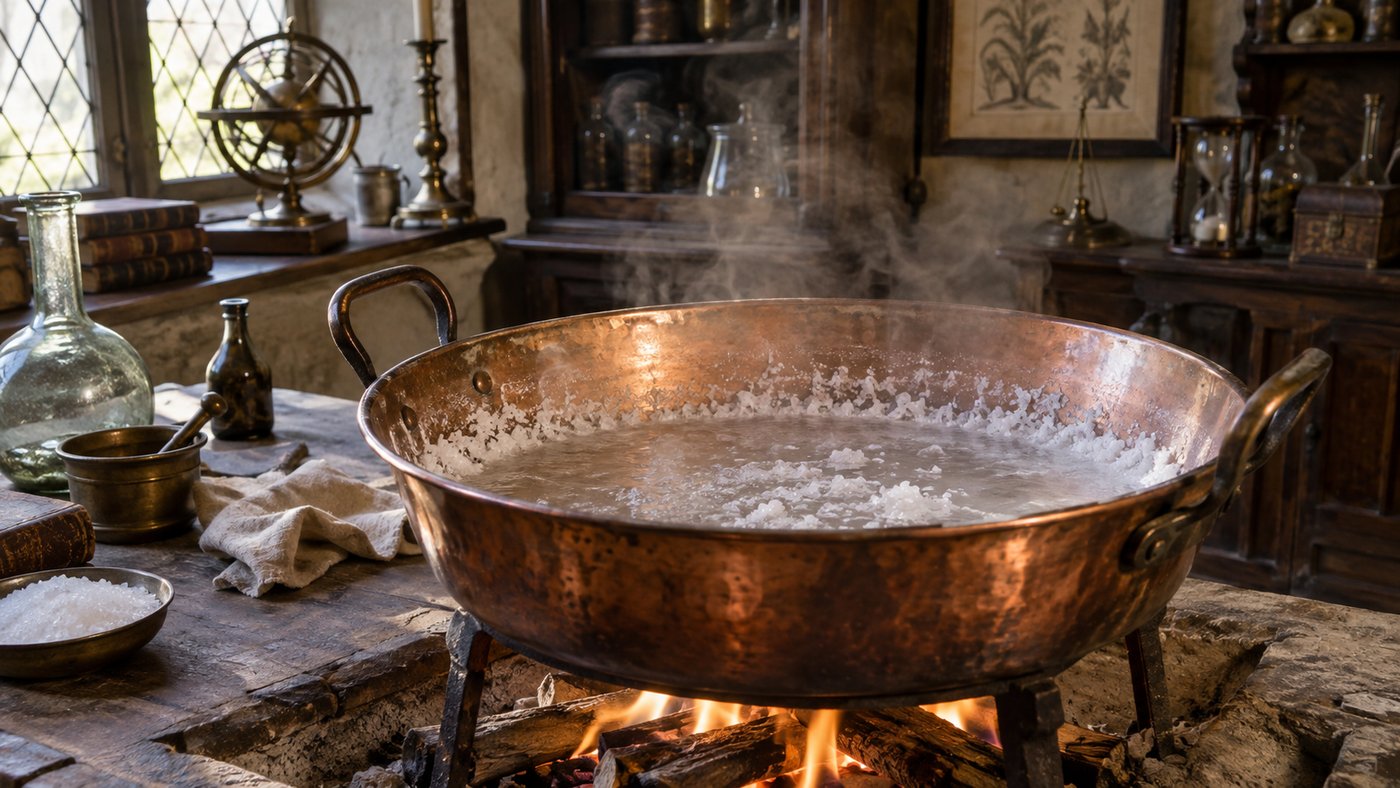
In 1695, an English physician and botanist, Nehemiah Grew, takes a closer interest in the spring. He evaporates the water, and collects small white crystals. He describes them, names them, and Epsom salts officially enter the pharmacies. A local apothecary claims he had already been making them for years: commercial quarrels begin at once. A salt that sells well always has several fathers.
But one question remains wide open: what is in this salt? Nobody knows. We have to wait until 1755. In Edinburgh, the chemist Joseph Black studies a white powder called “magnesia alba”. He shows that it has nothing to do with lime, with which it had been confused. It is a substance in its own right. Its name comes from Magnesia, a region of Greece known since Antiquity for its minerals.
Then in 1808, in London, Humphry Davy passes an electric current through this magnesia and succeeds in extracting a metal from it. He first calls it “magnium”. The name will evolve: it will be magnesium. The mystery of Epsom is finally solved. The water of the pond was loaded with magnesium sulphate. The cows had been right to pull a face.
Since then, Epsom salts have never left the cupboards. Today they are found mostly in the bath water, with their centuries-old reputation.
One mineral, several forms
Magnesium itself has become a star mineral. It takes part in hundreds of reactions in the body. It contributes to the reduction of tiredness, to the normal functioning of the nervous system and to normal muscle function. Your body does not make it: it finds it in food, oilseeds and nuts, green vegetables, whole grains.
And this is where the Epsom story becomes useful. On a magnesium label, the word “magnesium” is not enough. It is always paired with something else: sulphate, citrate, bisglycinate, malate. Each form has its own profile, notably for digestive comfort. Epsom sulphate, as you will have understood, has been known for its effect on transit for four centuries.
At Herba Barona, in Paris, when we read a magnesium label with you, the first line we look at is the form. A habit that comes to us, in a way, from an English cow.
Four centuries later, this mineral has been given learned names, chemical formulas, capsules and tablets. But it all began with a refusal. That of a thirsty herd in front of a bitter pond. When it comes to labels, the cows of Epsom had simply read the first line before anyone else.