
The Herba Barona blog › Sem categoria
MCT oil: C8, C10, how to use it day to day
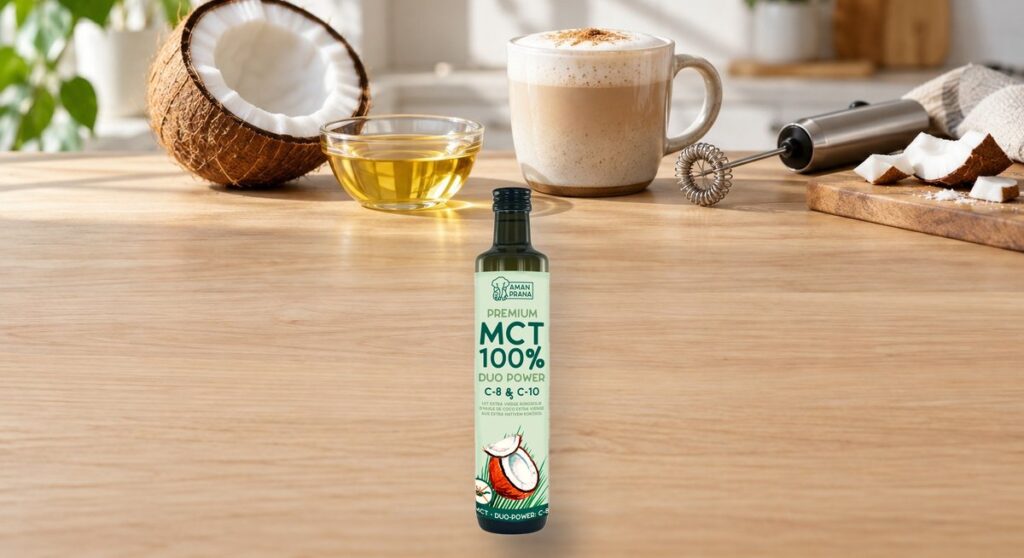
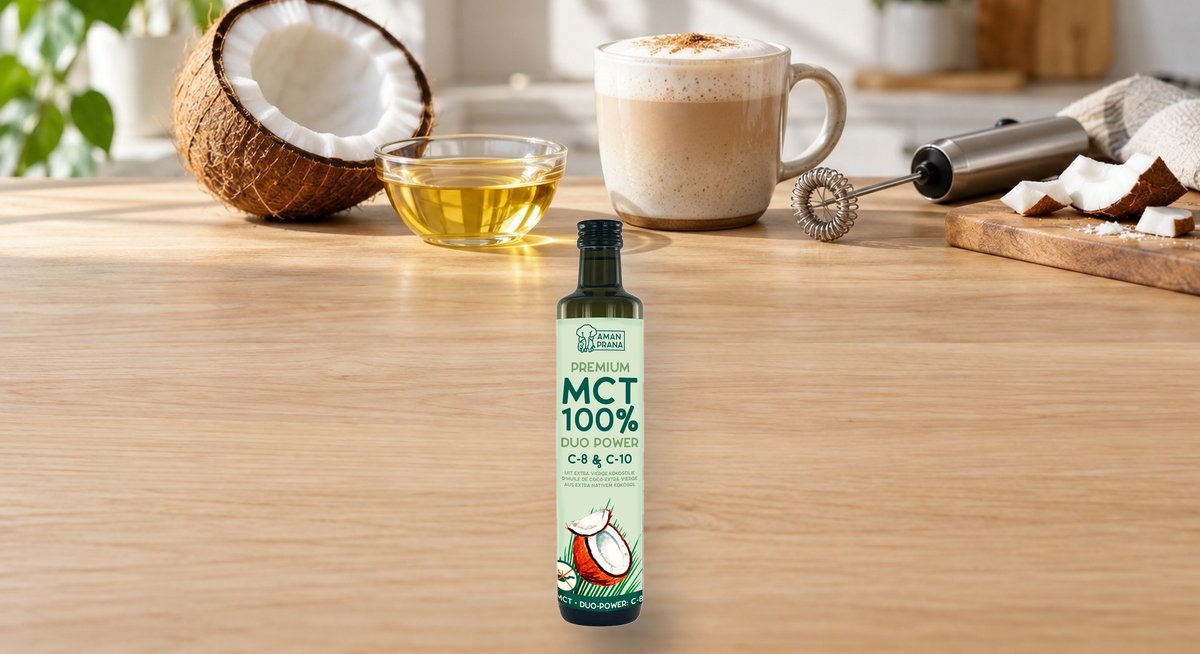
MCT oil often intrigues people seeing it for the first time on our shelves: an oil derived from coconut that stays liquid, with “C8” and “C10” on the label. The questions follow: what does that mean, and what do you actually do with it in the kitchen? Here’s what we explain at the counter, bottle in hand. It’s kept with our keto and ketogenic products.
MCT, C8, C10: what these letters mean
MCT stands for medium chain triglycerides. These are fats whose fatty acids have a shorter chain than those in most table oils. The number after the C indicates the number of carbon atoms in that chain:
- C6, caproic acid;
- C8, caprylic acid;
- C10, capric acid;
- C12, lauric acid.
MCT oil is obtained from coconut oil, keeping mainly the C8 and C10 fractions.
MCT oil or coconut oil: not the same thing
Classic coconut oil is mainly made up of C12, lauric acid, around 60%. MCT oil, by contrast, contains almost none. On the label of Amanprana’s organic MCT oil, you’ll read around 53% C8, 45% C10, 1.5% C12 and 0.5% C6.
The difference is also visible to the eye. Coconut oil solidifies below around 25°C, whereas MCT oil stays liquid, even when cold. It also lacks the coconut aroma: it’s neutral, which makes it easy to add to almost anything. If it’s virgin coconut oil and its aroma that interest you, our article on the uses of virgin coconut oil covers it in detail.
C8 and C10: how to read a label
Not all MCT oils are alike. Some are almost entirely C8, others blend C8 and C10, and others still keep a share of C12. A few pointers for comparing:
- The fatty acid profile, as a percentage: this is the oil’s true identity card.
- The origin: coconut alone, or coconut blended with palm. Amanprana’s oil comes solely from organic coconut, with no palm oil.
- The ingredient list: an MCT oil needs no additives, and this one contains none.
- The organic label, if that matters to you.
An oil that states its percentages, like Amanprana’s, lets you know exactly what you’re buying. If a label doesn’t give the fatty acid profile, ask for it before buying: without that figure, there’s no way to know what the bottle actually contains, or to compare it with another.
How to use it day to day
The best-known use is “bulletproof” coffee: one to two tablespoons of MCT oil in a hot coffee, then a blitz with a blender or milk frother to get a creamy drink. Without emulsifying, the oil stays on the surface, which is much less pleasant.
It also slips into a smoothie, a dressing, a bowl or a yoghurt. Since it’s neutral, it doesn’t change the taste of the dish. This is why it appeals to people following a ketogenic diet who want to add fat without having to think about it. The simplest approach is to attach it to something you already do every day: morning coffee, lunchtime salad or afternoon smoothie.
The rule to remember: start gently. Amanprana recommends starting with one teaspoon a day, then gradually increasing to one or two tablespoons. Introducing it too quickly can cause temporary digestive discomfort.
In cooking: watch the heat
MCT oil is not a frying oil. The brand asks that it not be heated above 160°C. It therefore suits cold or lukewarm preparations, and is best added at the end of cooking. For pan-searing, use an oil that withstands heat, such as Amanprana’s organic red palm oil, virgin and cold-pressed, with a smoke point of around 230°C. For ketogenic desserts, raw organic cacao butter is another fat often found in the same basket.
Store the bottle at room temperature, away from direct light. If pregnant, breastfeeding, dealing with a liver condition or undergoing treatment, ask your doctor for advice before using it daily. The whole Amanprana range is on the shelf.
Frequently asked questions
Does MCT oil have a taste?
Very little. It’s neutral and doesn’t smell of coconut, which makes it easy to add to almost anything.
Can it be added to tea?
Yes, just like in coffee. Emulsify it, otherwise it rises to the surface.
Should it be kept in the fridge?
No, room temperature is enough, away from light. And even when cold, it stays liquid.
How long does a 500 ml bottle last?
It all depends on your daily dose. At one tablespoon a day, expect around a month.
Curious to see an oil that doesn’t solidify? Come to 10 rue Théophile Roussel, in Paris 12th, Tuesday to Saturday: we’ll show you the bottle and talk recipes.