
The Herba Barona blog › Sem categoria
Black seed oil: unfiltered, in capsules, how to use it
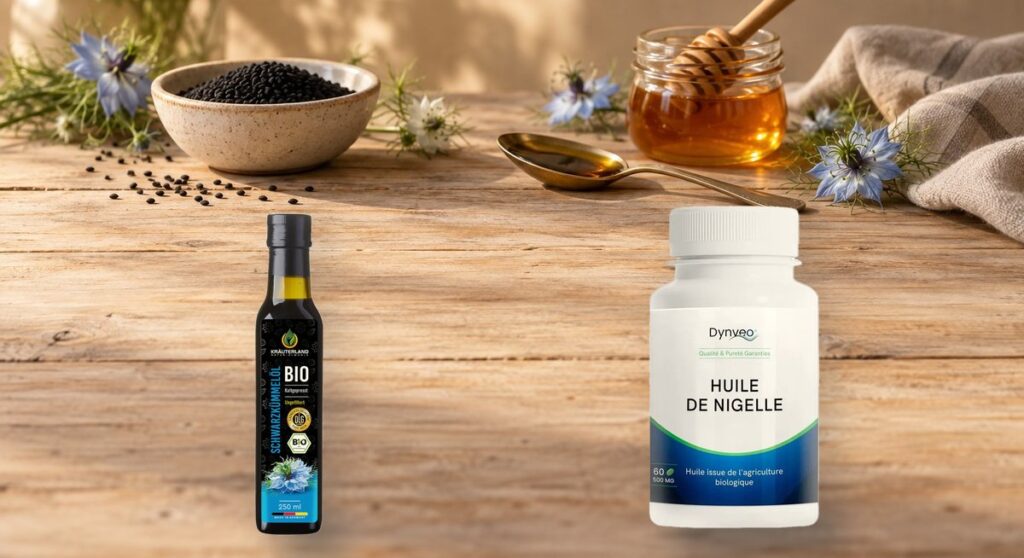
Black seed oil has its regulars, who have known it since childhood, and its curious newcomers, who discover it and leave with three questions: why “unfiltered”? Should it be drunk neat? And is this taste normal? Yes, it is, and we’ll explain why. Here’s what we tell people at the counter of our Paris 12th shop, bottle in hand. You’ll find all our products on the black seed in Paris page.
Black seed, a small black seed
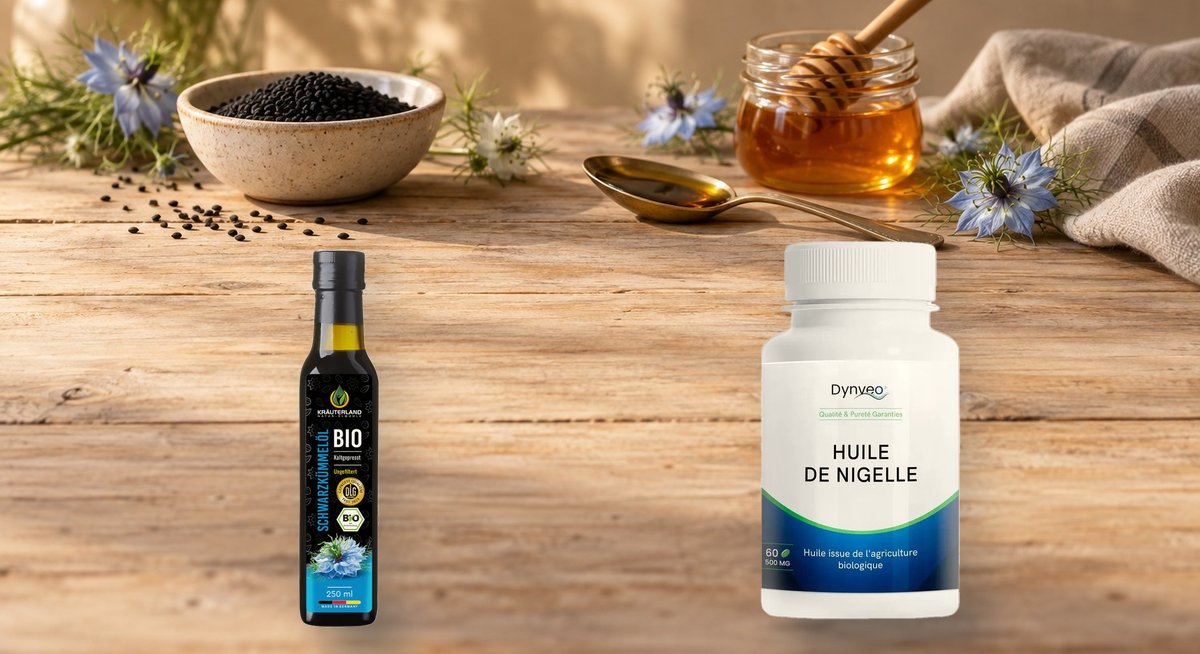
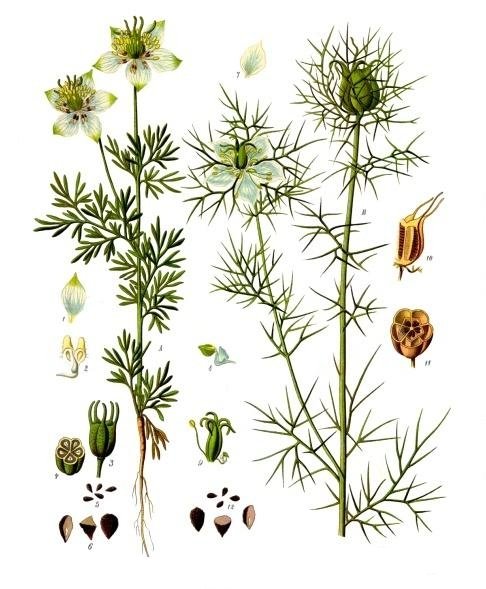
Black seed (Nigella sativa), also called black cumin, is a plant in the buttercup family. Its small, angular black seeds are harvested, and many already know them from cooking, on certain breads or cheeses. The oil is obtained by pressing these seeds.
It has a long history: its use goes back more than 3,000 years in Middle Eastern and Mediterranean traditions, and black seeds were found in the tomb of Tutankhamun. On the composition side, our oil product pages state over 80% unsaturated fatty acids, mainly linoleic acid (omega-6) and oleic acid (omega-9), as well as thymoquinone, the aromatic compound that gives it its character.
Filtered or unfiltered: what changes
A filtered oil has been passed through a filter to make it clear. It is lighter in colour and milder in taste. An unfiltered oil keeps microscopic seed particles and forms a slight sediment at the bottom of the bottle. Its colour is more intense, ranging from golden brown to dark green, and its taste stronger. This sediment is nothing unusual: just shake the bottle before each use.
Our bottled black seed oils are all from the German brand Krauterland, unfiltered and obtained by first cold pressing. Three sizes are available:
- The 250 ml organic bottle, to try it out.
- The 500 ml organic bottle, in glass, for regular use.
- The litre Krauterland Nutrilife, pressed from Egyptian seeds and awarded a gold medal by the DLG, the German agricultural society. This size is not labelled organic.
How to take it orally
Krauterland’s product page recommends one teaspoon a day, neat or mixed with honey, preferably in the morning. It’s simple, but you should be warned: the taste is strong, slightly sharp and bitter, and it surprises first-timers at the first spoonful.
Honey is the best-known trick to sweeten it. You can also drizzle the oil over a raw vegetable salad or vegetables, once the dish is served. Avoid heating it: it is cold-pressed specifically to preserve its heat-sensitive compounds.
The product page mentions courses of one to three months, with a break of a few weeks in between. If you are on treatment, pregnant or breastfeeding, ask your doctor or pharmacist for advice first.
Capsules: without the taste
For those who are really put off by the taste, there’s Dynveo’s organic black seed oil capsules. Here, the process is different: the oil is extracted using supercritical CO₂, then enclosed in a tapioca-based plant capsule, with no carrageenan. Four capsules provide 2,000 mg of oil, and the label states at least 3% thymoquinone and at least 55% linoleic acid.
The dosage ranges from one to four capsules a day, with a large glass of water, preferably away from meals. The product page recommends starting with just one capsule, then gradually increasing, and asks people allergic to the buttercup family to seek medical advice. This is the convenient solution when travelling or at the office, when you don’t want to carry a bottle.
For external use, on skin and hair
Black seed oil is also used in skincare. A few drops are applied to the skin or hair, in a gentle massage, neat or mixed with another plant oil such as argan or jojoba. It also goes into homemade preparations, hair masks or massage oils. Its smell remains strong: a little goes a long way. The product page advises people allergic to the buttercup family to do a patch test on a small area of skin before first use. If you like oils with a dual purpose, cooking and skincare, our article on organic virgin coconut oil will also appeal to you, and our other skincare products are in the beauty range.
Frequently asked questions
Why is there sediment at the bottom of my bottle?
Because the oil is unfiltered. This sediment is made of seed particles. Shake the bottle before use.
How should black seed oil be stored?
In a cool place, away from light, cap tightly closed. Once opened, Krauterland’s product page recommends keeping it preferably in the fridge and using it within six months.
Oil or capsules, which to choose?
The oil is more versatile: it’s used by the spoonful, in cold cooking and on the skin. Capsules are more convenient and tasteless, but are only for oral use.
Can black seed oil be used in cooking?
Yes, as long as it’s added after cooking: over hummus, a cold soup or grilled vegetables. Its taste quickly dominates, so a few drops are enough.
The best way to understand this taste is still to talk about it in front of the shelf: come and see us on rue Théophile Roussel, between Ledru-Rollin and Bastille.