Home › Podcast › The molecule that came from outer space
The molecule that came from outer space
Episode in French. The full text can be read below in English.
The text of the episode
Welcome to Herba Barona, a food supplements shop in Paris. Every episode tells the story of a product we know badly, and you leave with one thing to remember. Today: PQQ.
A strange curriculum vitae
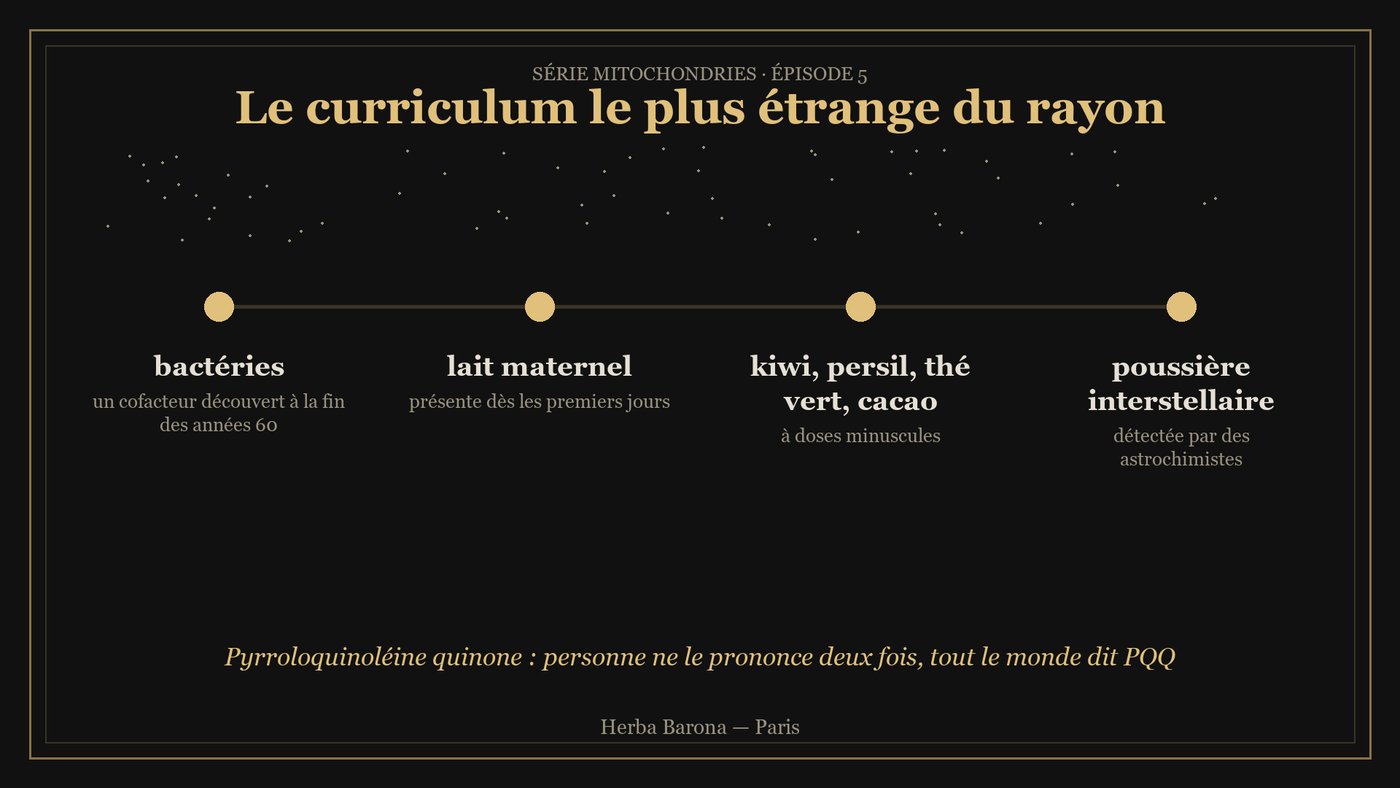
Of all the molecules we talk about in this podcast, today's has the strangest curriculum vitae. It was found in bacteria. It was found in breast milk. And it has been detected… in interstellar dust.
Its name is pyrroloquinoline quinone. Nobody can say that twice in a row, so everybody says: PQQ.
From bacteria to the stars
Its story begins at the end of the nineteen-sixties, when researchers studying bacteria come across an unknown cofactor — a small tool-molecule, essential to the working of some of their enzymes. Nothing exceptional, they think. Then the analyses grow finer, and PQQ starts turning up everywhere: in plants, in fruit — kiwi contains it, so does parsley —, in green tea, in cocoa… and so on all the way to stardust analysed by astrochemists. A reinforced, highly stable molecule that seems to cross the cosmos without coming to harm.
The birth of new power plants
But what made PQQ famous is something else. It is the day researchers observed its link with a phenomenon we talked about in the episode on sport: mitochondrial biogenesis. The birth of new mitochondria.
A quick reminder. Your mitochondria, the power plants of your cells, are not installed once and for all. They live, they age, they are dismantled, they are replaced. Your body runs that permanent building site with molecular switches — conductors that give the signal: "Build new power plants." Endurance exercise presses those switches. So do certain phases of dietary restraint. And PQQ interests researchers precisely for its interactions with those signalling pathways — the control circuits of mitochondrial renewal. That is why, in the scientific literature, its name comes up so often next to the word "mitochondria".
A molecule that takes a beating
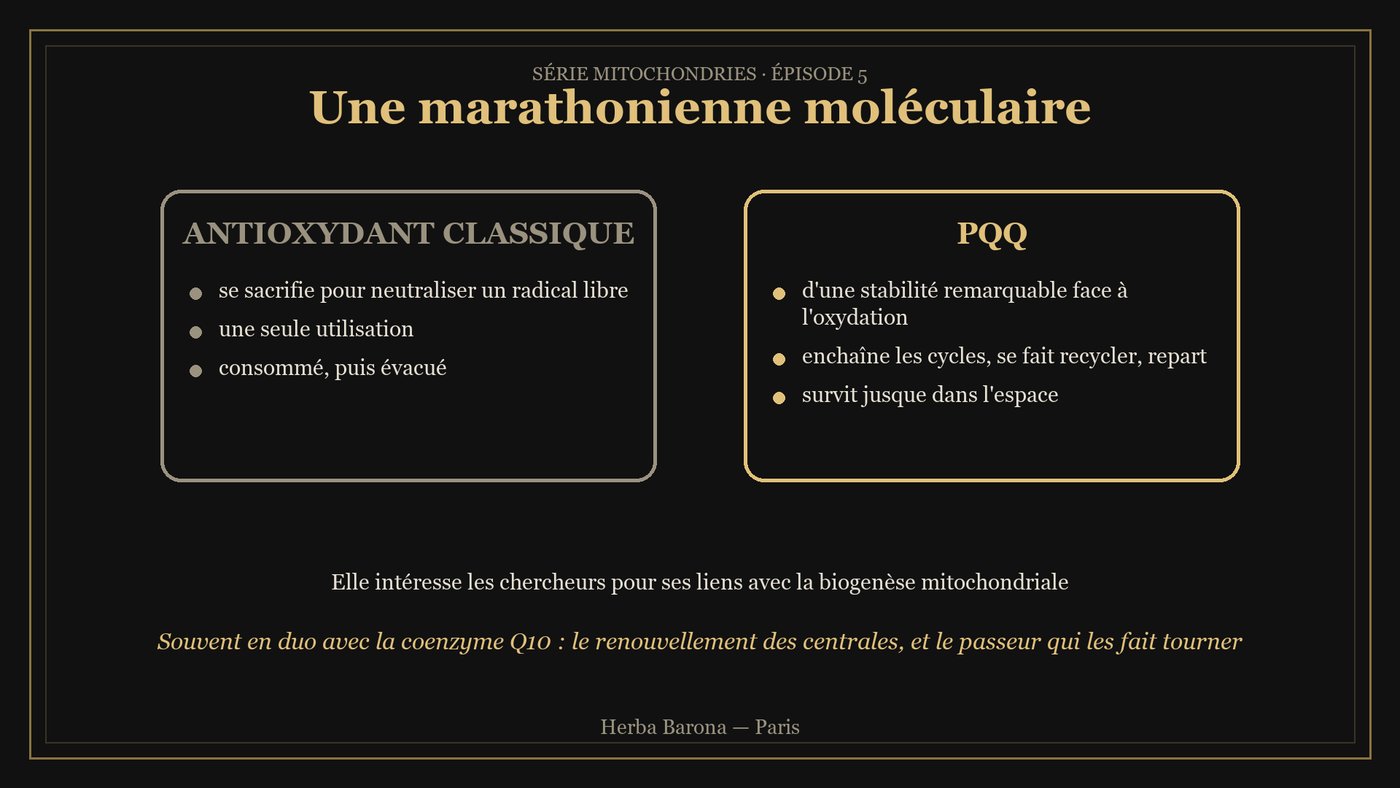
Another character trait: PQQ takes a beating. It is a molecule of remarkable stability in the face of oxidation — where other antioxidants sacrifice themselves in a single use, it can run through cycle after cycle, be recycled, and set off again. A kind of molecular marathon runner. You can see why it survives in space.
Where our intake comes from
We humans cannot make it. Our intake comes from food — those famous kiwis, parsley, green tea, cocoa, in tiny amounts — and, for the last few years, from food supplements, where it often appears paired with coenzyme Q ten: the specialist in renewing the power plants, alongside the electron ferryman that keeps them running. On paper, the two complement each other beautifully.
A molecule born among bacteria, present in mothers' milk, found again in the dust of the stars, and now inviting itself into the conversation about our power plants.
It really did need an episode to introduce it. It had come a very long way.
That was an episode of the Herba Barona podcast, recorded in Paris. See you soon.