
The Herba Barona blog › Sem categoria
L-theanine: from green tea to capsule, how to take it
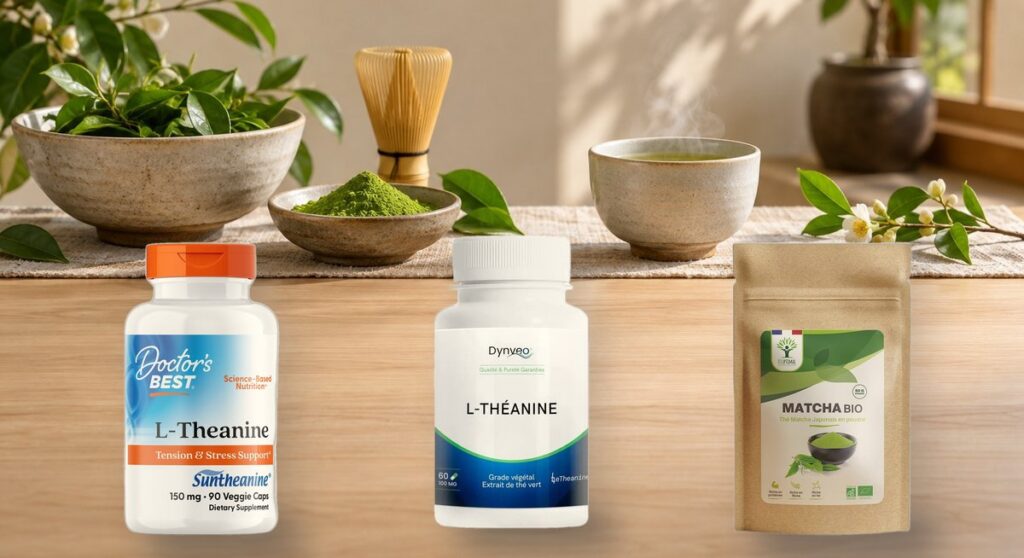
“What exactly is L-theanine? And why take it in a capsule rather than just drinking tea?” We’re asked this almost every week at the counter. The answer comes down to a few simple points: where this molecule comes from, how it’s obtained, and how to read what’s written on the bottle. Our products are kept with the other amino acids, in our Paris shop.
A molecule born in the tea leaf
L-theanine is a somewhat unusual amino acid: unlike most of its relatives, it doesn’t go into building proteins. It’s found almost exclusively in the leaves of the tea plant, Camellia sinensis. It’s what gives green tea its umami flavour, that round, deep taste that is neither sweet, salty nor bitter.
Japanese growers have been “working” it without knowing it for centuries. Tea plants destined for matcha are shaded for a few weeks before harvest: deprived of some light, the leaf converts less of its theanine, which builds up instead. The goal was taste, milder and less bitter. Tradition also tells that Buddhist monks drank green tea before their long meditation sessions. This is a traditional-use story, reported as such.
Tea, matcha or capsule: what really changes
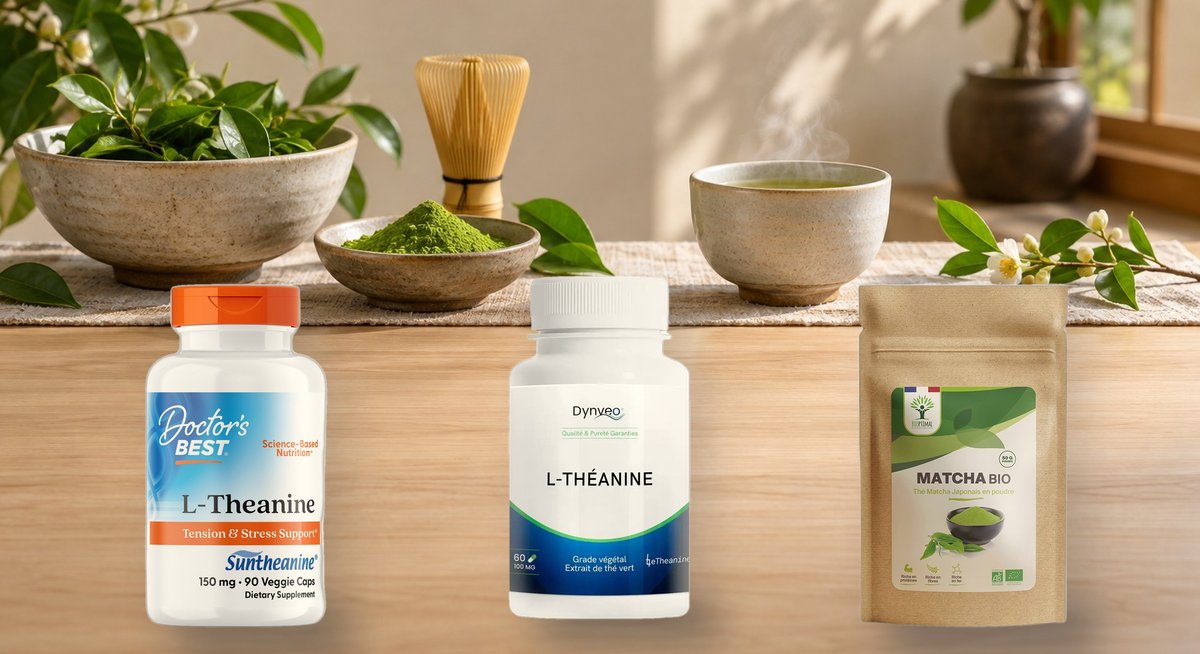
A cup of green tea contains theanine, but in a variable amount depending on the leaf, the brew and the steeping time. It also brings caffeine. Matcha goes further, since you drink the whole leaf ground into powder: our Bioptimal organic matcha tea, 50 g pouch, is whisked into a bowl of water at 70-80°C, never boiling. Its label notes the caffeine content and advises against it for children, teenagers and pregnant or breastfeeding women.
The capsule, on the other hand, provides a precise, always consistent amount of L-theanine, with no caffeine. This is what’s sought by those who want a regular dose, or who simply don’t drink tea.
Suntheanine or BeTheanine: two ways to obtain it
Theanine exists in two mirror-image forms, L and D, like a right hand and a left hand. Only the L form is the one produced by the tea plant. A standard chemical synthesis gives a mix of both, which is why serious brands state the form and origin of their raw material.
- Suntheanine: a pure L-theanine produced in Japan by Taiyo International, via enzymatic fermentation. This is used in Doctor’s Best L-theanine Suntheanine 150 mg, in a bottle of 90 plant-based capsules.
- BeTheanine: a green tea leaf extract obtained by double water infusion, with no organic solvent. This is found in Dynveo’s plant-based L-theanine, in a bottle of 60 capsules.
Neither is “better” in absolute terms. One is an isolated molecule, the other a standardised plant extract. It’s a matter of preference.
Reading the label without mistakes
This is where customers most often get confused. On a plant extract, there are two figures: the weight of the extract, and the share of L-theanine it contains. For Dynveo, the label states, for 2 capsules, 500 mg of BeTheanine green tea extract, including 200 mg of L-theanine, with a minimum standardisation of 40%. It’s this second figure that’s used for comparison.
For Doctor’s Best, it’s more direct: 150 mg of Suntheanine L-theanine per capsule, with no plant extract to work out. So remember the rule: compare the amount of L-theanine, not the weight of the capsule or the extract.
How to take it day to day
L-theanine is swallowed with a glass of water. Dynveo recommends one to two capsules a day, preferably with meals, and states two possible moments: one capsule in the morning or early afternoon, or one capsule 30 to 60 minutes before bed. A few counter-level pointers:
- stay within the daily dose stated on the bottle, without exceeding it;
- many customers take it with their morning coffee, to recreate the pairing that tea naturally contains;
- if you already take a formula that contains it, don’t unknowingly double up with a separate capsule.
This last point is not just theoretical. Theanine appears in several combined formulas, such as Dynveo’s Chronobio Sleep Onset Complex, which combines 200 mg of BeTheanine L-theanine, melatonin derived from St John’s wort and valerian. Its product page in fact advises against it for people on medication, because of the St John’s wort. Always read the full composition before combining two products.
These supplements are for adults only. If pregnant, breastfeeding or undergoing treatment, ask your doctor or pharmacist for advice first.
What if you’d rather stick to tea?
That’s a very good way to discover theanine, as long as you’re happy with the caffeine that comes with it. A green tea or matcha in the morning, a herbal tea in the evening: if you’re unsure, our article on tea or herbal tea, which hot drink for which moment will help you plan your day. Our full matcha selection is also on the shelf, alongside teas and herbal teas.
Frequently asked questions
Does L-theanine in capsule form contain caffeine?
No. Both our L-theanine capsules contain none. Tea and matcha, on the other hand, provide both at once.
Can it be taken with coffee?
Yes, it’s actually a very common use: you’re simply recreating the pairing that green tea already contains. Follow the dose on the label.
Do the capsules suit vegetarians?
Yes. Doctor’s Best uses a hypromellose capsule, Dynveo a pullulan capsule, both plant-based shells.
How should the bottle be stored?
Tightly closed, dry, away from heat and direct light, and used before the date stated on the label.
Want to compare the two bottles and see a matcha before choosing? We’re waiting for you at our Paris 12th shop, 10 rue Théophile Roussel, just steps from Ledru-Rollin metro station, Tuesday to Saturday.