
The Herba Barona blog › Sem categoria
Glycine powder: taste, dosage, how to take it
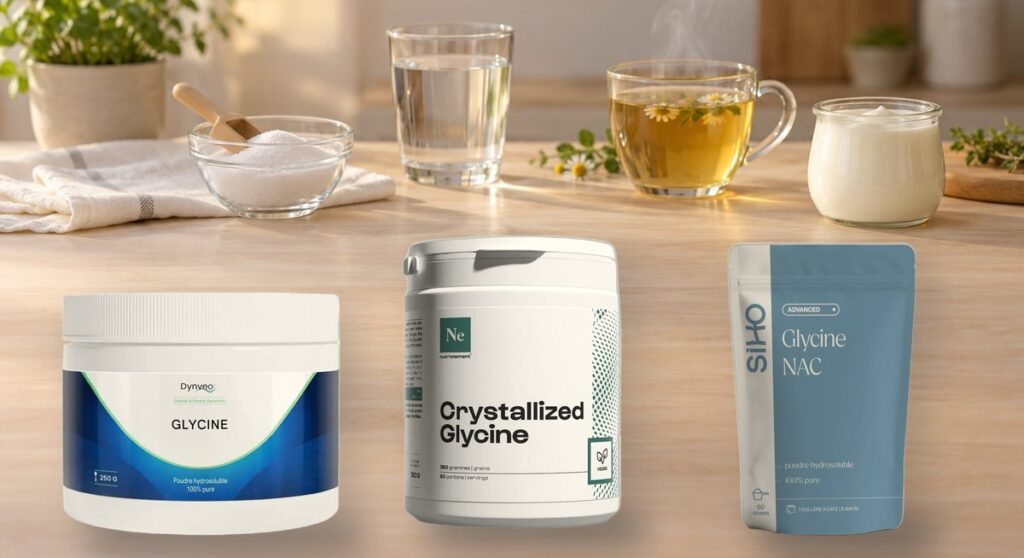
You notice it from the first sip: glycine has a sweet taste, even though it isn’t a sugar. This is often what surprises customers discovering it, just before the next question: “How much do I use, and in what?” Between 250 g, 360 g or 750 g tubs and pouches with a scoop, the stated doses aren’t the same from one brand to another. Here’s how to make sense of glycine powder, with all our products gathered on the glycine page.
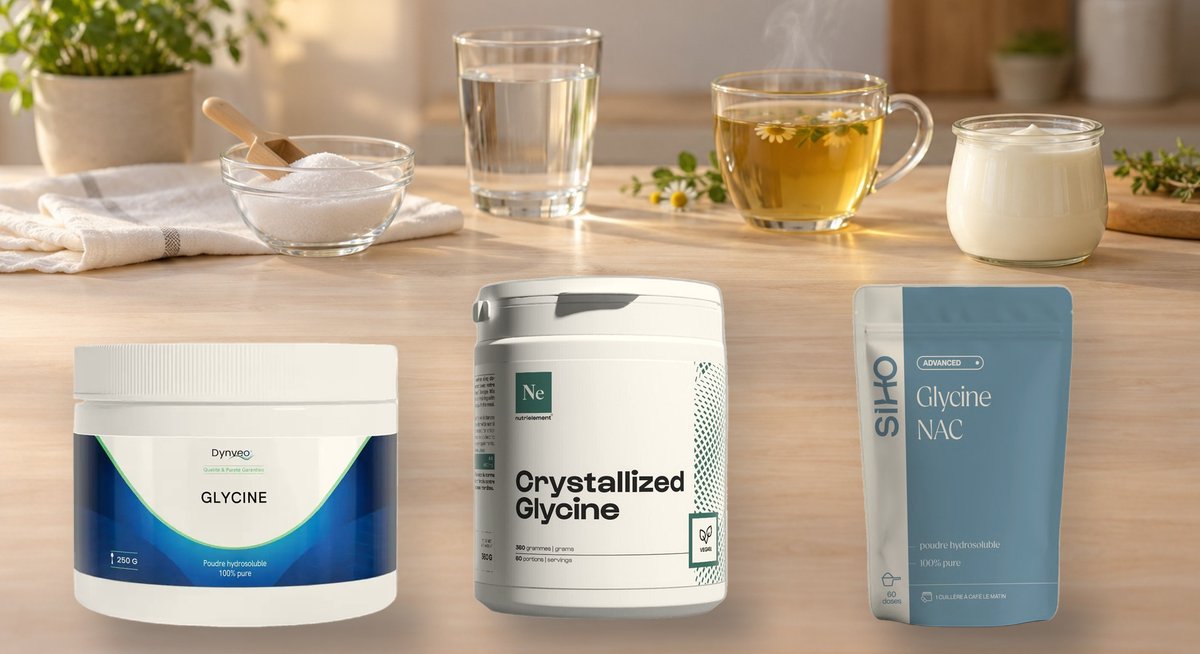
Glycine, the smallest amino acid
Glycine is the simplest of the twenty amino acids that make up proteins. Its name comes from the Greek glykys, “sweet”, and it was indeed its taste that struck the chemists who isolated it in the 19th century. The body can produce it, and food also provides it.
It’s found mainly in collagen, where it makes up about a third of the amino acids. Hence its main dietary sources: gelatine, skin, cartilage and long-simmered bone broths. A diet centred on fillets and lean meats provides less of it than that of our grandparents. Our bone broth range is there for those who prefer to go through the pot.
A mild taste, with no added flavouring
As a powder, glycine comes as fine white crystals. Dissolved in water, it gives a light drink, slightly sweet, with no aftertaste. Nutripure estimates its sweetening power at between 0.6 and 0.9 compared with table sugar: it’s therefore less sweet than sugar, with a sweetness close to that of glucose.
This is what allows brands to add nothing. Our pure glycine powders contain no flavouring or sweetener: a single ingredient, glycine. It can sweeten a plain yoghurt, fromage blanc, porridge or a herbal tea. However, it doesn’t replace sugar in baking, since it doesn’t caramelise.
What dose? What the labels say
There’s no universal dose: each maker states its own, and that’s the one to follow. On our labels:
- Dynveo’s pure glycine, 250 g tub, of USP and EP quality, states 9 g for two measuring scoops per day;
- Nutrimuscle’s crystalline glycine, 360 g tub, states a dose of 6 g, and also comes in a 750 g tub;
- Nutripure’s crystalline glycine, 310 g pouch, states 10 g per day, i.e. one supplied 10 ml scoop, for 31 doses. It is available in our shop only.
If you’re starting out, there’s nothing stopping you from beginning below the stated dose, then working up to it. However, do not exceed it.
How to take it
Glycine dissolves very quickly, even in cold water. A glass of water is enough, but you can also pour it into a juice, tea, coffee or herbal infusion: Nutripure states that it remains stable when heated. The brand suggests taking it in one or two doses, preferably in the evening with a meal, or after training for athletes.
Why powder rather than capsules? Simply a matter of quantity. With several grams a day, you’d have to swallow a handful of capsules. A spoonful or a scoop in a glass is simpler, and the taste poses no problem at all.
Keep the tub or pouch tightly closed, dry and away from light: like all powders, glycine is sensitive to moisture, which makes it clump.
Glycine alone or combined?
Some formulas combine glycine with another amino acid. This is the case with SIHO’s Glycine NAC, which combines 2 g of glycine and 600 mg of N-acetylcysteine per 2.6 g dose, with no flavouring or sweetener. It is taken in the morning on an empty stomach in a large glass of water. Its taste is sweet with a hint of sulphur, brought by the NAC: a squeeze of lemon juice or sparkling water suits it very well.
Glycine does not, however, replace collagen: collagen provides a whole set of amino acids, glycine just one. Our collagen guide details the different forms and origins.
Glycine supplements are for adults only. If pregnant, breastfeeding or undergoing treatment, ask your doctor or pharmacist for advice before starting, particularly for a formula that also contains NAC.
Frequently asked questions
Is glycine powder vegan?
Yes. Our pure glycine powders contain no animal matter, unlike collagen, which is extracted from skin or bone.
Can it be put in a hot drink?
Yes, it withstands heat. A herbal tea or tea suits it very well.
Can it replace sugar?
It sweetens a drink or a yoghurt, but it’s less sweet than table sugar and doesn’t behave the same way in baking.
What’s the difference between brands?
The content is the same, pure glycine. What changes is the size, the recommended dose, the measuring tool and the controls stated by each maker.
Want to compare sizes and scoops before buying? Come and see us at 10 rue Théophile Roussel, in Paris 12th: we’ll line up the tubs side by side and choose together.