
The Herba Barona blog › Sem categoria
Bacopa (brahmi): powder, capsules or extract, how to choose
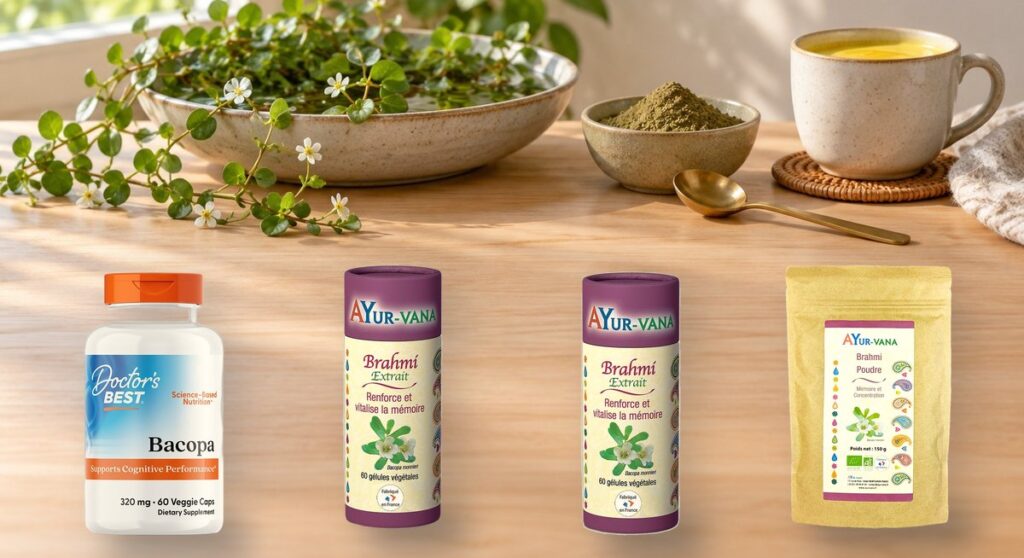
Bacopa, brahmi, Bacopa monnieri: three names for the same small plant, already enough to leave you unsure. Add to that the different forms, powder, whole-plant capsules, standardised extracts, and figures that don’t match from one label to another. To choose, you mainly need to understand what each form actually contains. Our products are gathered on the bacopa monnieri page of our Paris shop.
Brahmi, a plant from India’s wetlands
Bacopa is a small creeping aquatic plant, with fleshy leaves and white or slightly mauve flowers. It grows in the wetlands and marshy areas of India, Nepal and Sri Lanka. Botanists now classify it in the plantain family.
In Ayurveda, traditional Indian medicine, it is called brahmi, after Brahma, the creator god. It is placed among the medhya rasayana, the plants that tradition associates with the intellect, and ancient texts such as the Charaka Samhita already mention it. This is a traditional use, passed down for centuries, and we present it as such. One small trap to be aware of: in some regions of India, the word brahmi also refers to a different plant, centella. On our products, it is indeed Bacopa monnieri.
Powder, whole-plant capsules or extract: the real difference
All forms start from the same plant, but they don’t retain the same thing.
Powder is the dried, ground plant. Our bacopa brahmi powder is 100% organic plant, in a 150 g pouch. It’s the traditional form, dosed by the spoonful.
Whole-plant capsules contain this same powder, already dosed. Ayur-vana’s brahmi, 120 capsules, provides 800 mg of whole-plant powder per 2 capsules, in a plant-based shell.
Standardised extracts concentrate bacosides, the compounds used as a reference point for this plant. Ayur-vana’s brahmi extract is standardised to 20% bacosides, with 300 mg of extract per capsule. Doctor’s Best’s Bacopa Synapsa uses a patented extract, standardised to 55% bacosides, at 320 mg per capsule.
Reading the standardisation on the label
This is the figure that marks the difference between forms, though you still need to know where to look for it.
- Powder or extract? A plant powder has no standardisation figure: it contains whatever the plant contains.
- The percentage of bacosides: it indicates the concentration of the extract. A 20% extract and a 55% extract are not the same product.
- The amount in milligrams: of the powder or the extract. Always check whether it’s given per capsule or per daily dose.
- Other ingredients: Ayur-vana’s extract, for example, contains acacia fibre as a carrier.
A highly standardised extract is neither more nor less natural than a powder: it’s just another way of presenting the plant. Those who like the traditional approach prefer the whole plant, those who want a numerical benchmark prefer a standardised extract.
How to take it
Capsules are taken with a meal, with a glass of water. Doctor’s Best states one Synapsa capsule a day, preferably with a meal containing a little fat. Ayur-vana recommends taking brahmi in the morning or early afternoon.
Powder requires a little more preparation. Traditionally, it’s mixed into hot water, a plant-based milk or a golden milk, sometimes with a little ghee, as Ayurveda calls for. Its taste is bitter and grassy: a little honey softens it. If the flavour puts you off, go straight for the capsules.
Bacopa is taken as a course lasting several weeks: Ayur-vana mentions 8 to 12 weeks, Doctor’s Best at least two months. Always follow the daily dose stated on the product.
Bacopa alone or in a formula
It’s also found in combined formulas, alongside other active ingredients. This is the case for Nutripure’s Nootropure, available in our shop only, which combines a Bacopin bacopa extract standardised to 20% bacosides with tyrosine, rhodiola, citicoline and huperzine. Bacopa is present in a smaller amount here than in a standalone extract. To discover other plants from the same tradition, our Ayurvedic plants range offers many.
Bacopa is not recommended for pregnant or breastfeeding women without medical advice. If undergoing treatment, ask your doctor or pharmacist for advice before starting.
Frequently asked questions
Are bacopa and brahmi the same plant?
Yes, brahmi is the Ayurvedic name for Bacopa monnieri. Just be careful with the word brahmi used alone, which can sometimes refer to centella.
Do the capsules suit vegetarians?
Yes, our bacopa capsules have a plant-based shell, made of hypromellose.
Which form should you start with?
Whole-plant capsules are a good starting point: no taste, no preparation, an already measured dose.
Can the powder be used in cooking?
It can be added to a smoothie, a fruit compote or a coconut milk drink. Its bitterness remains noticeable: pair it with mild flavours instead.
Between whole plant and standardised extract, the clearest way is still to read the labels together: we’re waiting for you Tuesday to Saturday at our Paris 12th shop, a few minutes from Gare de Lyon.