Home › Podcast › Ten tonnes of liver for thirty milligrams
Ten tonnes of liver for thirty milligrams
Episode in French. The full text can be read below in English.
The text of the episode
Welcome to Herba Barona, a food supplements shop in Paris. Every episode tells the story of a product we know badly, and you leave with one thing to remember. Today: alpha-lipoic acid.
1951, Texas
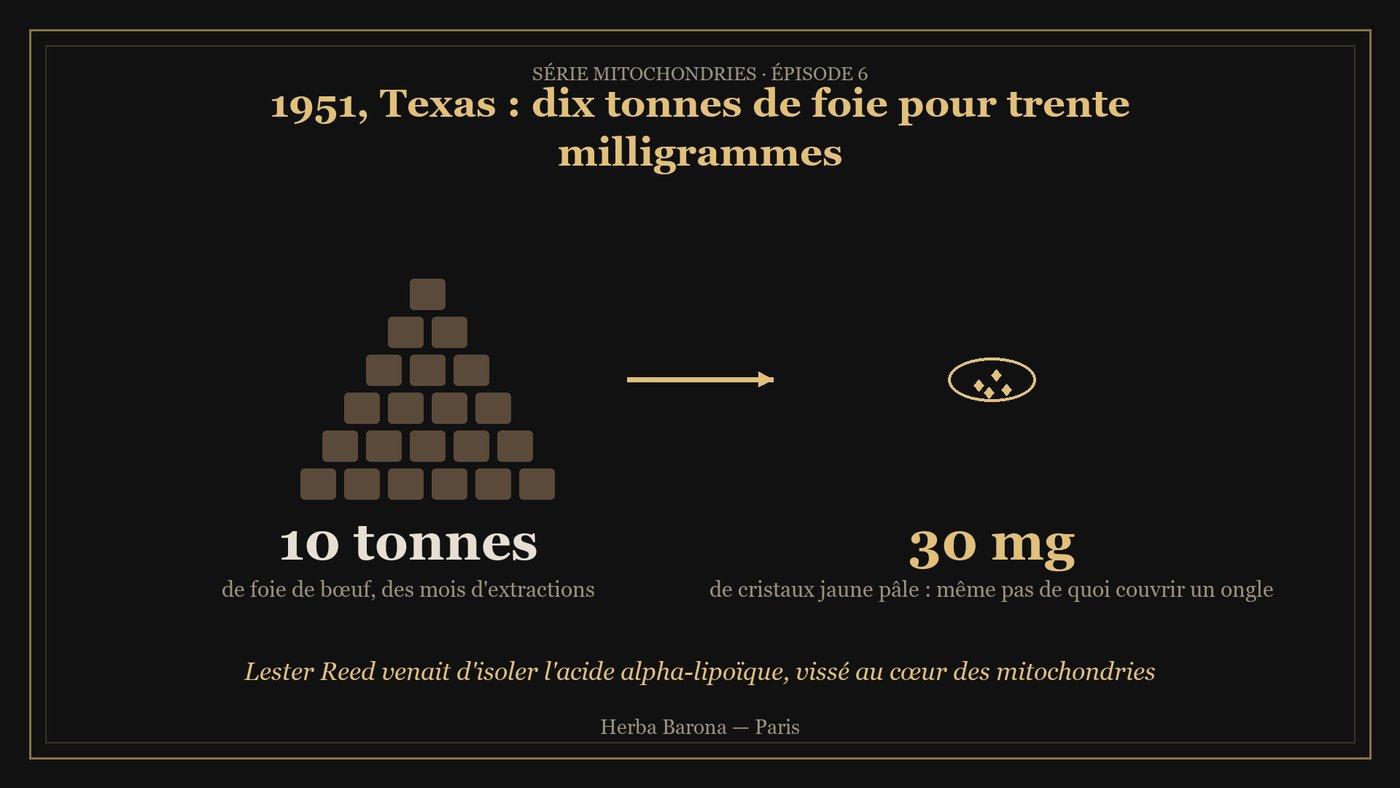
Nineteen fifty-one. Texas. A biochemist named Lester Reed sets his mind on isolating a mysterious substance that everyone suspects exists, but that nobody has ever seen in a pure state.
To manage it, he needs raw material. A great deal of raw material. His team will process around ten tonnes of beef liver. Ten tonnes. Months of work, of extractions, of purifications. And at the end, at the bottom of the tube, the treasure: about thirty milligrams of pale yellow crystals. Not even enough to cover a fingernail.
Bolted into the machine
That substance is alpha-lipoic acid. And if it was so hard to isolate, it is precisely because the body makes very little of it… but in the most strategic places there are: at the very heart of the mitochondria, our power plants.
Because alpha-lipoic acid is not a guest in the mitochondrion. It is part of the machinery. Remember: when sugar arrives at the power plant, it has to pass a decisive checkpoint — a large enzyme that prepares it before it enters the great energy production cycle. Well, alpha-lipoic acid is a cog in that checkpoint. Literally bolted into it. Without it, the fuel stays outside the door.
An amphibious molecule
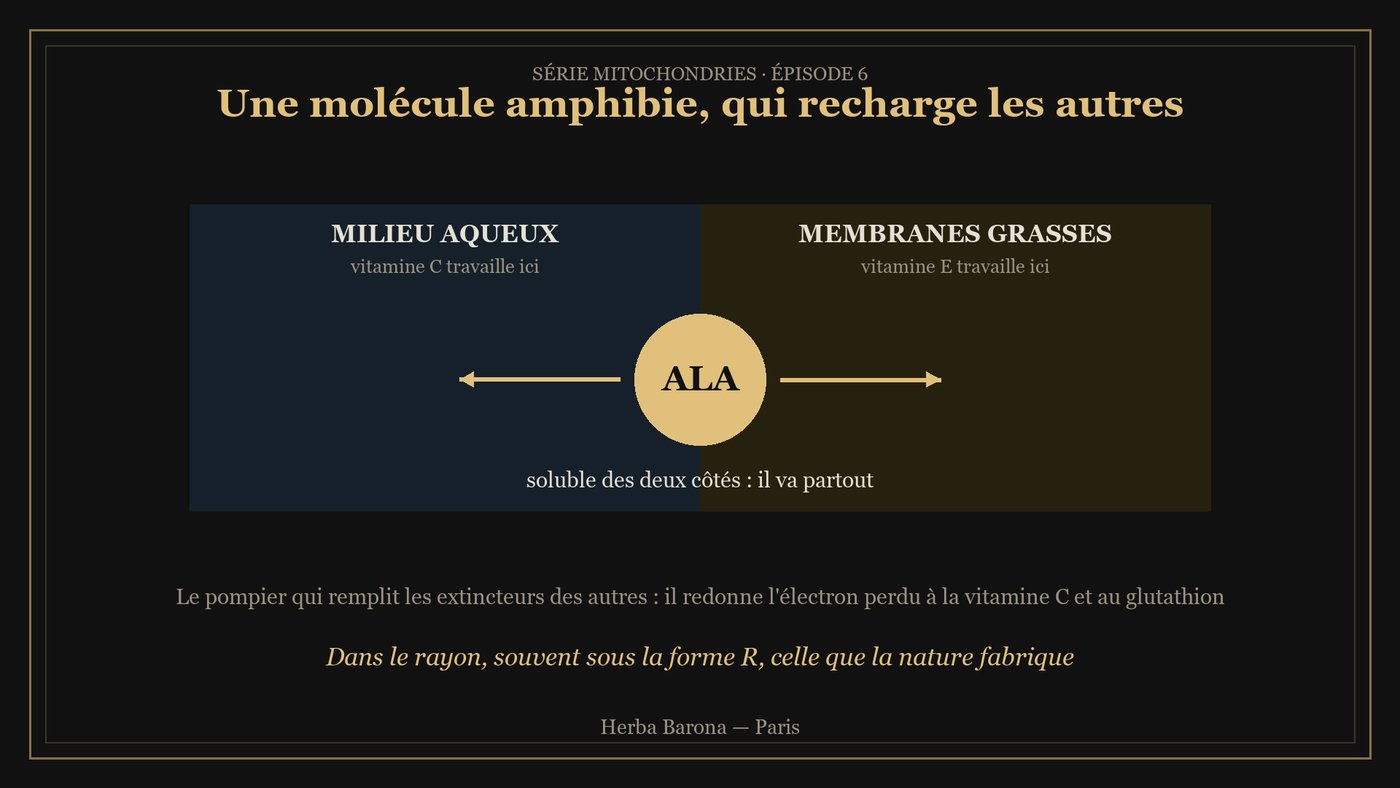
But what made its reputation is its second life. Because this molecule has a very rare talent: it is amphibious. Most antioxidants have picked their camp — vitamin C works in water, vitamin E in fats, each one at home. Alpha-lipoic acid, for its part, is soluble on both sides. It circulates in the watery parts of the cell and crosses the fatty membranes. It goes everywhere.
The recycler
And it does not just put out the sparks itself — those free radicals we have talked about so much in this series. Biochemists credit it with an even subtler role: that of a recycler. When a molecule of vitamin C or of glutathione has sacrificed itself to neutralise a free radical, it comes out discharged, unusable. Alpha-lipoic acid is among the molecules able to recharge them — to give back the lost electron, so they can head back to the front. The firefighter who refills the other firefighters' extinguishers.
A molecule made inside the power plant, a cog of energy production on one side, an all-terrain maintenance worker on the other. You can see why it has found a place on the food supplement shelves — often, in fact, in one particular form, called the R form, the one nature makes.
Fifty years of loyalty
As for Lester Reed, he stayed faithful to his discovery for his whole career — fifty years studying those giant enzymes where his little molecule is bolted in.
Ten tonnes of liver for thirty milligrams. Some precious things are decidedly not measured by weight.
That was an episode of the Herba Barona podcast, recorded in Paris. See you soon.