
Home › Podcast › The fat your body cannot make
The fat your body cannot make
Episode in French. The full text can be read below in English.

The text of the episode
Welcome to Herba Barona, a food supplements shop in Paris. Every episode tells the story of a product we know badly, and you leave with one thing to remember. Today: omega 3. And an unsettling truth to begin with: there are fats your body absolutely needs — and that it cannot make.
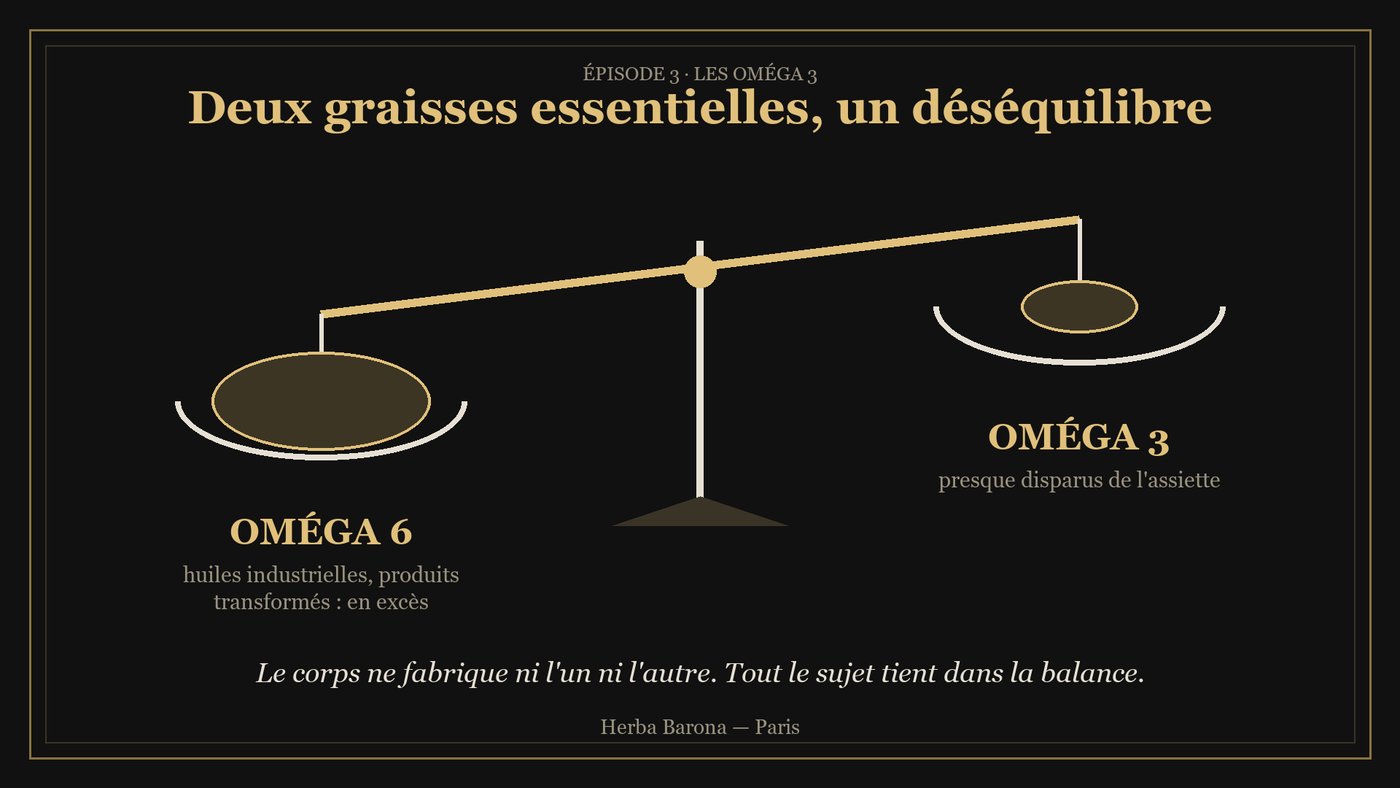
Two essential fats
That is rare in the human body. For almost everything else it manages: it transforms, it recycles, it synthesises. But here, nothing doing, the machine does not have the tool. They are called essential fatty acids, and there are two of them in that case: omega 6, and omega 3. So why does everyone only talk about omega 3? Because the modern plate is overflowing with omega 6: industrial vegetable oils, processed foods — we get far more than we need. Omega 3, on the other hand, has almost disappeared from our plates. The whole subject lies in that imbalance: the scale has tipped to one side, and it is the other pan that needs refilling.
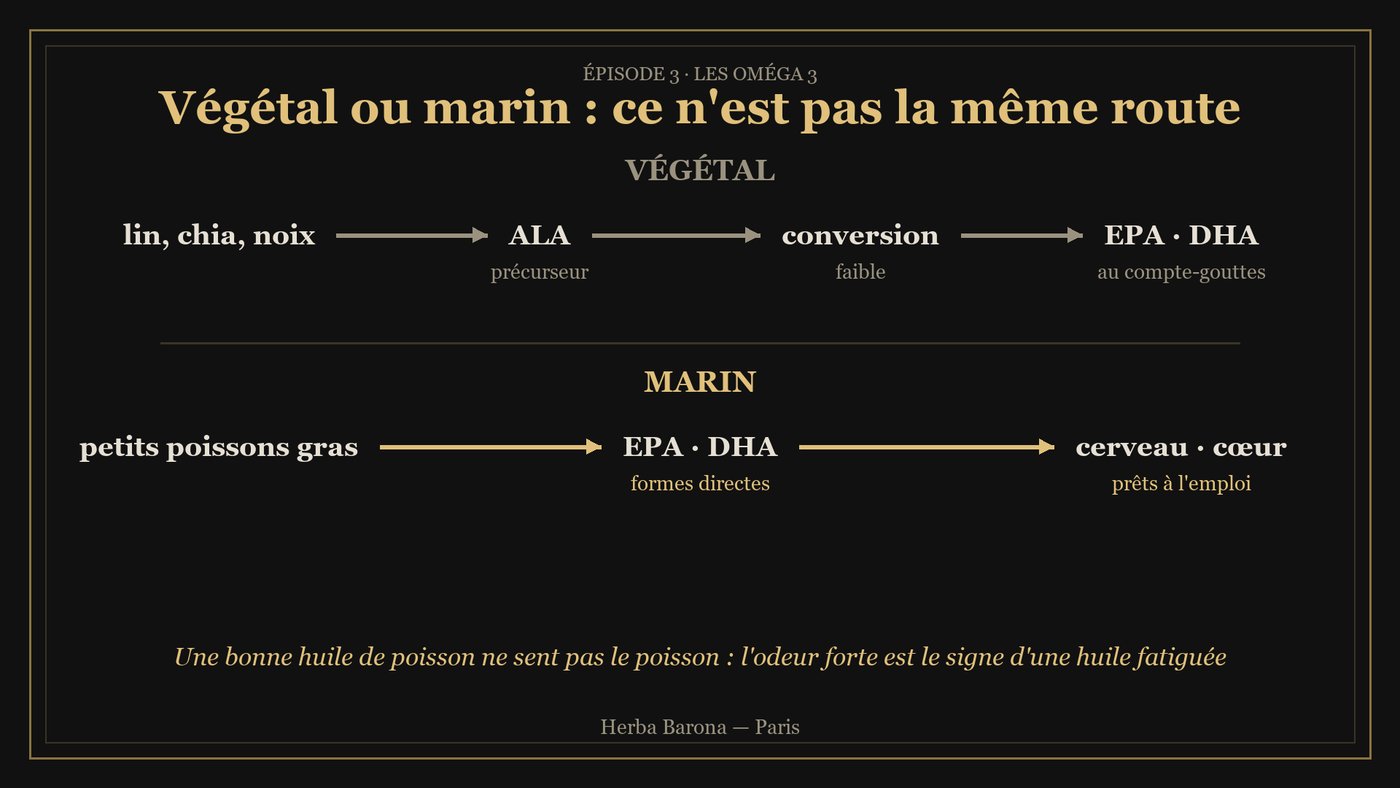
Reading the label: ALA, EPA, DHA
And this is where you have to learn to read a label, because omega 3 itself splits into two worlds. The plant world first: flaxseed, rapeseed, walnuts, chia seeds. Their omega 3 is called ALA. It is valuable — but it has a flaw very few people know about: it is not the form your body uses. To make use of it, the body first has to convert it into EPA and DHA, the two active forms. And that conversion is frankly poor: barely a few per cent make it to the end of the road. A handful of walnuts is excellent for your health; but believing it replaces fish is probably the most widespread mistake on the shelf. The marine world, for its part, delivers EPA and DHA ready-made, directly usable: sardines, mackerel, herring — the oily fish of ordinary days, the ones our grandparents ate. And the post-war children all remember the famous morning spoonful of cod liver oil, that daily grimace. We can smile about it. But our grandmothers, without knowing it, were on to something.
The brain, a fatty organ
Why does it matter so much? Follow me into the brain for a second. It is the fattiest organ in your body: a large part of its matter is made of lipids. And among those fats there is one the brain asks for above all others: DHA. It settles into the very membrane of your neurons — it is literally part of the walls of the house. The retina of your eyes is soaked in it too. And EPA works on its own side, for the heart. These are not salesman's promises: DHA contributes to normal brain function and normal vision, EPA and DHA to normal heart function — those are the sentences officially recognised in Europe. And beyond that, research is looking very closely at these fats of calm: nervous balance, serenity, mental clarity. It is no accident that they are sometimes nicknamed brain food.
Why not simply eat fish?
So, the question we are often asked in the shop: why not simply eat fish? But that is the best answer! If you eat sardines or mackerel two or three times a week, you are doing exactly the right thing — carry on, and keep your money. The capsule is not there to replace the ideal plate. It is there for real life: the one where oily fish shows up once a month, where the children will not touch it, where you no longer quite know what to cook. That is what a background supplement is: the safety net of ordinary weeks.
Choosing your oil well
A word on choosing well, and it applies to every brand. These fats are alive, fragile: heat and light damage them, like an oil going rancid in a cupboard. A fish oil that smells strongly of fish is a tired oil — that smell is not normal, it is a signal. Look too at where it comes from: small fish rather than large ones, which concentrate heavy metals, or an oil purified and tested batch by batch. And at home, keep it cool and away from the light.
What you take away today: your body does not make omega 3 — and not all omega 3 is equal. Plants give ALA, which converts badly. The sea gives EPA and DHA, the direct forms, the ones your brain and your heart are waiting for. Now you know how to read the label. And remember the sign that never lies: a good fish oil does not smell of fish.
That was an episode of the Herba Barona podcast, recorded in Paris. See you soon.