
Home › Podcast › The most unloved molecule on the shelf
The most unloved molecule on the shelf
Episode in French. The full text can be read below in English.
The text of the episode
Welcome to Herba Barona, a food supplements shop in Paris. Every episode tells the story of a product we know badly, and you leave with one thing to remember. Today: creatine. The most studied molecule on our whole shelf — and probably the most unloved. That is an injustice, and this story deserves to be told from the beginning.

1832, a French scientist
The beginning is 1832. A French chemist, Michel-Eugène Chevreul, analyses a meat extract and finds an unknown substance in it. He names it creatine, from the Greek kréas: flesh. Hold on to that: creatine was not invented in a sports laboratory. It was discovered in a piece of meat, almost two centuries ago, by a French scientist. It was on your ancestors' plates with every boiled dinner. And it is inside you right now: your own body makes it every day, because it cannot function without it.
The body's match
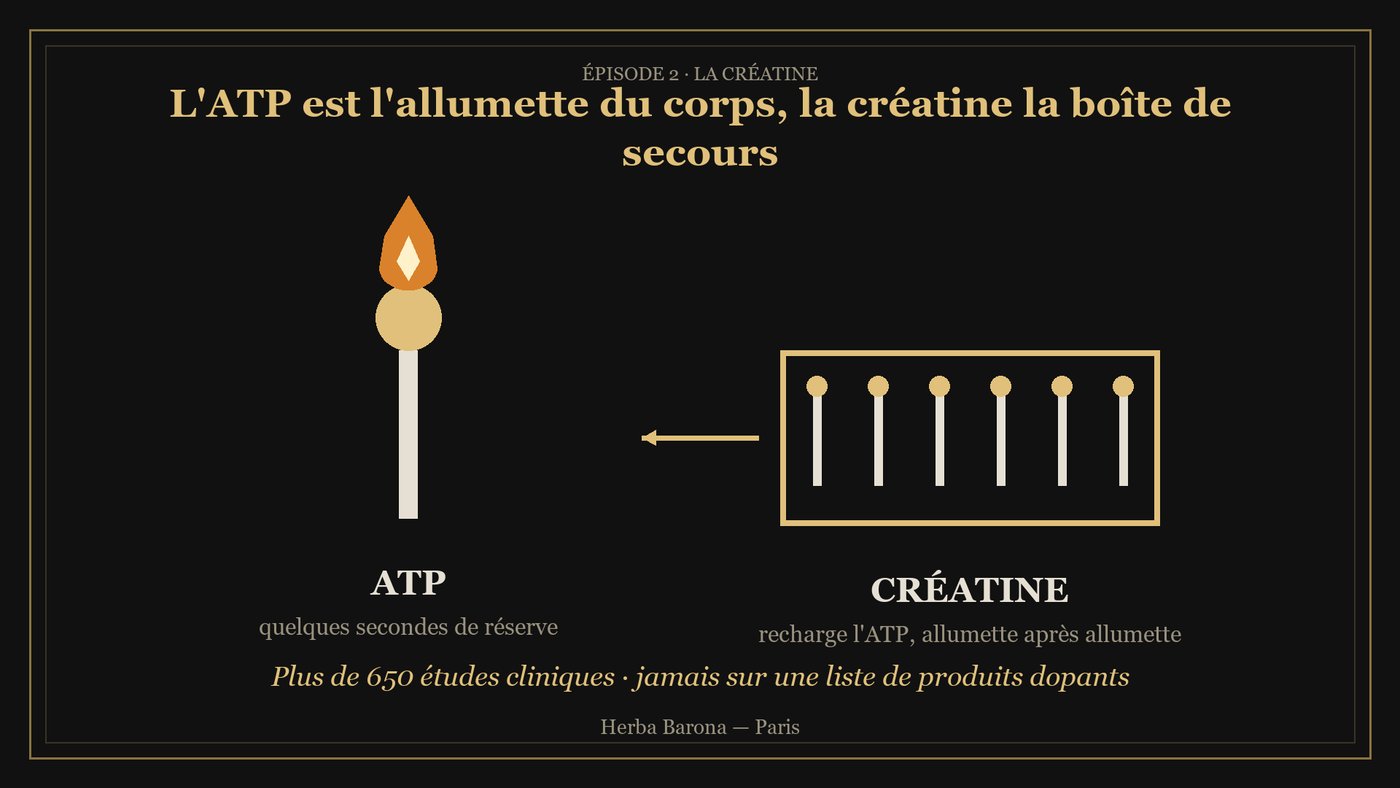
To understand what it does, picture this. Every move you make — standing up from a chair, climbing stairs, catching a running child — burns a small energy molecule called ATP. It is the body's match: it flares up, and it goes out almost immediately. The trouble is that your muscles only store a few seconds' worth in advance. And that is where creatine comes in: it is the spare matchbox. When the effort is short and intense, creatine is what reloads ATP, match after match. Without it, everything stops after a few seconds.
Six hundred and fifty studies
So why the murky reputation, the whiff of the changing room and of something dubious? Because at the end of the last century it entered sport through the door of weight rooms, and the confusion stuck. The reality is exactly the opposite. Creatine has never appeared on any list of doping products — never, anywhere. And above all, it has become the most scrutinised ingredient in the entire history of food supplements: more than 650 clinical studies. Not 650 blog posts — 650 studies, on athletes, on women, on older people, on vegetarians, over months and years. In looking for the flaw, researchers mostly piled up the evidence. So much so that Europe, so cautious that it authorises almost no claim on labels, has signed off on this one in black and white: creatine increases physical performance in successive bursts of short-term, high-intensity exercise. It is one of the very few officially authorised sentences in our whole shop.
The other organ that devours energy
And the story does not stop at muscle. Because there is another organ that devours ATP from morning to night: the brain. It weighs only two per cent of the body, but it is an energy pit. Researchers are looking at this very closely — concentration, mental fatigue, people who eat little or no meat and whose stores are naturally lower. It is one of the most active research fields right now, and it is changing the face of this molecule: not really an athlete's product any more, more a fundamental fuel that concerns everyone — including our seventy-year-old customers who want to keep the strength in their legs.
Two myths
Before we finish, let us deal with the two myths still clinging to this molecule. The first: creatine makes you puffy. The truth is finer than that: it does draw in water — but inside the muscle, where it works. That is not water retention, it is cell hydration. A well-hydrated muscle is a muscle that works. The second myth: it tires the kidneys. On that point, decades of studies in healthy adults have looked for the problem without finding it — which is in fact one of the reasons we have so much hindsight on it. The one real rule of caution: in case of kidney disease, talk to your doctor first.
The people nobody thinks about
And then there are the people nobody thinks about. Vegetarians and vegans first: dietary creatine comes from meat and fish — without them, stores run permanently at half speed, and they are often the ones who feel the difference most. Older people next: past a certain age, muscle melts away in silence, and the pairing of creatine plus exercise is one of the best documented ways of maintaining it. And women, finally, long kept at arm's length by the molecule's changing-room image — when they have exactly the same cells, and exactly the same matches to reload.
Choosing it well
One last piece of advice before the punchline, because not all creatines are equal: look for creatine monohydrate — the historical form, the one used in all the studies — with purity tested batch by batch. No need for exotic formulas: the simplest one is also the best proven.
What you take away today: creatine is not a changing-room product. It is a French molecule by its discovery, present in your body since always, and now the best proven on the whole shelf. Next time someone frowns at the sound of its name, you can answer: 650 studies. Who can beat that?
That was an episode of the Herba Barona podcast, recorded in Paris. See you soon.