
Home › Podcast › Collagen was invented in a cooking pot
Collagen was invented in a cooking pot
Episode in French. The full text can be read below in English.

The text of the episode
Welcome to Herba Barona, a food supplements shop in Paris. Every episode starts from a real question someone asks us in the shop, and you leave with one thing to remember. Today, to open the series, a product that surprises everyone who discovers it with us: a jar of bone broth. And an idea that turns the whole picture around: the first collagen in history was not invented in a laboratory. It was invented in a cooking pot.
Sunday's pot on the stove
Go back two generations. On Sundays, at our great-grandparents' house, there was a pot of boiled beef on the stove. And in that pot there were bones — a carcass left to simmer for hours at the back of the range. Nobody spoke about collagen, nobody spoke about amino acids. They called it broth, and they drank it because it was good, and because they could feel it did them good. Before capsules, before powders, collagen was not something you swallowed: it was something you ate.
And then we stopped. Because, honestly: who still simmers bones for twenty hours in a Paris flat?
Twenty hours of simmering
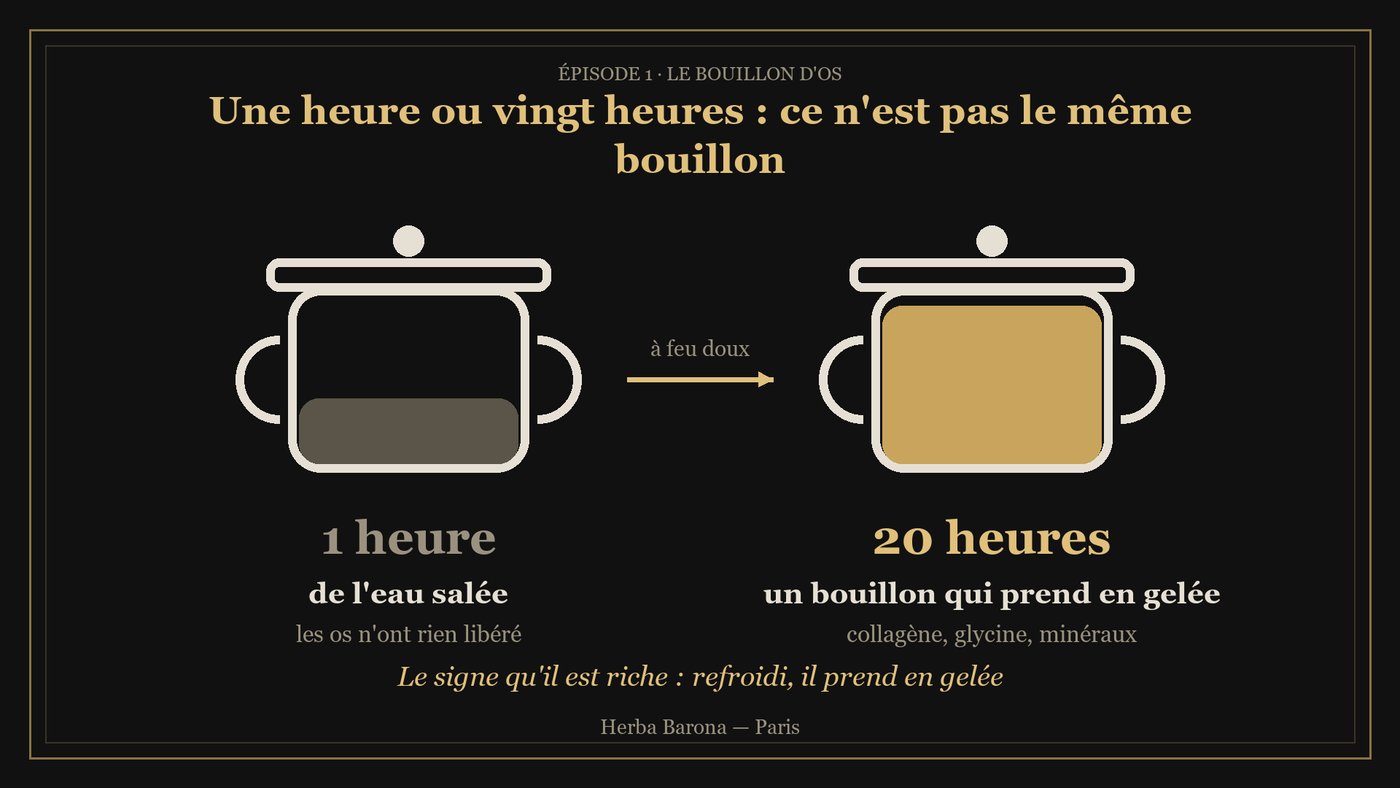
Twenty hours. Keep that number in mind, because it is not there for decoration. It is how long it takes, over a low flame, for bones to release what they hold inside: collagen, glycine, minerals. One hour of simmering gives you salted water. Twenty hours give you a broth that, once cooled, sets into jelly — the sign that it is rich. That is exactly what Jarmino does, the old-fashioned way. Bones from organic cattle, pasture-raised and grass-fed, in Bavaria. Twenty hours of slow simmering. Then the broth is concentrated, so that hours of stove time fit into one jar.

Three ingredients, one number
And here are two numbers that speak for themselves. The ingredient list fits into three words: organic beef bones, water, salt. No flavouring, no preservative, no flavour enhancer — the label takes three seconds to read. And the concentration: 37 grams of collagen per 100 grams of concentrate, with the amino acids of traditional broth, glycine first among them. In other words: what the Sunday pot gave our great-grandparents, in a dense version. All of it gluten-free, lactose-free, very nourishing and very low in calories.
The mug or the kitchen
In practice, how do you use it? Two schools of thought. The mug: a spoonful in hot water, stir, and you have a broth to drink — many of our customers have adopted it in the morning or during a break, instead of a tea, and it fits naturally into a light way of eating or into intermittent fasting. And the kitchen: a soup base, a risotto, a sauce, a deglazing — it replaces any industrial stock cube, and infinitely better. Same jar, two lives. And if you would rather taste before committing, the range also comes in ready-to-drink bottles, and in a chicken version.
What you take away today: bone broth is not a fad that came over from California. It is a French grandmother's recipe, buried by the stock-cube industry, and now coming back through the front door. The next time you see the word collagen on a label, remember: at the very beginning, it was not a capsule. It was a Sunday dish.
That was an episode of the Herba Barona podcast, recorded in Paris. See you soon.